

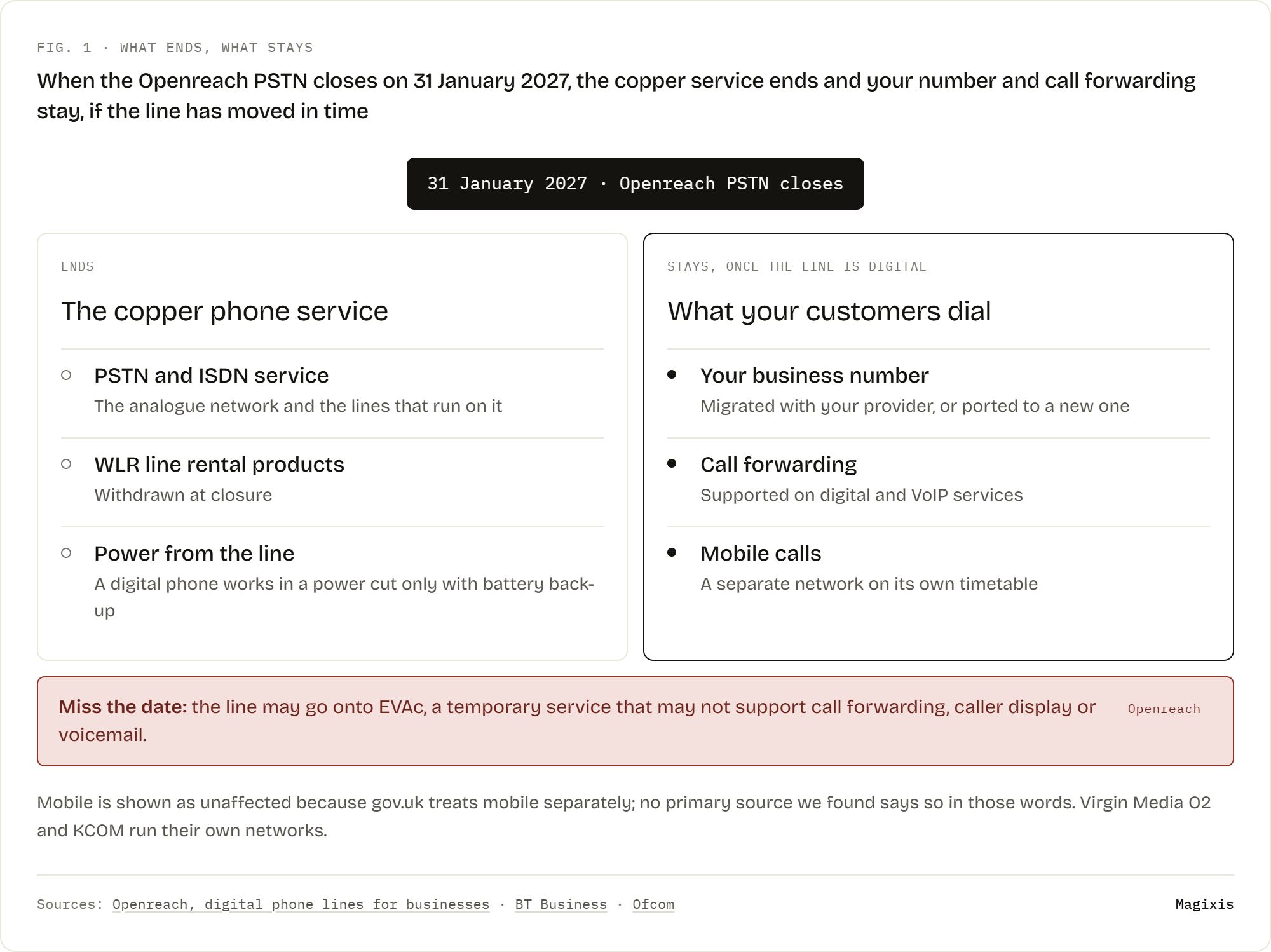
The Openreach landline network, the PSTN, closes on 31 January 2027, and Openreach says the date will not move again. What ends is the copper phone service. Your business number does not have to end with it: you can keep it by moving to a digital line with your current provider, or port it to a new provider with no direct charge. Call forwarding keeps working on digital and VoIP lines. The risk sits with lines that miss the date, which Openreach may move to a temporary emergency service that may not support call forwarding at all.
Mobile is shown as unaffected because gov.uk treats mobile separately; no primary source we found says so in those words. Virgin Media O2 and KCOM run their own networks.
This guide is for businesses whose customers ring a landline number they already know, and especially for businesses that forward that number: to a mobile, to a VoIP system, or to an answering service or AI receptionist. Magixis is one of those services. Every Magixis client keeps their number with their own carrier and forwards it to us, so what the switch-off does to the client's own line decides whether their calls keep arriving.
This covers the UK only. It is a plain-English reading of published guidance, not legal or telecoms engineering advice.
- The Openreach PSTN closes on 31 January 2027. Openreach, BT, gov.uk and Ofcom all give that date. No primary source supports "December 2027".
- You can usually keep your business number. Ofcom's General Condition C7.6 bars direct charges for porting it to a new provider.
- Call forwarding works on digital and VoIP lines. BT confirms call diversion on Digital Voice and on Cloud Voice Express.
- Lines that miss the date may go onto EVAc, a temporary emergency service that Openreach says may not support call forwarding, caller display or voicemail.
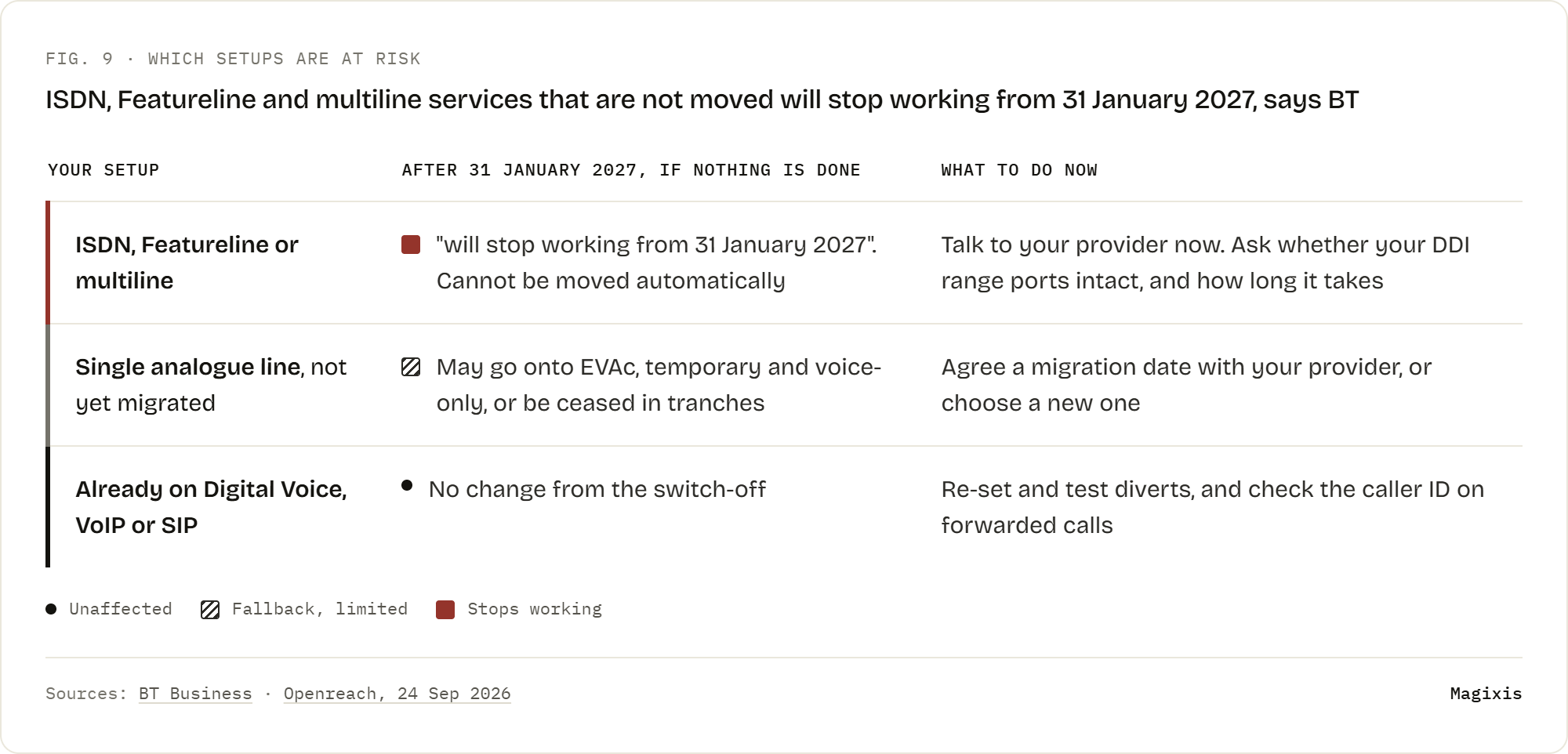
- ISDN, Featureline and multiline systems carry the most risk. BT says they cannot be moved automatically, and that services not moved will stop working from 31 January 2027.
What is the landline switch-off?
The landline switch-off is the closure of the Public Switched Telephone Network (PSTN), the copper network that carries traditional UK landline calls, together with the Wholesale Line Rental (WLR) products that run on it, including ISDN. Calls move to digital services that run over broadband, sold as Digital Voice, VoIP or cloud phone systems. The industry announced the retirement in 2017 with a target of 31 December 2025. Migration was paused twice over concerns about telecare users, and BT reset the date to January 2027 (House of Commons Library, CBP-9471, 1 April 2026).
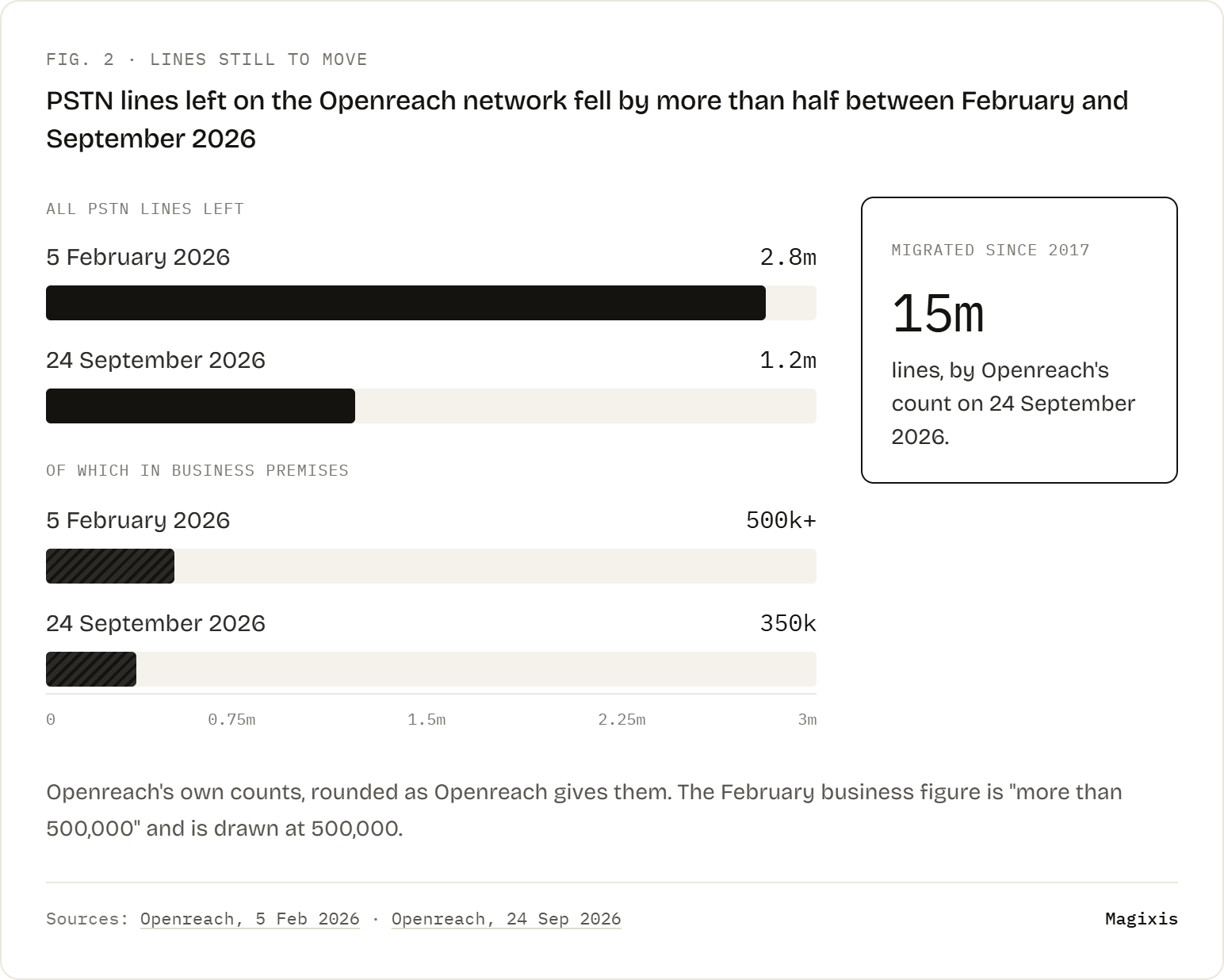
Most lines have already moved. Openreach counted about 2.8 million PSTN lines left on 5 February 2026, more than 500,000 of them in business premises (Openreach, 5 February 2026). By 24 September 2026 it was about 1.2 million lines, about 350,000 of them in business premises, with about 15 million migrated since 2017 (Openreach, 24 September 2026).
Openreach's own counts, rounded as Openreach gives them. The February business figure is "more than 500,000" and is drawn at 500,000.
When is it really? 31 January 2027, and what happens afterwards
For lines on the Openreach network, the date is 31 January 2027. Openreach, BT Business, the government's Connectivity Timeline (updated 29 July 2026) and Ofcom all give it, and Openreach's 24 September 2026 release says the deadline "remains unchanged". The "December 2027" date that appears on some tech blogs is not in any primary source.
The date is not a single-day cliff edge. From 1 February 2027, Openreach may move lines that have not migrated onto Emergency Voice and Access Continuity (EVAc), a temporary service with limited capacity. Lines that cannot go onto EVAc "will be ceased by Openreach in tranches". In the meantime the old service costs more: Openreach's legacy WLR prices doubled against 2025 levels from 1 October 2026.
- Move each line to a digital service with your provider, or a new one
- Legacy WLR prices doubled against 2025 levels from 1 October 2026
- WLR products withdrawn
- Openreach: date "remains unchanged"
- Unmigrated lines may go onto EVAc, temporary and limited in capacity
- Lines that can't go onto EVAc "will be ceased by Openreach in tranches"
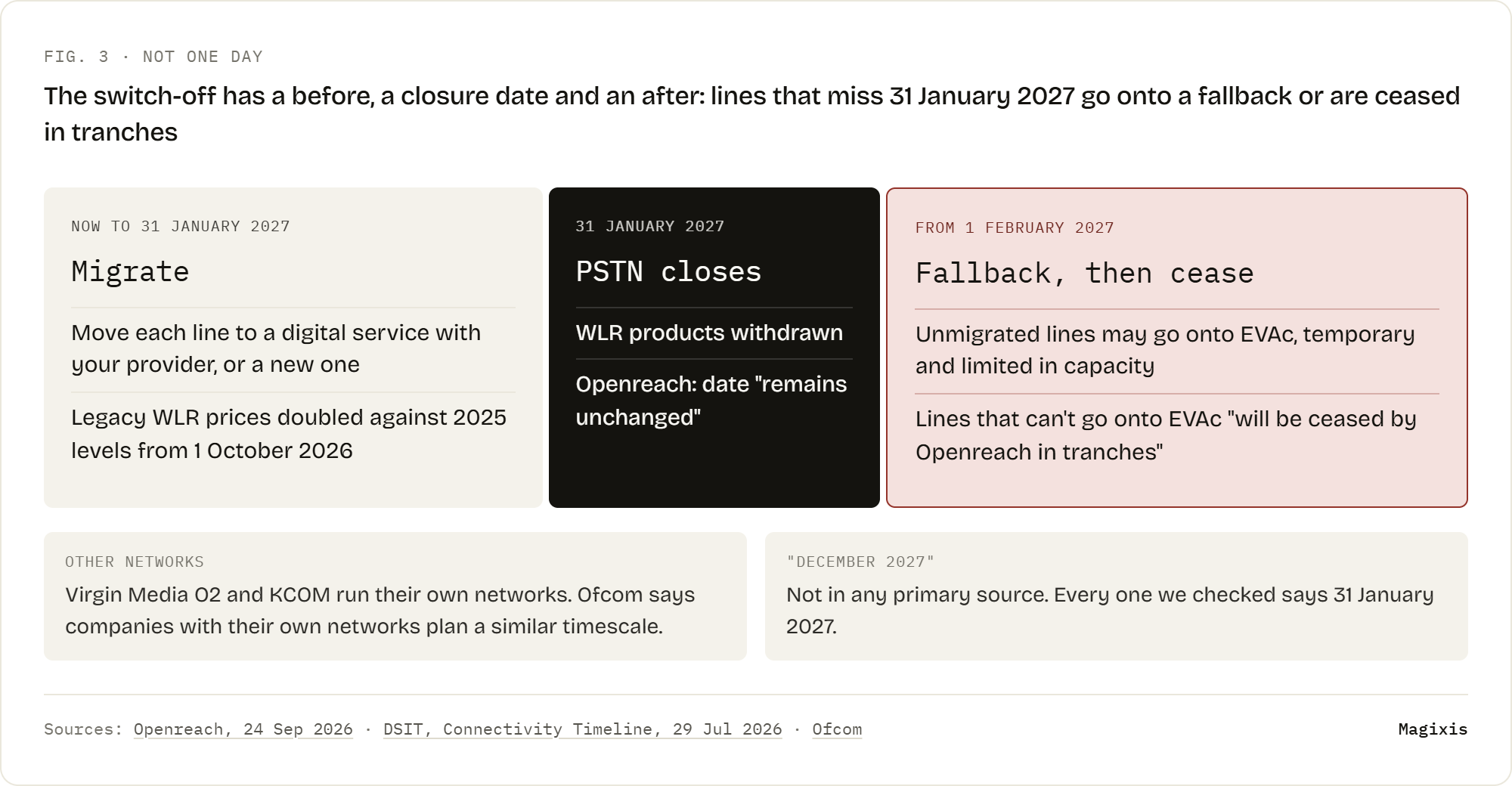
If your line is not on Openreach, the date may differ. Virgin Media O2 and KCOM run their own networks, and Ofcom says companies with their own networks plan a similar timescale. Ask your provider which network your line is on.
Will I keep my business number?
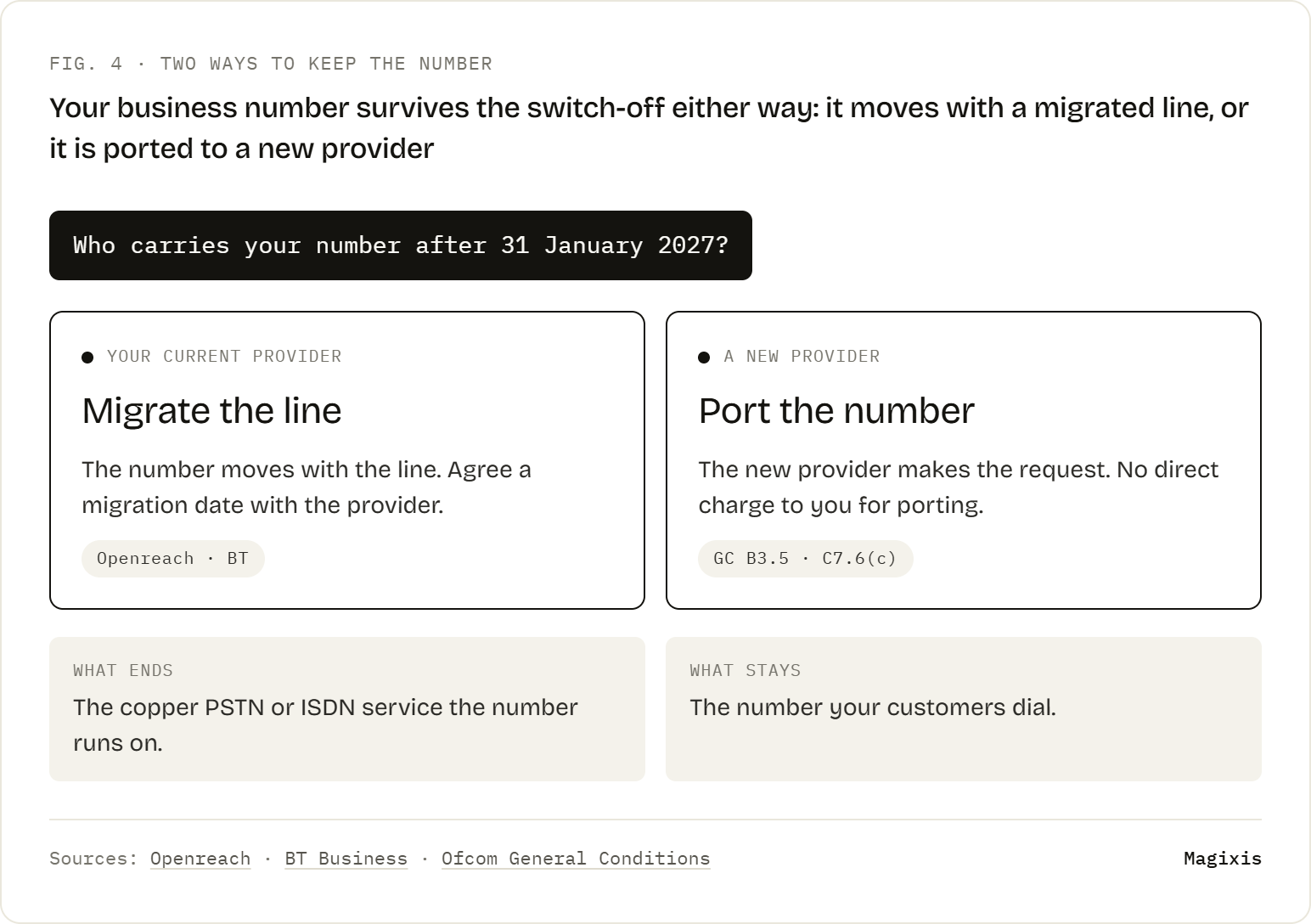
Yes, in almost every case. The service that ends is the copper line, and the number is separate from it. Openreach says "You can usually keep your existing business phone number when you switch to digital phone lines" (Openreach), and BT Business says the same for customers moving to a digital, IP-based service.
There are two routes. If you stay with your current provider, the number moves with the line when it is migrated. If you move to another provider, for example a VoIP or SIP service, the new provider ports the number across. Your porting rights are in section 07.
Will call forwarding still work?
Yes, on a migrated line. Forwarding is a feature of the phone service, and digital services carry it. BT's Digital Voice includes Call Diversion to "almost any phone, including your mobile", with codes for divert on no answer (#61#) and divert on busy (#67#) (BT, Call Diversion). BT also says "Customers pay for the diverted leg of the call" (BT Digital Voice). On BT Cloud Voice Express you can divert calls after a set number of rings, to voicemail or to another number (BT Business).
The exception is a line that misses the date. Openreach says EVAc may not support call forwarding, caller display or voicemail. A business that relies on a divert to a mobile or an answering service could lose it while the line itself still rings.
| Kind of forwarding | On a digital or VoIP line | On EVAc | Source |
|---|---|---|---|
| Landline to mobile | Works. BT Digital Voice diverts to "almost any phone, including your mobile". You pay for the diverted leg |
May not be supported |
BT Call Diversion help; Openreach |
| Divert on busy or no answer | Works. On BT: #67# for busy, #61# for no answer |
May not be supported |
BT Call Diversion help; Openreach |
| Divert inside a cloud phone system | Works. BT Cloud Voice Express diverts after a set number of rings, to voicemail or another number |
Not applicable: already digital |
BT Business help |
| Divert to an answering service or AI receptionist | Works as an ordinary divert to another number. No primary source addresses it specifically |
May not be supported |
Inference from the rows above |
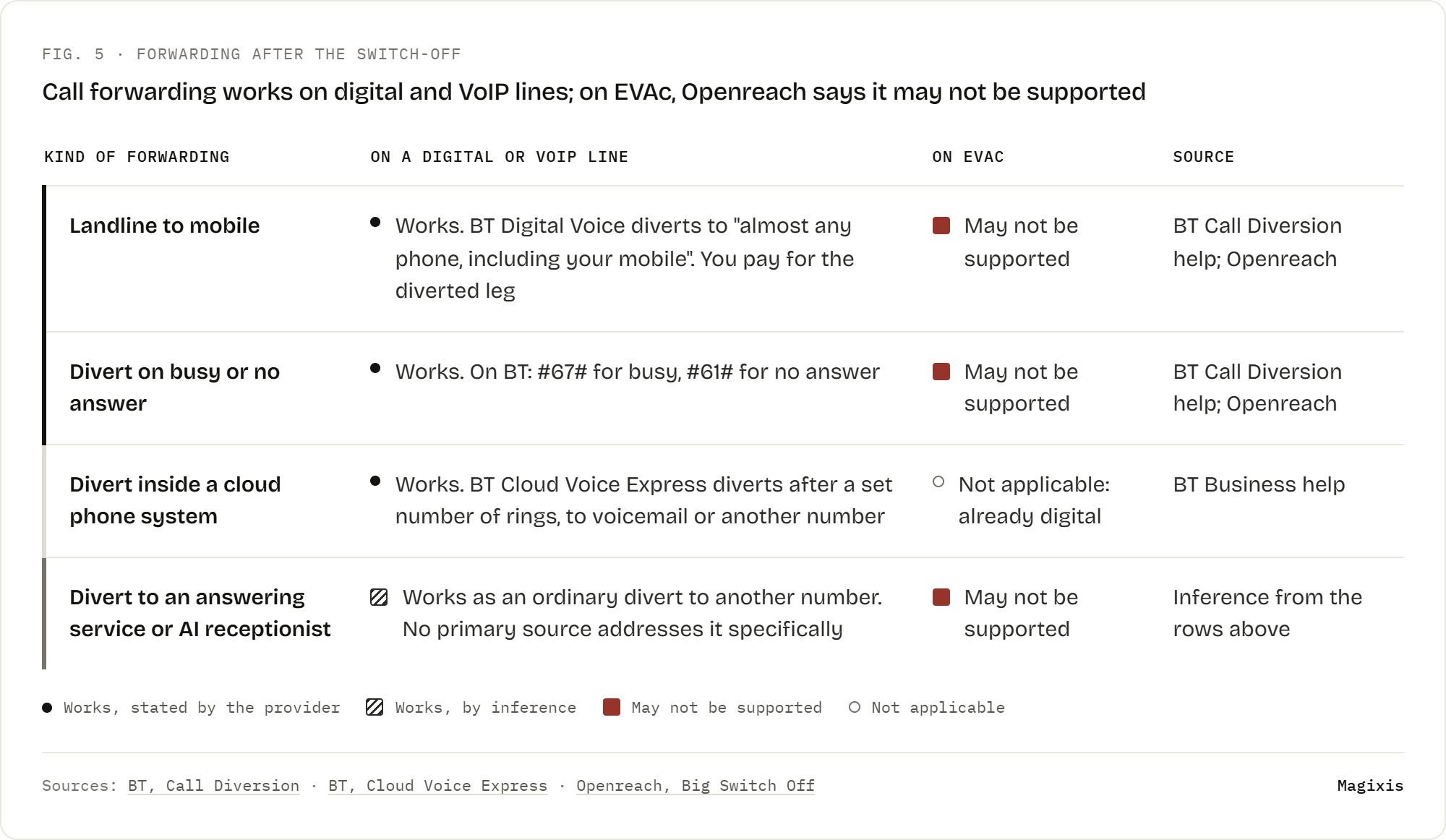
Plan to re-set and test every divert after migration: all calls, busy and no answer. No provider source we found promises that settings on the old line carry over to the new service.
Forwarding to a mobile, a VoIP system or an answering service: what to check
Forwarding to an answering service is an ordinary divert to another phone number, so it depends on the same thing as forwarding to a mobile: a migrated line with diversion switched on. No Ofcom, ICO or gov.uk source deals specifically with forwarding business calls to a third-party or automated answering service. The rules that do apply are the general ones on caller ID, covered in the next section.
This is how Magixis works, so we can describe the chain from our side. The client keeps their number with their own carrier and forwards it to a Magixis routing number. Nothing is ported. When the switch-off reaches the client's line, the part that changes is the client's own line and its divert. The routing number and the agent are already digital. Unforwarding returns calls to the client's own handset within minutes.
The chain as Magixis runs it: the client's number stays with their carrier and is forwarded to a Magixis routing number. Nothing is ported.
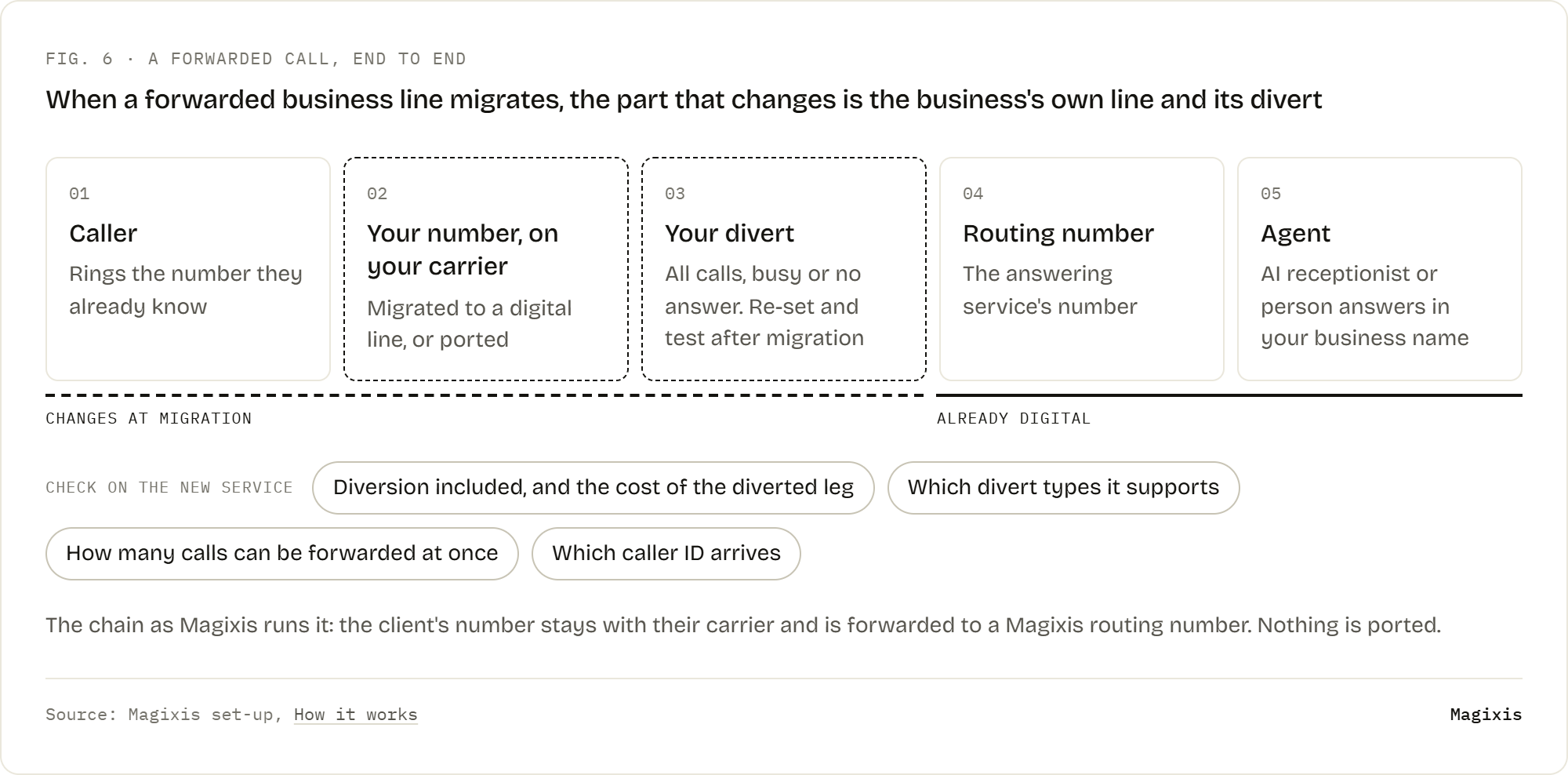
Before and after migration, check four things with your provider:
- Diversion is included on the new service, and what the diverted leg costs.
- Which divert types it supports: all calls, busy, no answer, after a set number of rings.
- How many calls can be forwarded at once. We found no rule on concurrent-call limits, so ask.
- Which caller ID the receiving phone or service sees.
Caller ID on forwarded calls: what Ofcom's rules say
Ofcom's rules require every call to carry a real number, and they allow a forwarded call to show the original caller's number. General Condition C6.4 requires caller line identification (CLI) to include "a valid, dialable Telephone Number which uniquely identifies the caller". Ofcom's CLI guidance allows a "Type 4" Presentation Number "for the onward transmission of the originating number" (paragraph 5.12 of the 2024 version). That is the mechanism that lets a forwarded call show the person who rang you rather than your own number.
Two limits apply. A number allocated to someone else can be presented only with their permission, which can be shown by contract. And providers that offer Type 4 require a contractual commitment from customers that they will only submit CLIs received from the public network. The guidance never uses the words "forwarded" or "diverted", so whether the original caller's number shows on a forwarded call depends on how your provider, and the receiving service, handle Type 4 onward transmission. Test it with a call from a mobile before you rely on it.
- 01"a valid, dialable Telephone Number which uniquely identifies the caller"General Condition C6.4
- 02A "Type 4" Presentation Number "for the onward transmission of the originating number"CLI guidance, paragraph 5.12 (2024 version); paragraph 5.11 (2018 version)
- 03A number allocated to a third party is presented only with their permission, which can be shown by contractCLI guidance (2018), paragraphs 5.5 and 5.6
- 04Providers offering Type 4 require customers to commit, by contract, to submit only CLIs received from the public networkCLI guidance (2018), paragraph 5.12
- 05No paragraph uses the words "forwarded" or "diverted"
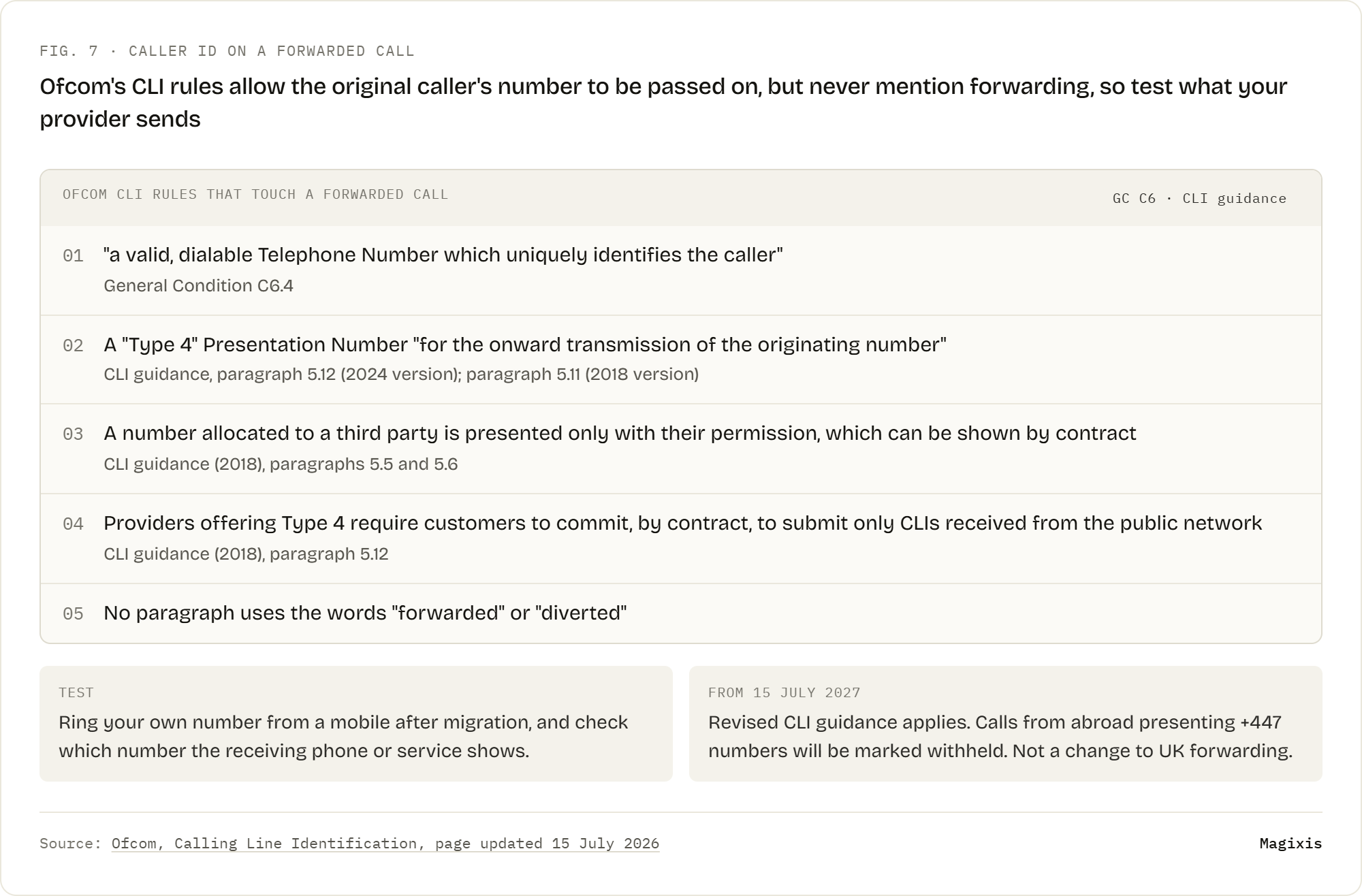
Ofcom last updated its CLI guidance page on 15 July 2026, and a revised version applies from 15 July 2027. From that date, calls from abroad that present UK mobile (+447) numbers will be marked as withheld. That change does not concern forwarding within the UK.
Porting your number: your rights
If you change provider, you have a right to take your number with you. Ofcom's General Condition C7.6 requires providers to offer porting "on reasonable terms and conditions", for at least one month after you end the old contract, with "no direct charges" to you for it. If porting fails, the number and services must be reactivated until the port completes (C7.7(c)). These rights apply to all businesses, whatever their size (Ofcom, General Conditions that protect business customers, 6 March 2024).
The new provider makes the request on your behalf (General Condition B3.5). Porting must happen "within the shortest possible time", and once validated, activation must be completed "within one business day". The provider must tell you the porting date (B3.9), and compensation provisions apply to delays of more than one business day (B3.10).
We found no specific rule for non-geographic numbers (03, 0800, 0345) or for ranges of direct-dial (DDI) numbers. Confirm those with the new provider.
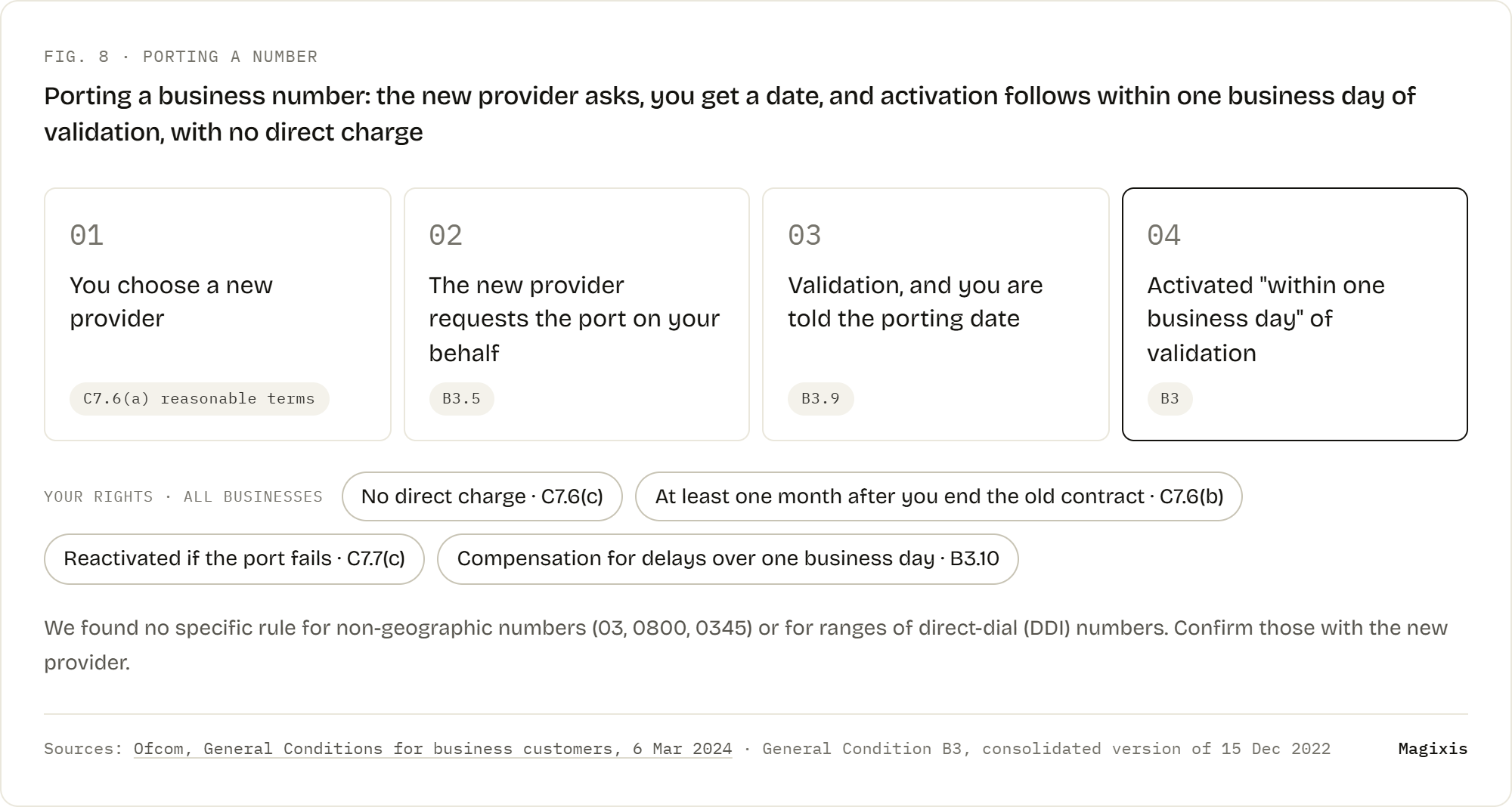
For non-geographic numbers (03, 0800, 0345) and ranges of direct-dial (DDI) numbers, we found no specific rule. Condition B3 covers telephone numbers generally, but confirm a range port with the new provider before you sign.
ISDN and multi-line systems: the highest-risk setups
ISDN, Featureline and multiline systems carry the most risk. BT says these cannot be moved automatically, and that ISDN, Featureline and multiline services that are not moved "will stop working from 31 January 2027" (BT Business). If your business has several lines, a switchboard or a block of DDI numbers, talk to your provider now. Ask whether your DDI range can be ported intact and how long that will take; we found no published rule on either.
| Your setup | After 31 January 2027, if nothing is done | What to do now |
|---|---|---|
| ISDN, Featureline or multiline | "will stop working from 31 January 2027". Cannot be moved automatically |
Talk to your provider now. Ask whether your DDI range ports intact, and how long it takes |
| Single analogue line, not yet migrated | May go onto EVAc, temporary and voice-only, or be ceased in tranches |
Agree a migration date with your provider, or choose a new one |
| Already on Digital Voice, VoIP or SIP | No change from the switch-off |
Re-set and test diverts, and check the caller ID on forwarded calls |
Card machines, alarms, lifts and power cuts
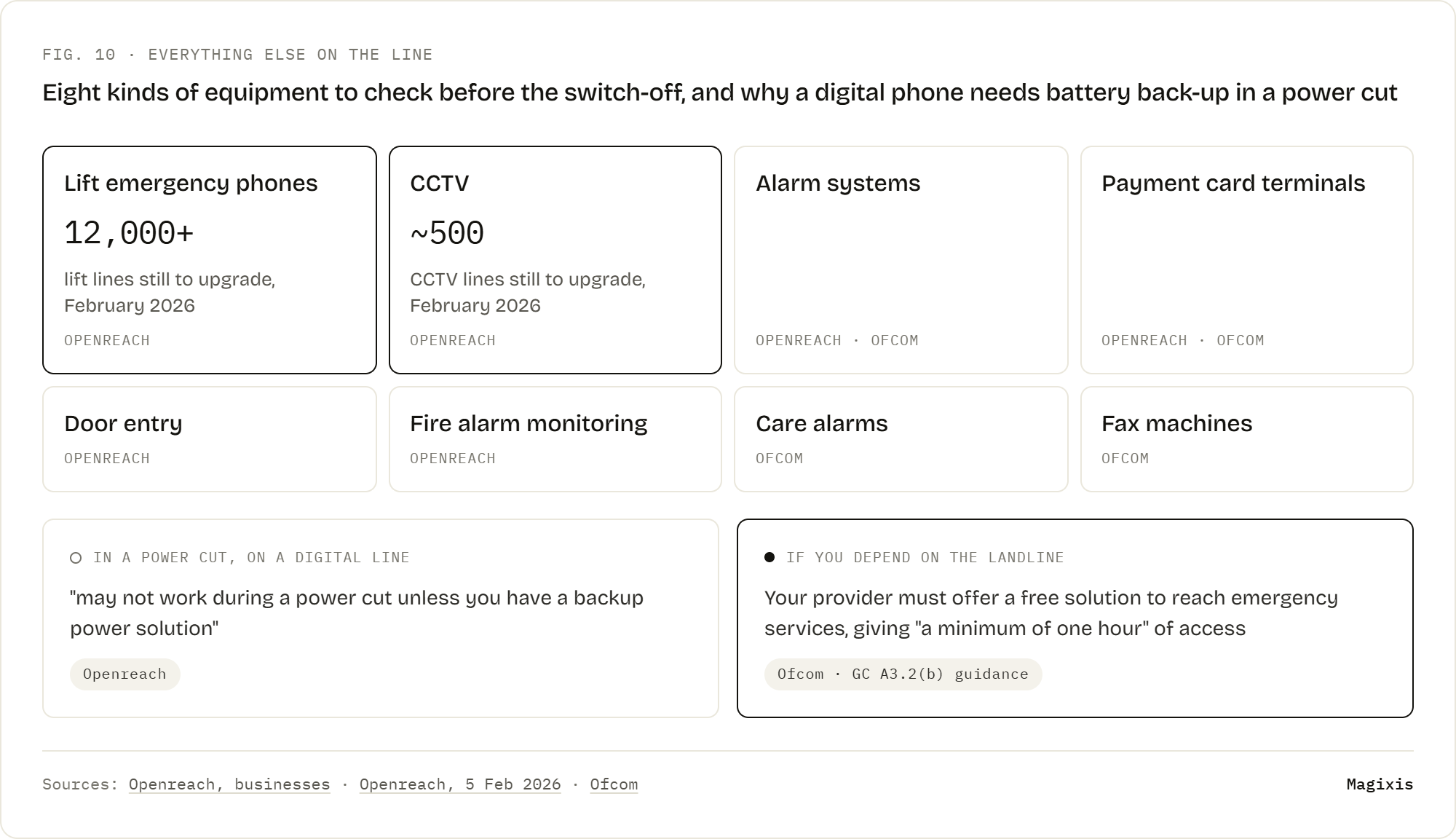
Phones are the easy part. Openreach asks businesses to check everything else connected to the line: alarm systems, CCTV, payment card terminals, door entry, lift emergency phones and fire alarm monitoring. In February 2026 Openreach said more than 12,000 lift lines and around 500 CCTV lines still needed upgrading. Ofcom adds care alarms, security alarms and fax machines, and tells small businesses to check card machines and alarms.
Power is the other change. A digital phone works in a power cut only with battery back-up, and Openreach says digital lines "may not work during a power cut unless you have a backup power solution". Providers must offer customers who depend on their landline a free way to reach emergency services in a power cut. Ofcom's guidance requires at least one solution giving "a minimum of one hour" of access (Ofcom). Openreach also offers free equipment testing at its test labs.
What happens if you miss the date (EVAc)?
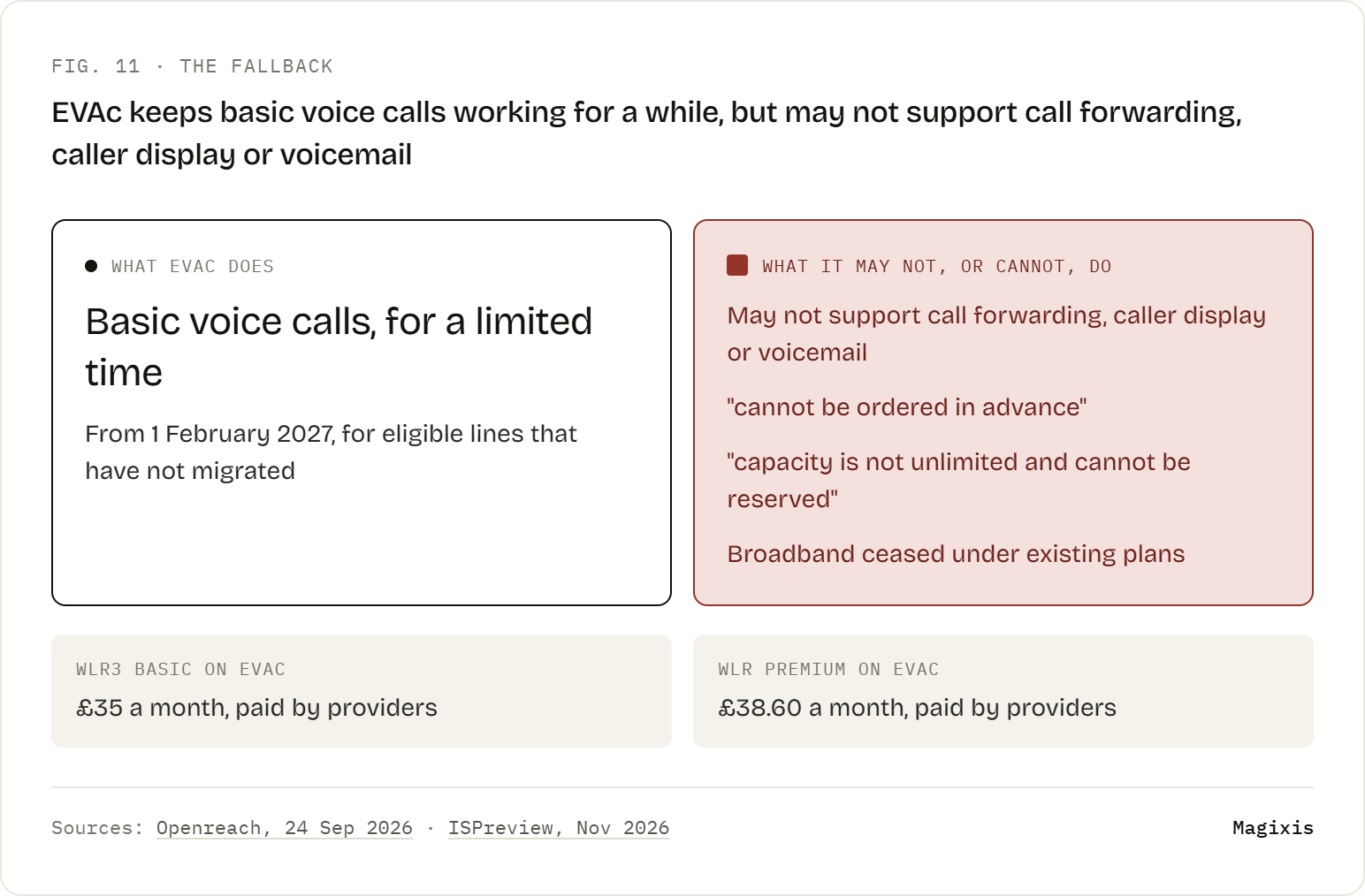
A line still on the PSTN after 31 January 2027 may be moved onto EVAc, Openreach's last-resort service, or ceased. EVAc is temporary and voice-only. It "cannot be ordered in advance", and its "capacity is not unlimited and cannot be reserved". Openreach says it may not support call forwarding, caller display or voicemail. Providers pay Openreach £35 a month for WLR3 Basic on EVAc, or £38.60 for Premium, according to Openreach's 24 September 2026 release.
Broadband is the other catch. Under Openreach's existing plans, broadband on a line moved to EVAc would stop working. Openreach told providers on 24 September 2026 that it is developing a way to keep broadband on those lines, and ISPreview reports that those migrations probably won't start until around mid-April 2027. In a letter to providers reported on 2 November 2026, Openreach said EVAc "is not built to support the connectivity needs of a modern business" (VoIP Review).
Treat EVAc as a safety net for a voice line, and plan as if it will not carry your divert.
Myths versus facts
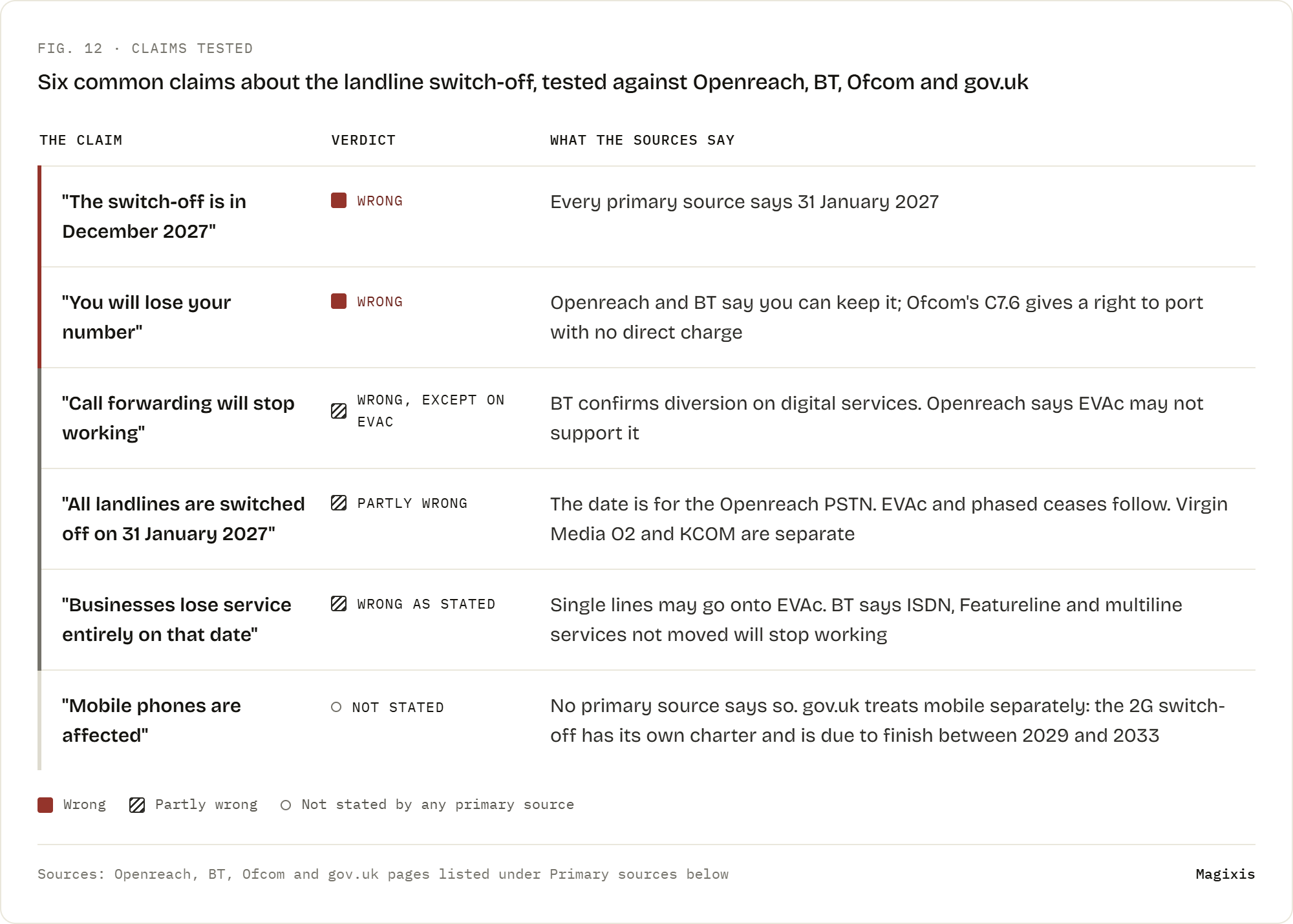
Much of what circulates about the switch-off is half right. These are the common claims, tested against primary sources.
| The claim | Verdict | What the sources say |
|---|---|---|
| "The switch-off is in December 2027" | Wrong | Every primary source says 31 January 2027 |
| "You will lose your number" | Wrong | Openreach and BT say you can keep it; Ofcom's C7.6 gives a right to port with no direct charge |
| "Call forwarding will stop working" | Wrong, except on EVAc | BT confirms diversion on digital services. Openreach says EVAc may not support it |
| "All landlines are switched off on 31 January 2027" | Partly wrong | The date is for the Openreach PSTN. EVAc and phased ceases follow. Virgin Media O2 and KCOM are separate |
| "Businesses lose service entirely on that date" | Wrong as stated | Single lines may go onto EVAc. BT says ISDN, Featureline and multiline services not moved will stop working |
| "Mobile phones are affected" | Not stated | No primary source says so. gov.uk treats mobile separately: the 2G switch-off has its own charter and is due to finish between 2029 and 2033 |
Your checklist for the next 12 weeks
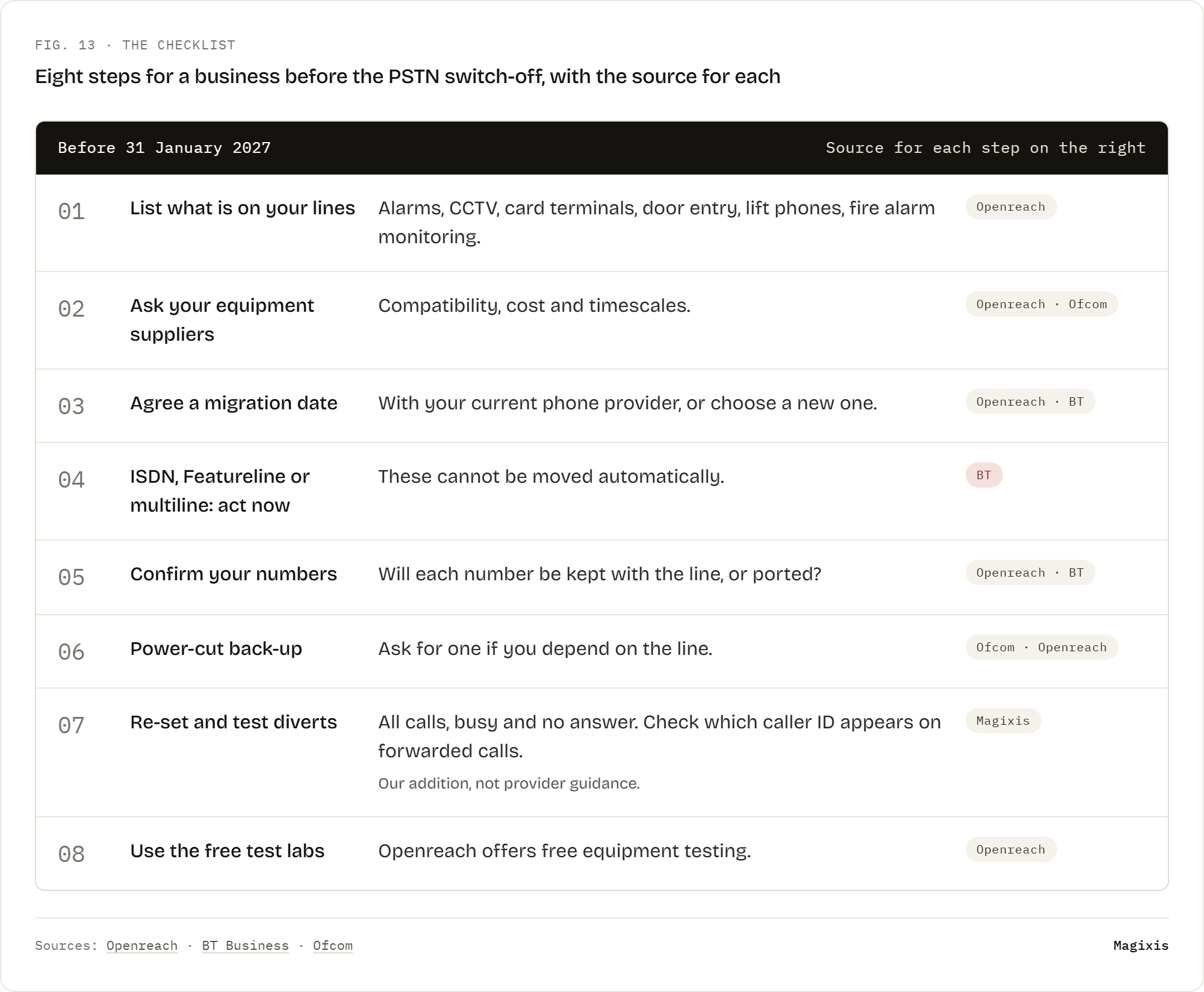
There are 12 weeks between this post and 31 January 2027. The list comes from Openreach, BT and Ofcom guidance. Step 7 is our own addition.
- 01List what is on your linesAlarms, CCTV, card terminals, door entry, lift phones, fire alarm monitoring.Openreach
- 02Ask your equipment suppliersCompatibility, cost and timescales.Openreach · Ofcom
- 03Agree a migration dateWith your current phone provider, or choose a new one.Openreach · BT
- 04ISDN, Featureline or multiline: act nowThese cannot be moved automatically.BT
- 05Confirm your numbersWill each number be kept with the line, or ported?Openreach · BT
- 06Power-cut back-upAsk for one if you depend on the line.Ofcom · Openreach
- 07Re-set and test divertsAll calls, busy and no answer. Check which caller ID appears on forwarded calls.Our addition, not provider guidance.Magixis
- 08Use the free test labsOpenreach offers free equipment testing.Openreach
What to ask your phone provider
- Which network is my line on, and what is its switch-off date?
- Will my number move with the line, or does it need porting? If I have a DDI range, can it move intact, and how long will that take?
- Is call diversion included on the new service, which divert types does it support, and what does the diverted leg cost?
- When a call is forwarded, will the original caller's number be passed on?
- If my line ends up on EVAc, will my existing divert keep working?
- If you migrate me without my asking, what contract terms and prices apply afterwards?
If your provider can't answer the fourth question, test it yourself: forward the line to a mobile and ring it from another phone.
Where Magixis sits
Magixis answers a business's existing number by call forwarding. The client keeps the number with their own carrier and forwards it to a Magixis routing number. Nothing is ported, and unforwarding returns calls to the client's own handset within minutes. The switch-off does not change that arrangement, but it does change the client's line. If you are moving to a digital line before 31 January 2027, set the divert up again on the new service and ring your own number to check it arrives.
How the forwarding is set up is on how it works, prices are on the pricing page, and what happens to call data is on our trust page.
Dates that will date this post
Industry announces PSTN retirement, target 31 December 2025
National stop-sell of PSTN products (reported)
Government asks industry to pause migration after "serious incidents"; PSTN Charter signed 18 December
BT resets the date to 31 January 2027
Ofcom writes to providers setting out its expectations
Fixed Telecoms Modernisation Charter, covering businesses
Openreach announces EVAc pricing and work to keep broadband on EVAc lines
Legacy WLR prices doubled against 2025 levels
Openreach PSTN closes
WatchEVAc for unmigrated lines; other lines ceased in tranches
WatchRevised Ofcom CLI guidance applies
Watch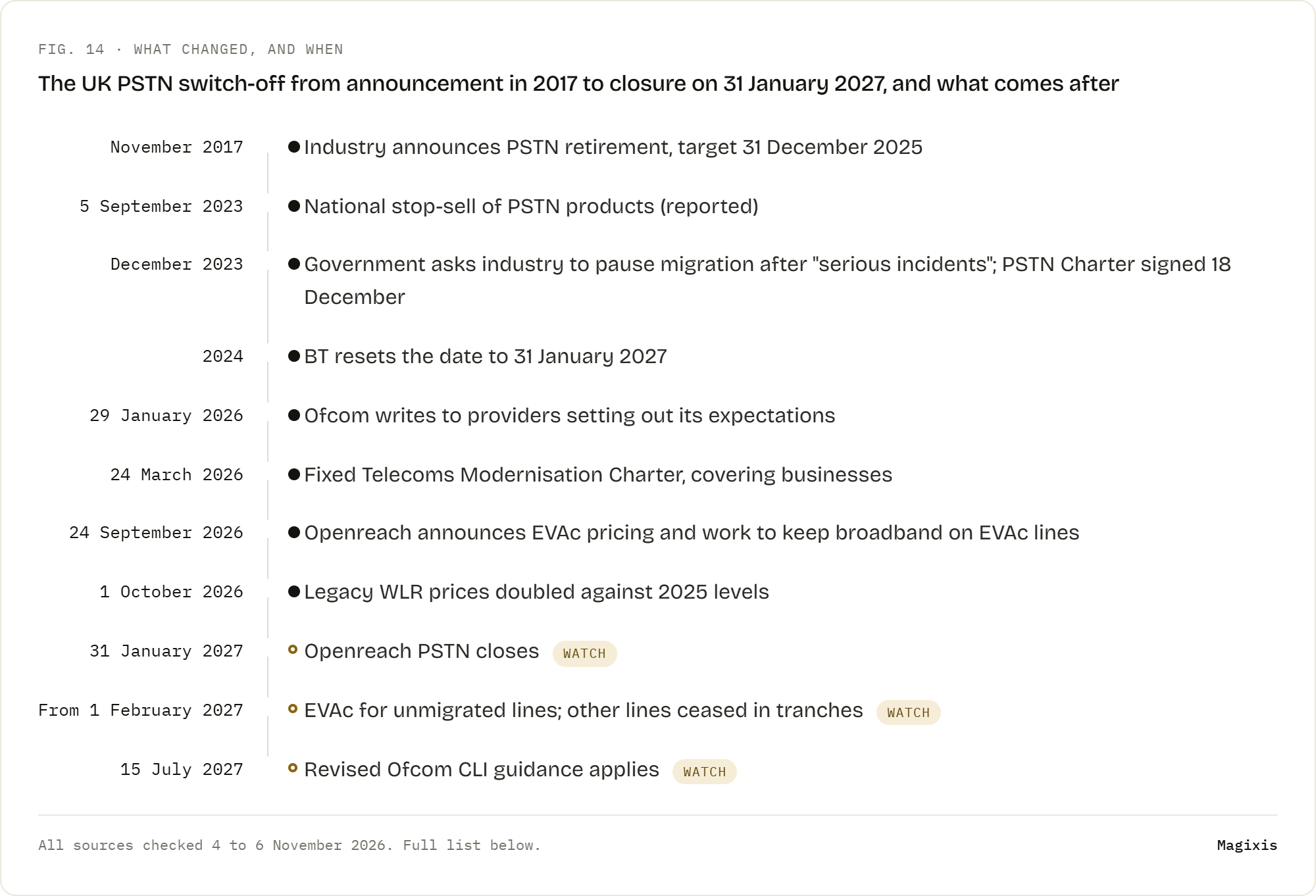
Every source in this post was checked between 4 and 6 November 2026. The things most likely to change it are Openreach's EVAc timetable after 31 January 2027 and the revised CLI guidance in July 2027.
FAQ
When is the UK landline switch-off?
31 January 2027 for lines on the Openreach network. Openreach, BT, gov.uk and Ofcom all give that date, and Openreach says it remains unchanged. Virgin Media O2 and KCOM run separate networks, so check with your provider if your line is on one of them.
Will I lose my business phone number?
No, in almost every case. You can keep the number by migrating the line with your current provider, or port it to a new provider. Ofcom's General Condition C7.6 bars direct charges for porting.
Does call forwarding work after the switch-off?
Yes, on a line that has moved to a digital or VoIP service. BT confirms call diversion on Digital Voice and on Cloud Voice Express. On EVAc, the temporary fallback for lines that miss the date, Openreach says call forwarding may not be supported.
Can I forward my landline to an AI receptionist after the switch-off?
Yes. Forwarding to an answering service or AI receptionist is an ordinary divert to another number, so it works on any digital line that supports diversion. No Ofcom or gov.uk rule deals with it specifically. Test which caller ID arrives after you migrate.
What is EVAc?
Emergency Voice and Access Continuity is Openreach's temporary, voice-only service for lines still on the PSTN after 31 January 2027. It cannot be ordered in advance, its capacity cannot be reserved, and it may not support call forwarding, caller display or voicemail.
Is my mobile affected by the landline switch-off?
No primary source says it is. The government treats mobile separately, and the 2G switch-off has its own timetable, due to finish between 2029 and 2033. Diverting a landline to a mobile depends on the landline being migrated, not on the mobile network.
- Openreach, Openreach to protect broadband connections as PSTN closure approaches, 24 September 2026
- Openreach, Time for a 'big switch-up', 5 February 2026
- Openreach, Digital phone lines for businesses
- Openreach, The Big Switch Off
- BT Business, The PSTN, ISDN and ADSL switch off: what it means for you
- BT Business, Diverting calls on Cloud Voice Express
- BT, Digital Voice
- BT, All about Call Diversion
- DSIT, Telecommunications Modernisation: Connectivity Timeline, 29 July 2026
- DSIT, Telecommunications modernisation collection
- Ofcom, Your landline is going digital
- Ofcom, Protecting customers during the migration to digital landlines
- Ofcom, General Conditions that protect business customers, 6 March 2024
- Ofcom, Calling Line Identification guidance, updated 15 July 2026
- House of Commons Library, CBP-9471, 1 April 2026
- ISPreview, Openreach detail caveats with retaining broadband, November 2026
- VoIP Review, Openreach warns providers ahead of 2027 PSTN shutdown, 2 November 2026