When an AI receptionist books a paid call-out for a plumber or electrician, it has made a contract in the business's name. Three pieces of UK law then apply to that call. The Consumer Contracts Regulations 2013 decide whether the customer can cancel and what you must send them. The Consumer Rights Act 2015 turns what was said on the call into terms of the contract. The Digital Markets, Competition and Consumers Act 2024 decides whether the call-out price you quoted was the whole price.
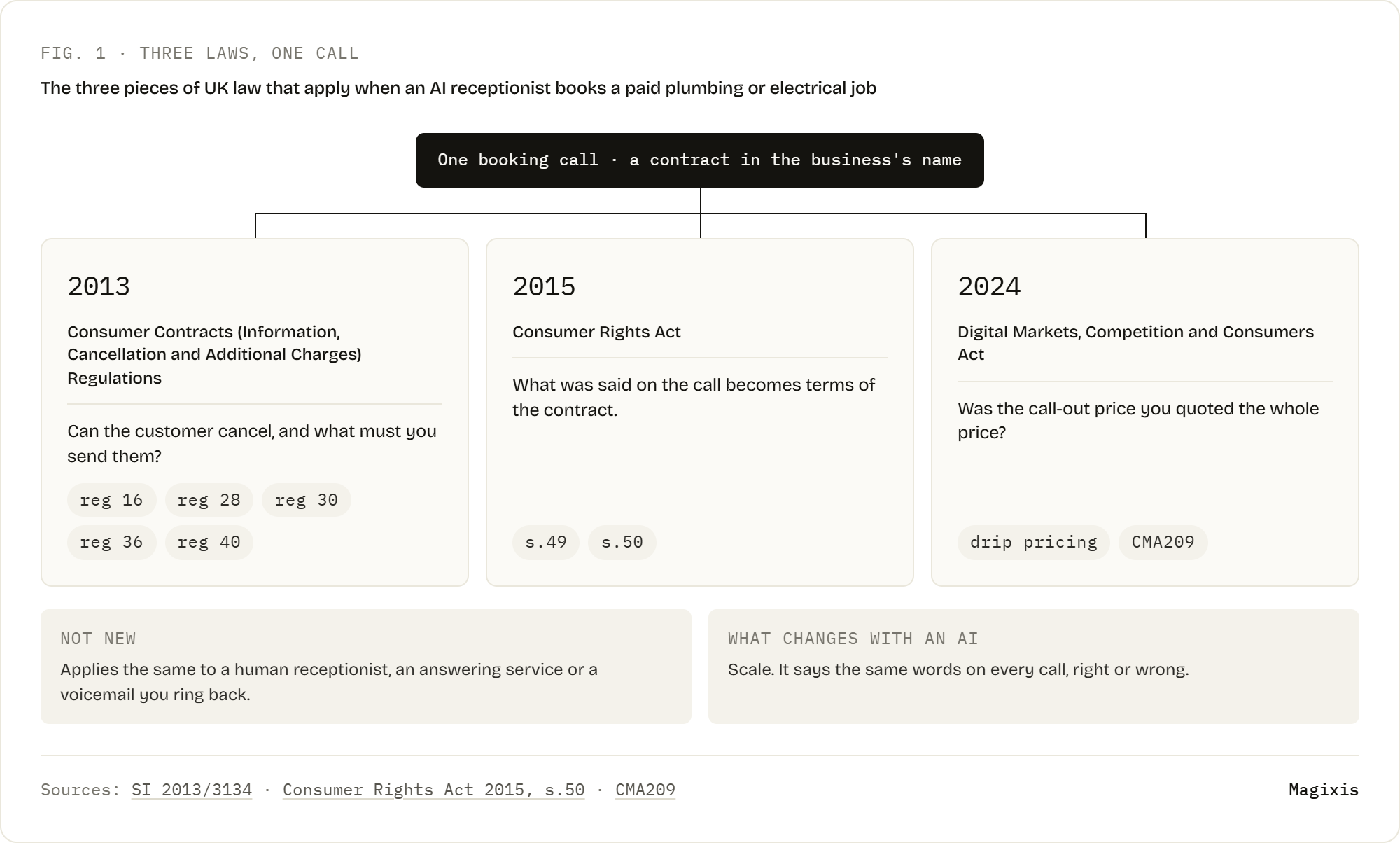
None of this is new, and it applies the same to a human receptionist, an answering service or a voicemail you ring back. What changes with an AI is scale: it says the same words on every call, so a script that is right protects you on every job, and a script that is wrong breaks the law on every job.
This is a plain-English reading of the rules, not legal advice.
- A job agreed over the phone is a distance contract. The customer usually gets 14 days to cancel, and you must confirm the contract on a durable medium such as email before the work starts.
- Emergency call-outs lose the right to cancel, but only for the urgent repair. Extra work or non-essential parts sold on the same visit are still cancellable.
- Starting within 14 days needs the customer's express request. Without it, or without the cancellation information, the customer can cancel and pay nothing for work already done.
- Whatever the receptionist says can become a contract term. "Someone will be there within the hour" is a promise if the customer relied on it.
- The call-out price must include every fee the customer will necessarily pay, VAT included. The CMA can now fine up to 10% of turnover or £300,000, whichever is greater.
Why the phone call is where the risk sits
Tradespeople already know the call is where the work comes from. In a survey of more than 220 tradespeople by Fix Radio and The Builders Station, 34% said they believed they had lost work because they could not answer the phone, and 60% said they struggled to answer it while working (Fix Radio, 3 October 2022; the methodology is not published). Customers see the other side of it. In an Opinium survey of 2,000 UK adults for HomeServe, 38% said that after asking for a quote they never heard back, despite chasing (HomeServe, 30 March 2023).
The two surveys use different samples and are not comparable with each other. Fix Radio has not published its methodology.
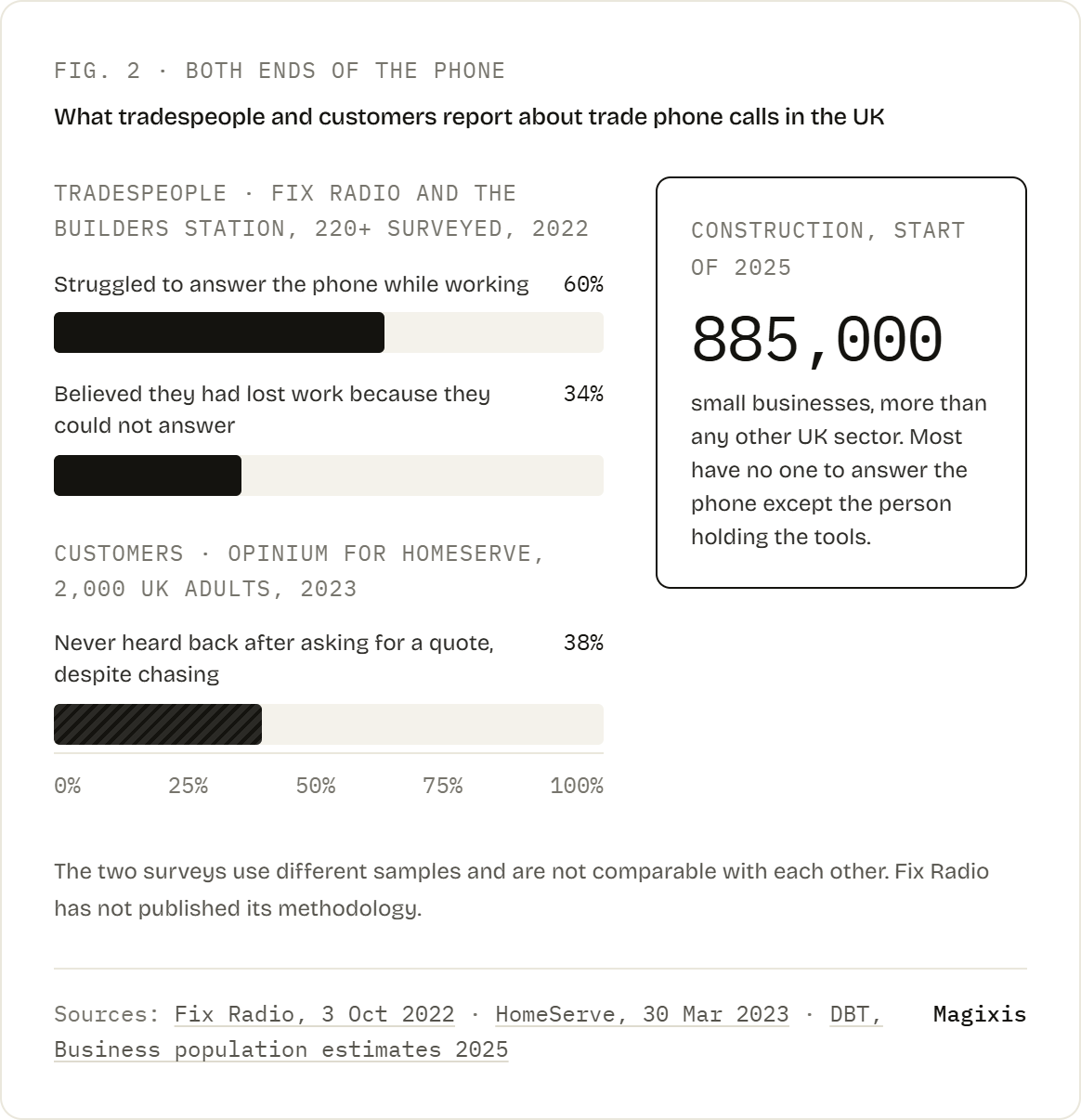
So the pressure to get every call answered and booked is real. Construction has more small businesses than any other UK sector, 885,000 at the start of 2025 (Department for Business and Trade), and most of them have no one to answer the phone except the person holding the tools. An answering service or AI receptionist fixes that. It also means someone other than you is now making promises and quoting prices on your behalf.
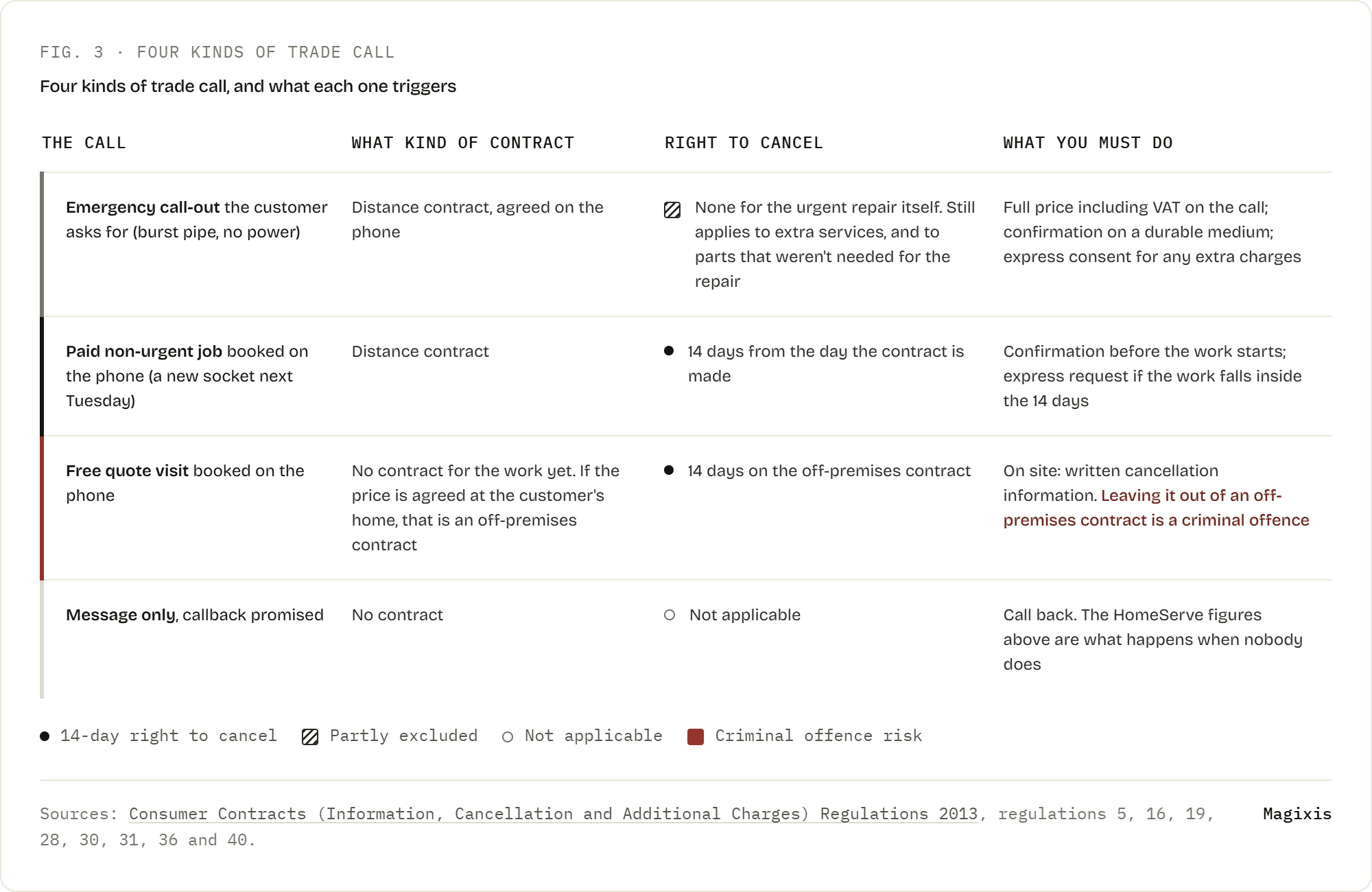
Four kinds of trade call, and what each one triggers
| The call | What kind of contract | Right to cancel | What you must do |
|---|---|---|---|
| Emergency call-out the customer asks for (burst pipe, no power) | Distance contract, agreed on the phone | None for the urgent repair itself. Still applies to extra services, and to parts that weren't needed for the repair |
Full price including VAT on the call; confirmation on a durable medium; express consent for any extra charges |
| Paid non-urgent job booked on the phone (a new socket next Tuesday) | Distance contract | 14 days from the day the contract is made |
Confirmation before the work starts; express request if the work falls inside the 14 days |
| Free quote visit booked on the phone | No contract for the work yet. If the price is agreed at the customer's home, that is an off-premises contract | 14 days on the off-premises contract |
On site: written cancellation information. Leaving it out of an off-premises contract is a criminal offence |
| Message only, callback promised | No contract | Not applicable |
Call back. The HomeServe figures above are what happens when nobody does |
Is a job booked over the phone a distance contract?
Usually, yes. Regulation 5 defines a distance contract as one "concluded between a trader and a consumer under an organised distance sales or service-provision scheme without the simultaneous physical presence of the trader and the consumer". A business that routinely takes bookings by phone, through a receptionist, an answering service or an AI agent, is running exactly that kind of scheme.
The line moves if the price is agreed in person. If the phone call only books a free visit, and the customer agrees the price with you in their kitchen, that later agreement is an off-premises contract: one made in the "simultaneous physical presence of the trader and the consumer" away from your business premises. Off-premises contracts carry the heaviest duty in the Regulations. Under regulation 19, entering into one without giving the customer the cancellation information is a criminal offence.
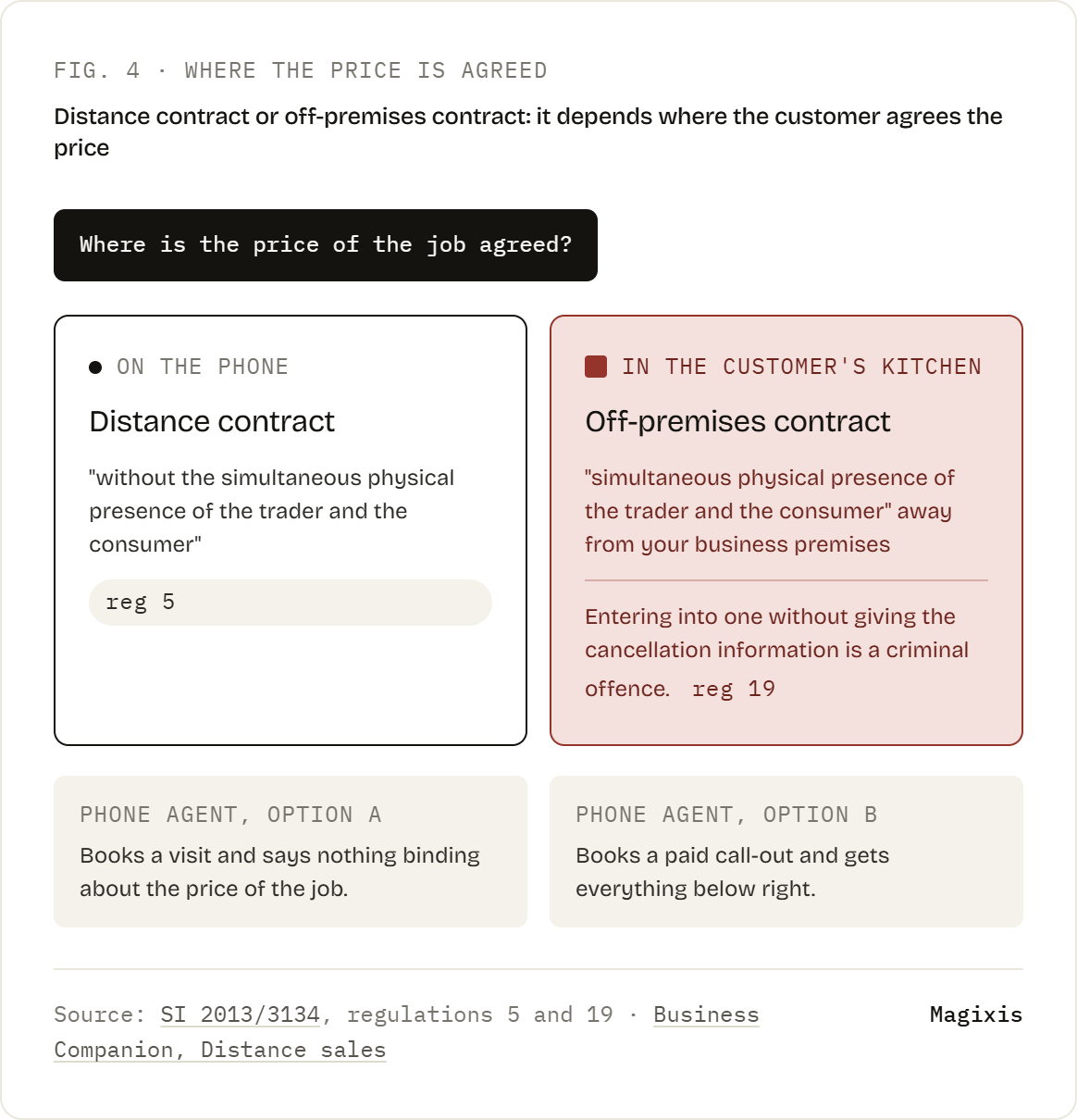
The practical split for a phone agent is simple. Either it books a visit and says nothing binding about the price of the job, or it books a paid call-out and gets everything below right.
What happens to the 14-day right to cancel?
For services, the cancellation period ends 14 days after the day the contract is entered into (regulation 30). Most trade jobs booked by phone happen well inside that window, which is where regulation 36 comes in.
Regulation 36(1) says the trader "must not begin the supply of a service before the end of the cancellation period" unless the consumer "has made an express request". For a distance contract that request does not have to be in writing. For an off-premises contract it does, "on a durable medium".
If the customer asked you to start early and then cancels, they pay "in proportion to what has been supplied" (regulation 36(4)). If you never got the express request, or never gave the cancellation information, the consumer "bears no cost for supply of the service, in full or in part, in the cancellation period" (regulation 36(6)). And if the cancellation information was never given at all, regulation 31 stretches the cancellation period by up to 12 months.
Illustration: a job started on day 4. The day it starts changes nothing about the rules; only the express request and the cancellation information do. Payment bars show what the trader recovers, not an amount.
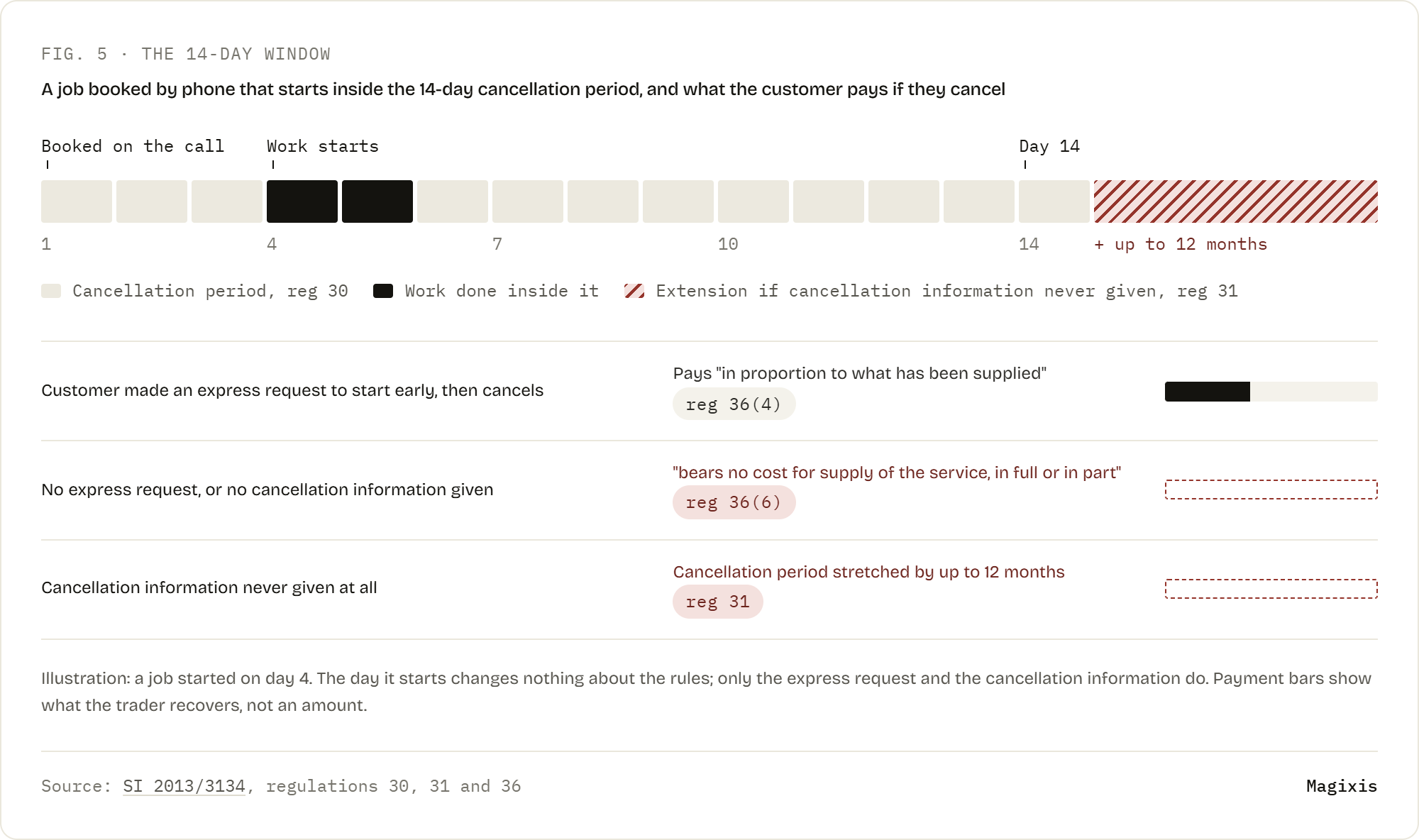
That is the scenario to design against: a customer who has had the boiler serviced or the consumer unit replaced, cancels within the window, and owes you nothing because nobody asked the right question on the phone.
On a call, getting the express request right means asking one plain question, such as "We can come on Thursday, which is inside your 14-day cancellation period. Do you want us to go ahead before then? If you cancel after we've started, you'll pay for the work done." An AI receptionist that keeps a transcript also keeps the evidence that the question was asked and answered.
Do emergency call-outs have a cancellation right?
Not for the emergency repair itself. Regulation 28(1)(e) excludes contracts "where the consumer has specifically requested a visit from the trader for the purpose of carrying out urgent repairs or maintenance".
Two limits matter. First, the customer has to have asked for the visit. A receptionist that talks a routine enquiry up into an "emergency" has not created an urgent-repair contract. Second, regulation 28(2) keeps the right to cancel for services "in addition to the urgent repairs or maintenance requested", and for goods other than replacement parts that were necessary for the repair, when you supply them on that visit. Fix the burst pipe and it is not cancellable. Sell a new cylinder on the same visit and that part of the job is.
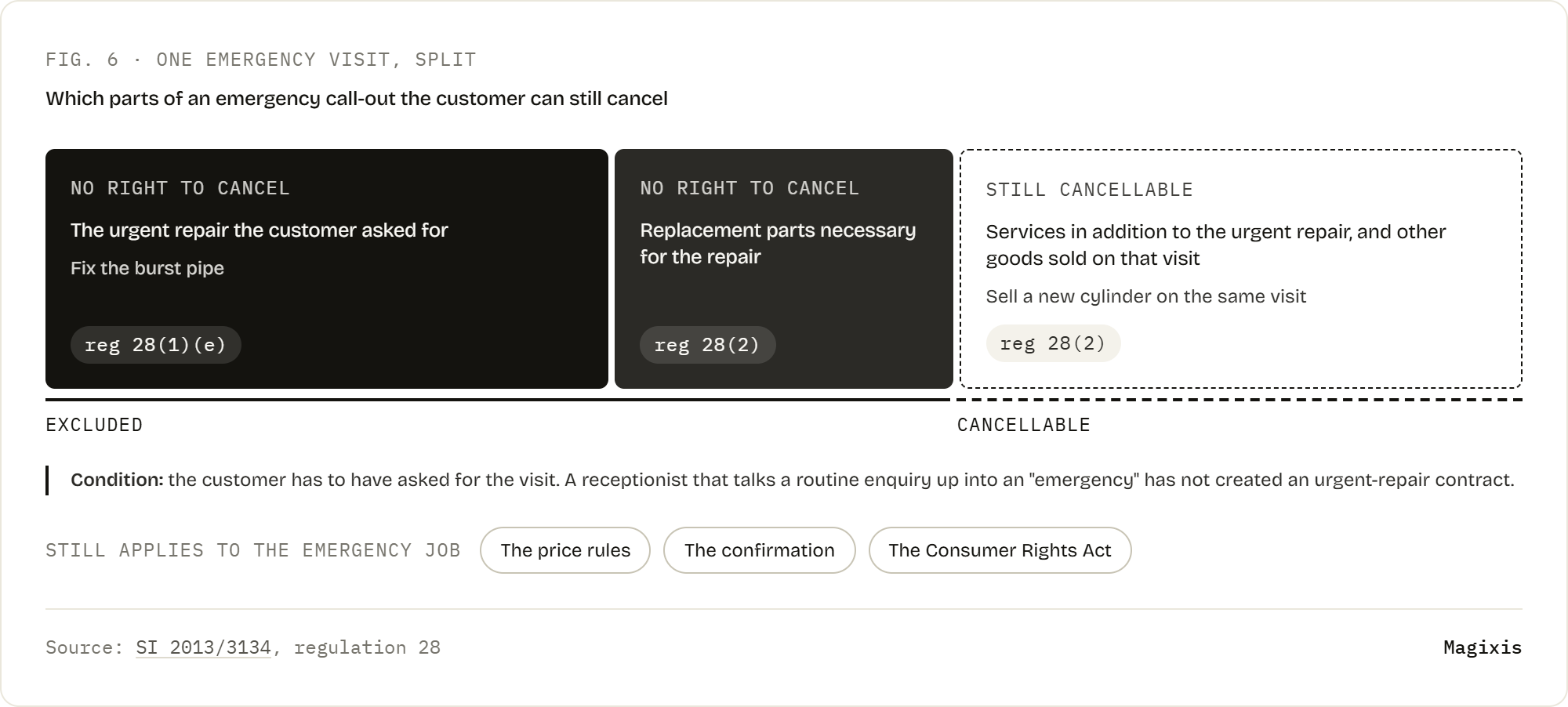
The exception removes the right to cancel. It does not remove the rest: the price rules, the confirmation and the Consumer Rights Act all still apply.
What must the confirmation contain, and can it be a text?
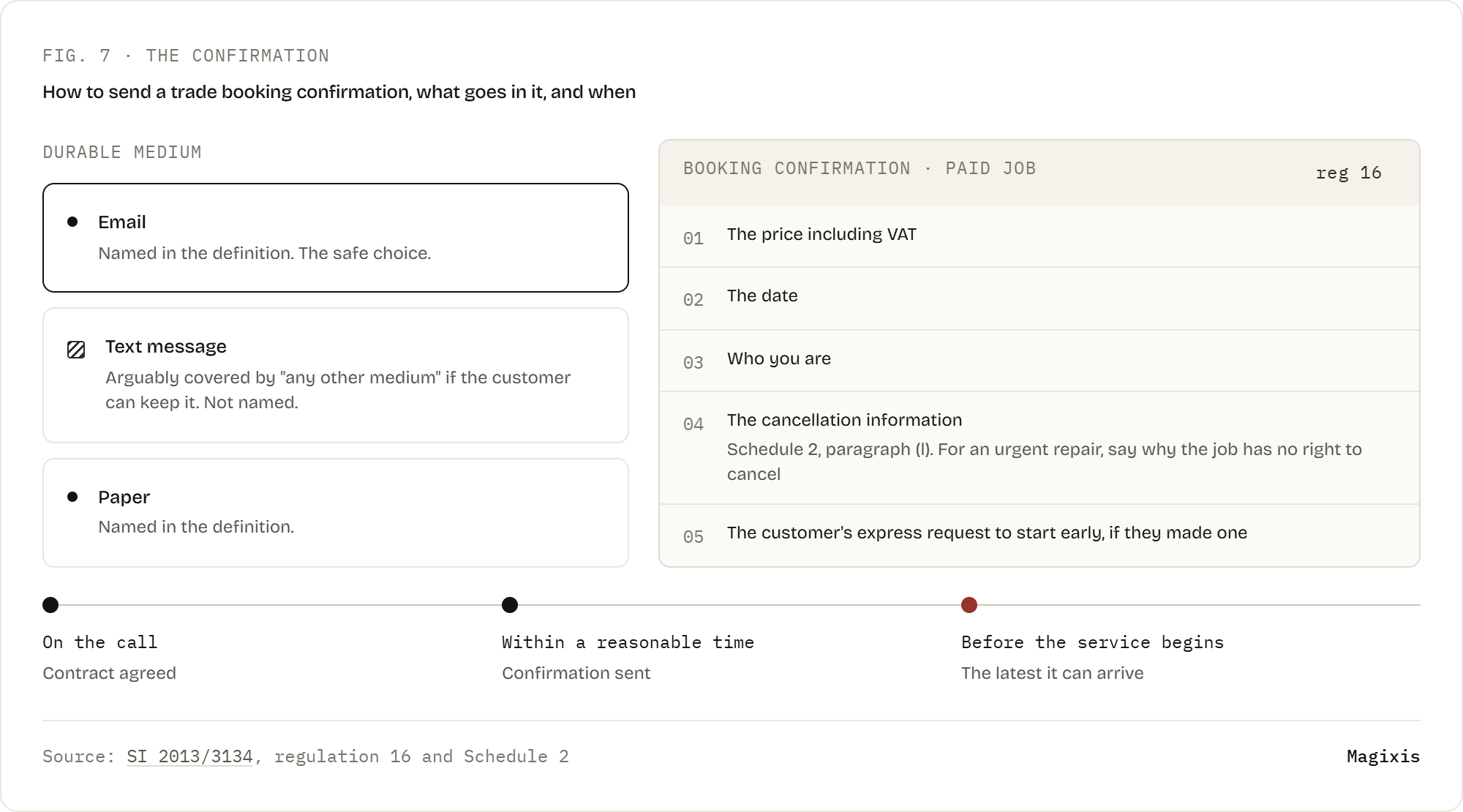
Regulation 16 requires the trader to "give the consumer confirmation of the contract on a durable medium", within a reasonable time and in any case before the service begins. A durable medium is "paper or email, or any other medium that allows information to be addressed personally to the recipient" and lets them store it for future reference.
Email is named in the definition, so it is the safe choice. A text message the customer can keep is arguably covered by "any other medium", but it is not named. For a paid job, the confirmation should repeat the price including VAT, the date, who you are, and the cancellation information (paragraph (l) of Schedule 2), or say why the job has no right to cancel if it is an urgent repair. If the customer made an express request to start early, record that too.
- 01The price including VAT
- 02The date
- 03Who you are
- 04The cancellation informationSchedule 2, paragraph (l). For an urgent repair, say why the job has no right to cancel
- 05The customer's express request to start early, if they made one
Can what the receptionist says on the phone bind you?
Yes. Section 50(1) of the Consumer Rights Act 2015 treats as a term of every service contract "anything that is said or written to the consumer, by or on behalf of the trader, about the trader or the service", if the consumer took it into account when deciding to go ahead, or in a later decision about the service.
"By or on behalf of the trader" covers a receptionist, an answering service and an AI agent. So these, said on a booking call, can all become terms:
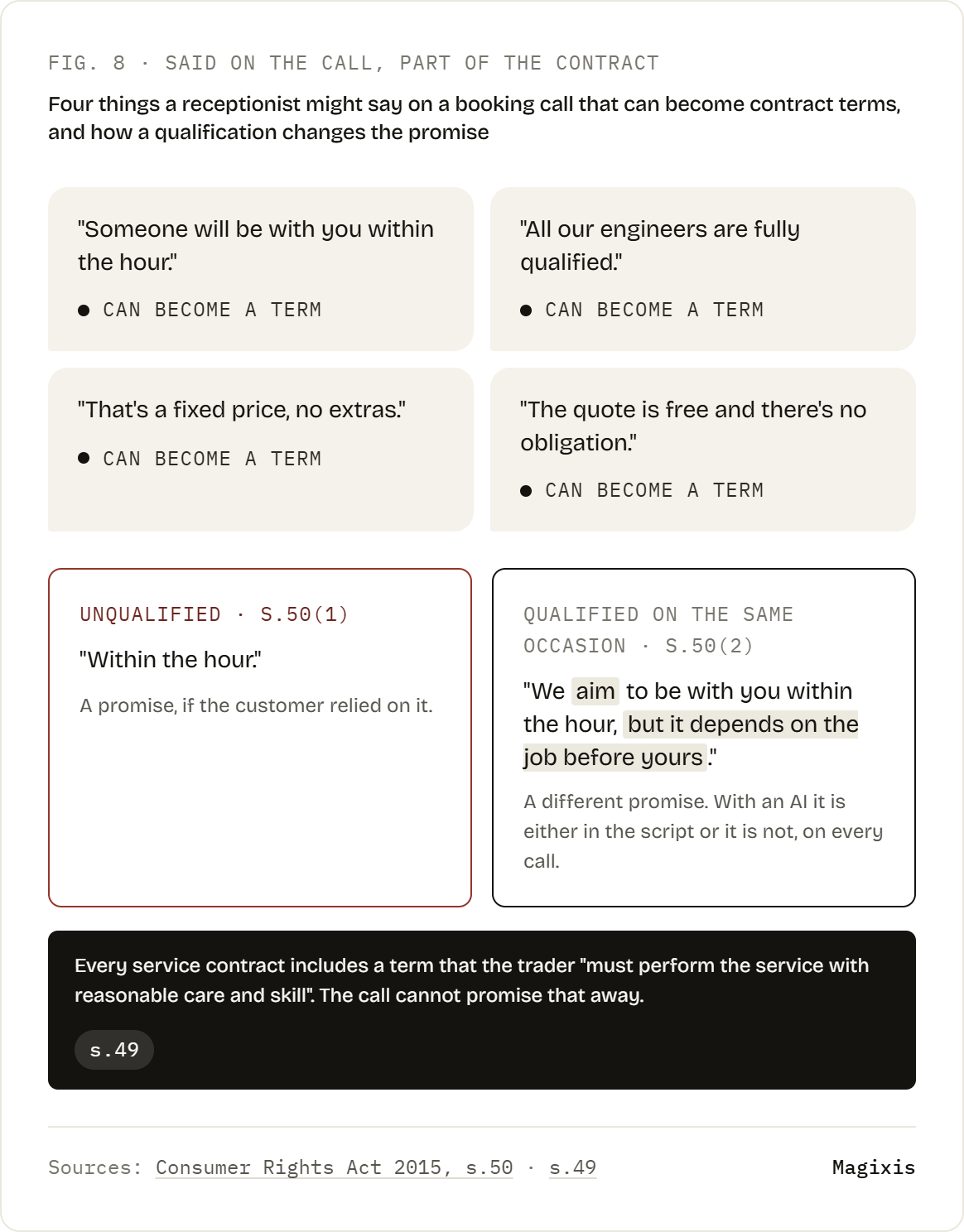
There is a protection in section 50(2): the statement is subject to "anything that qualified it and was said or written to the consumer by the trader on the same occasion". A receptionist that says "we aim to be with you within the hour, but it depends on the job before yours" has made a different promise from one that says "within the hour". With a human receptionist that qualification depends on who picked up. With an AI it is either in the script or it is not, on every call.
Separately, section 49 means every service contract includes a term that the trader "must perform the service with reasonable care and skill". The call cannot promise that away.
Does the call-out price have to include VAT and every fee?
The CMA's view is that any price you give a consumer should be the total price. Its price transparency guidance (CMA209, 18 November 2025) says traders "must tell consumers the total price of the product which includes any fees, taxes, charges or other payments... that the consumer will necessarily incur" (paragraph 3.11), and that "any prices offered or directed to consumers include VAT (where applicable)" (paragraph 4.7) (CMA209).
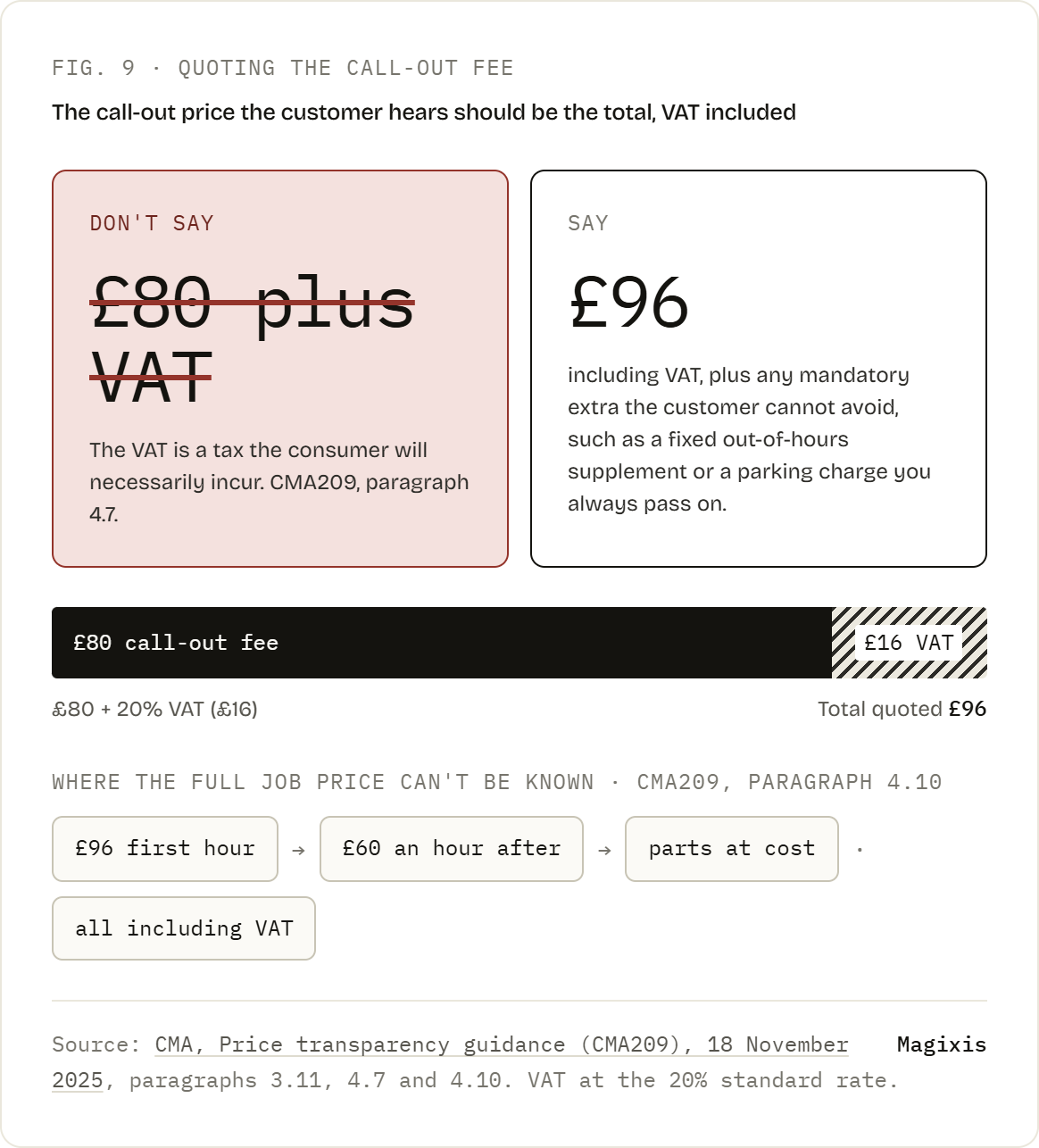
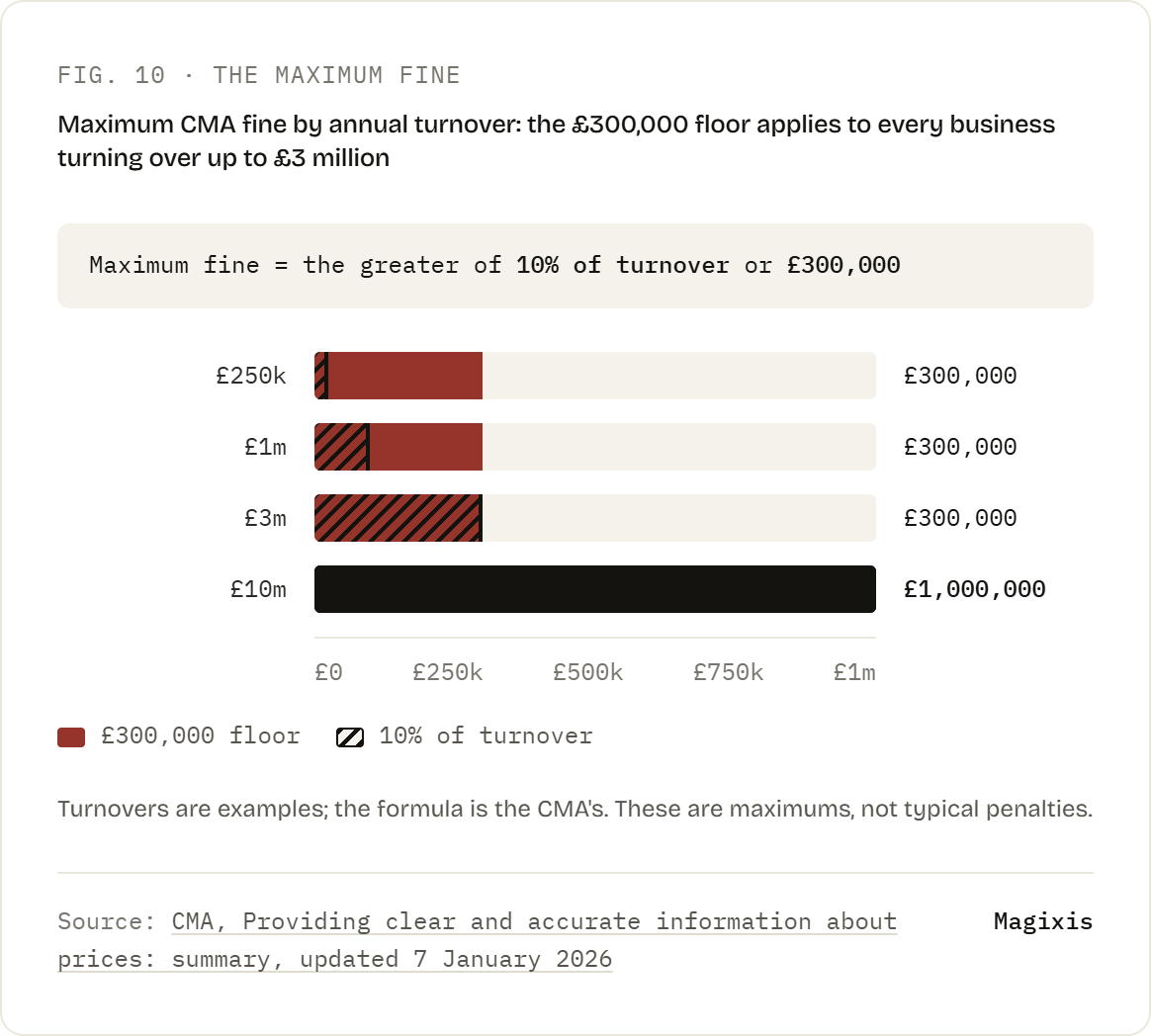
This is the DMCC Act 2024's ban on drip pricing, "where shoppers are shown an initial price for a product, but more fees are added ('dripped') as they proceed with their purchase" (CMA, 7 April 2025). The CMA now enforces it directly, and its summary guidance puts the maximum fine at "up to 10% of your turnover, or £300,000, whichever is greater" (CMA summary, updated 7 January 2026).
Turnovers are examples; the formula is the CMA's. These are maximums, not typical penalties.
One caveat, because it matters. CMA209's examples are adverts, websites, menus, emails and texts. It does not deal with a price spoken on a phone call. Its definition of an invitation to purchase is information that "indicates the characteristics of a product and its price" and "enables, or purports to enable, the consumer to decide whether to purchase", which is a fair description of a call-out price given to someone deciding whether to book. The safe reading is that the rules apply to the call.
In practice:
- Quote the call-out fee including VAT. "£80 plus VAT" becomes "£96".
- Include mandatory extras the customer cannot avoid, such as a fixed out-of-hours supplement or a parking charge you always pass on.
- Where the full job price can't be known, say how it will be worked out: "£96 for the first hour, then £60 an hour including VAT, plus parts at cost." CMA209 paragraph 4.10 allows this where the price "cannot reasonably be calculated in advance".
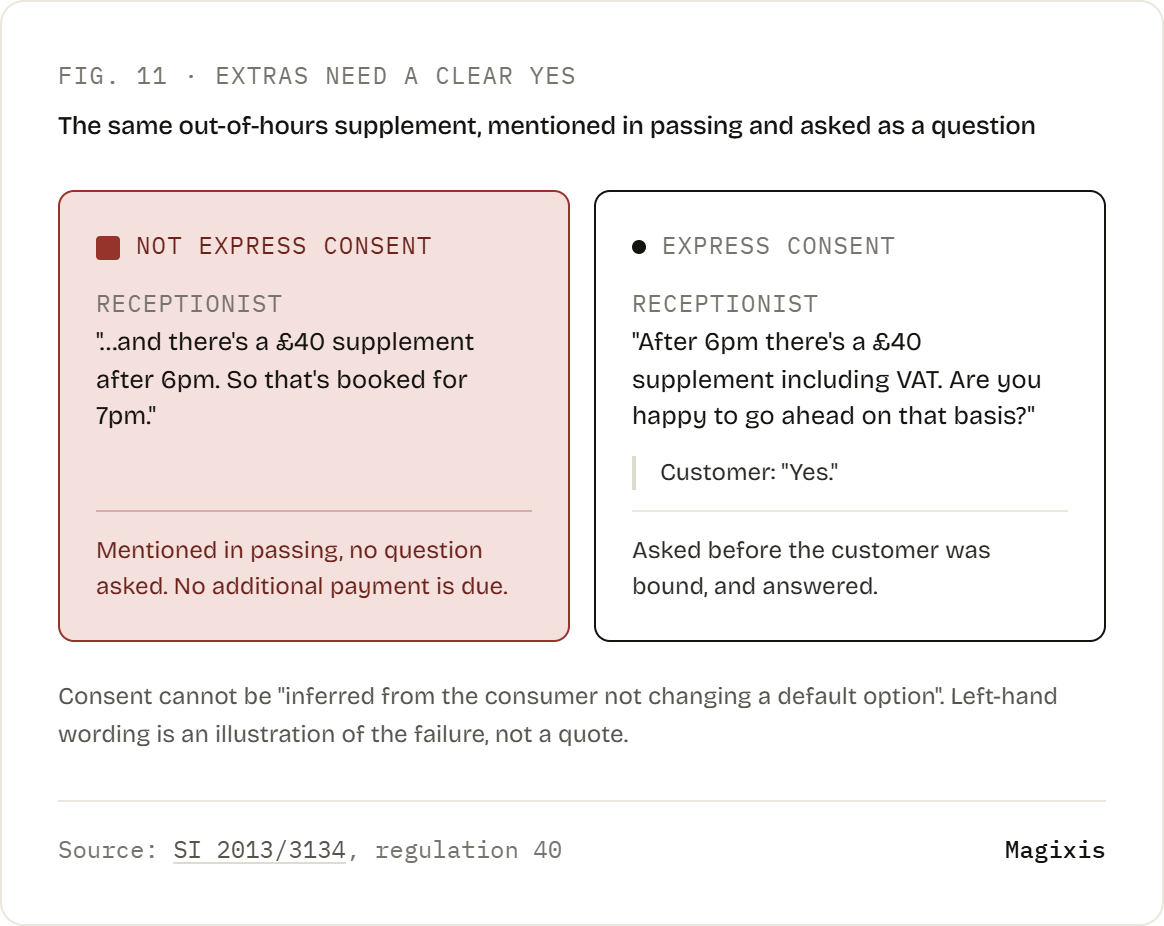
Extras need a clear yes. Regulation 40 says no additional payment is due unless "the trader obtained the consumer's express consent" before the customer was bound, and consent cannot be "inferred from the consumer not changing a default option". An out-of-hours supplement mentioned in passing, with no question asked, is not express consent.
Consent cannot be "inferred from the consumer not changing a default option". Left-hand wording is an illustration of the failure, not a quote.
A call script that stays on the right side of all three
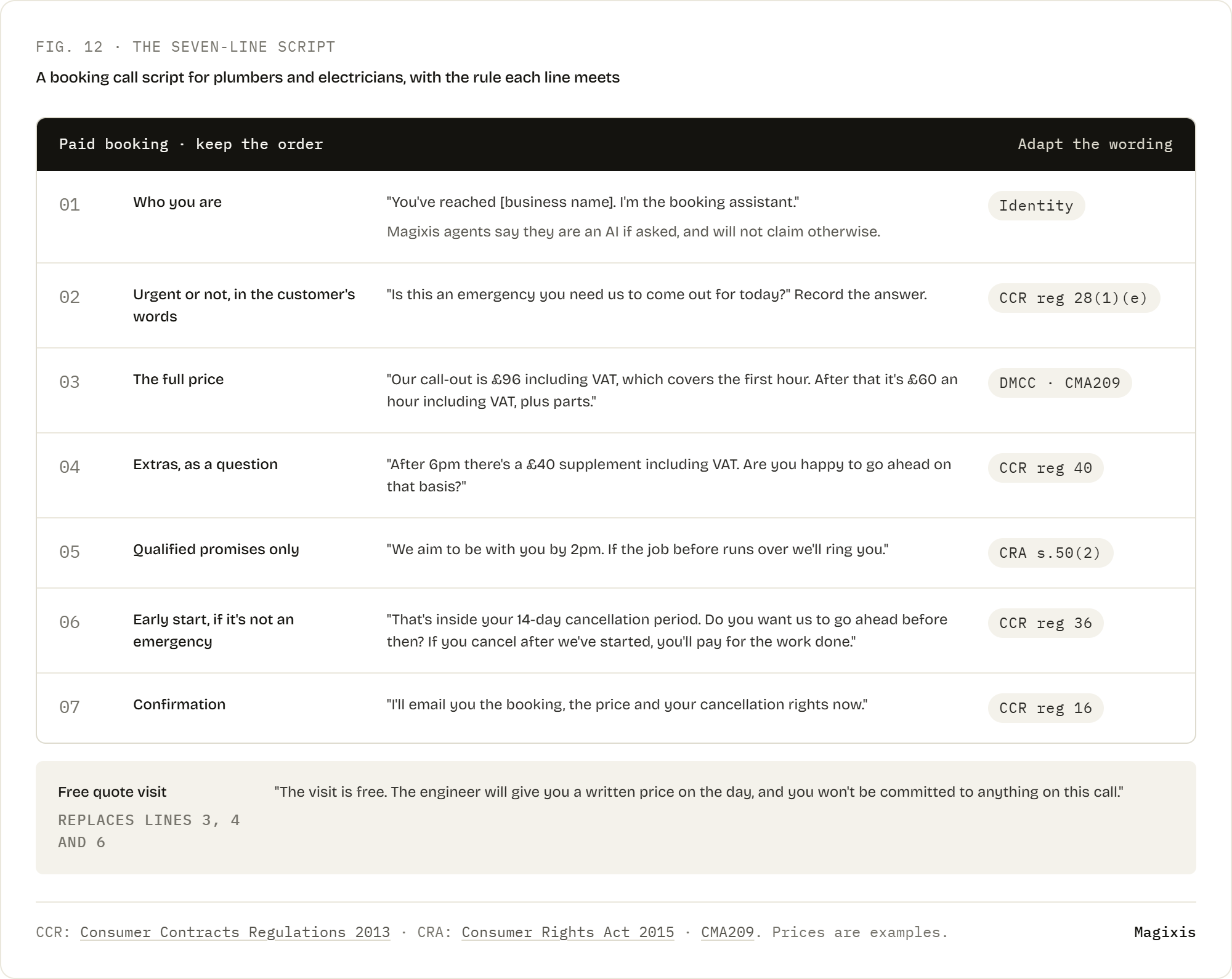
Seven lines cover most paid bookings. Adapt the wording; keep the order.
- 01Who you are"You've reached [business name]. I'm the booking assistant."Magixis agents say they are an AI if asked, and will not claim otherwise.Identity
- 02Urgent or not, in the customer's words"Is this an emergency you need us to come out for today?" Record the answer.CCR reg 28(1)(e)
- 03The full price"Our call-out is £96 including VAT, which covers the first hour. After that it's £60 an hour including VAT, plus parts."DMCC · CMA209
- 04Extras, as a question"After 6pm there's a £40 supplement including VAT. Are you happy to go ahead on that basis?"CCR reg 40
- 05Qualified promises only"We aim to be with you by 2pm. If the job before runs over we'll ring you."CRA s.50(2)
- 06Early start, if it's not an emergency"That's inside your 14-day cancellation period. Do you want us to go ahead before then? If you cancel after we've started, you'll pay for the work done."CCR reg 36
- 07Confirmation"I'll email you the booking, the price and your cancellation rights now."CCR reg 16
What to ask any AI receptionist for plumbers and electricians
- Can I see, word for word, what it says about price? Does the price include VAT and every mandatory fee?
- How does it decide something is an emergency, and does the customer's own request get recorded?
- Does it ask for an express request when the job falls inside the 14-day cancellation period?
- What confirmation does the customer get, by what medium, and does it include the cancellation information?
- Can I change the script myself, and is every call transcribed so I can prove what was said?
If a service can't answer the first question with the actual words, it is quoting prices on your behalf that you have never read.
Where Magixis sits
On a plumbing or electrical call, Magixis takes the caller's name, address and postcode, asks what is happening in plain terms (is water still running, has the stopcock been turned off), and books into your diary with a confirmation to the customer. Genuine emergencies go straight to your on-call engineer with the address. For gas or carbon monoxide alarms it gives no troubleshooting: it tells the caller to get everyone out, not to touch switches, and to ring the national gas emergency service. Quote requests become a booked survey, not a price.
Every call is transcribed, and on the Pro plan written into your CRM. That transcript is the record that settles a dispute about what was said. Whoever answers your phone, ask to read the price wording before it goes live, and check it against the script above. How it works for trades is on the plumbers and electricians pages, and what happens to the data is on our trust page.
Dates that will date this post
Consumer Contracts (Information, Cancellation and Additional Charges) Regulations made
Consumer Rights Act, sections 49 and 50 on services
DMCC Act consumer regime in force: CMA direct fines, drip pricing banned, fake reviews banned
CMA209 price transparency guidance published
CMA price transparency summary updated
The CMA's first enforcement decisions under the DMCC Act, particularly any on prices given by phone
Watch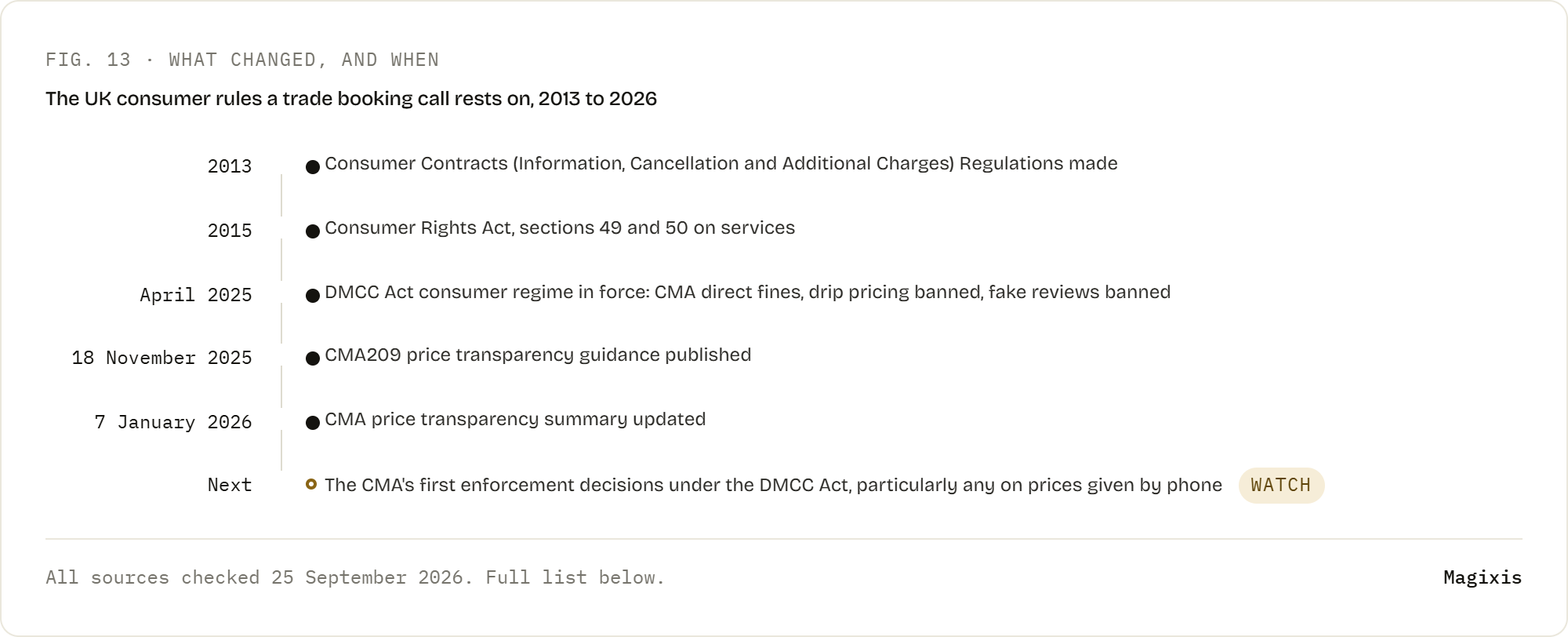
Every source in this post was checked on 25 September 2026. The CMA's first enforcement decisions under the DMCC Act are the most likely thing to change it, particularly if one deals with prices given by phone.
FAQ
Can a customer cancel a plumbing job booked over the phone?
Usually, yes. A job agreed by phone is normally a distance contract with a 14-day cancellation period. If the customer asked you to start within those 14 days and then cancels, they pay for what was supplied. If you never got that request, or never gave the cancellation information, they may pay nothing.
Do emergency call-outs have a 14-day cancellation right?
No, where the customer specifically requested a visit for urgent repairs or maintenance (regulation 28(1)(e)). The cancellation right still applies to any additional services, and to goods other than necessary replacement parts, supplied on the same visit.
Does a call-out fee have to include VAT?
The CMA's price transparency guidance says any prices offered to consumers must include VAT where applicable, and that the total price must include every fee the consumer will necessarily pay. Quote "£96 including VAT", not "£80 plus VAT".
Is what an AI receptionist says legally binding?
It can be. Section 50 of the Consumer Rights Act 2015 makes anything said to the consumer "by or on behalf of the trader" about the trader or the service a contract term if the consumer relied on it. That includes an AI agent answering your phone.
Can the booking confirmation be sent by text?
Email is named as a durable medium in the Regulations, so it is the safer choice. A text the customer can keep is arguably covered by "any other medium" that is addressed to them personally and can be stored, but it is not named.
Does this apply to sole traders?
Yes. The Regulations apply to any "trader" dealing with a consumer, whatever the size of the business. They do not apply to jobs for other businesses, such as a letting agent or a commercial client.
- Consumer Contracts (Information, Cancellation and Additional Charges) Regulations 2013 (SI 2013/3134)
- Consumer Rights Act 2015, section 50
- Consumer Rights Act 2015, section 49
- CMA, Price transparency guidance (CMA209), 18 November 2025
- CMA, Providing clear and accurate information about prices: summary, updated 7 January 2026
- CMA, New consumer protection regime comes into force, 7 April 2025
- Business Companion, Distance sales
- Fix Radio, 34% of tradespeople lose work by not answering phone, 3 October 2022
- HomeServe, Ghosted by tradespeople, 30 March 2023
- Department for Business and Trade, Business population estimates 2025, 2 October 2025