

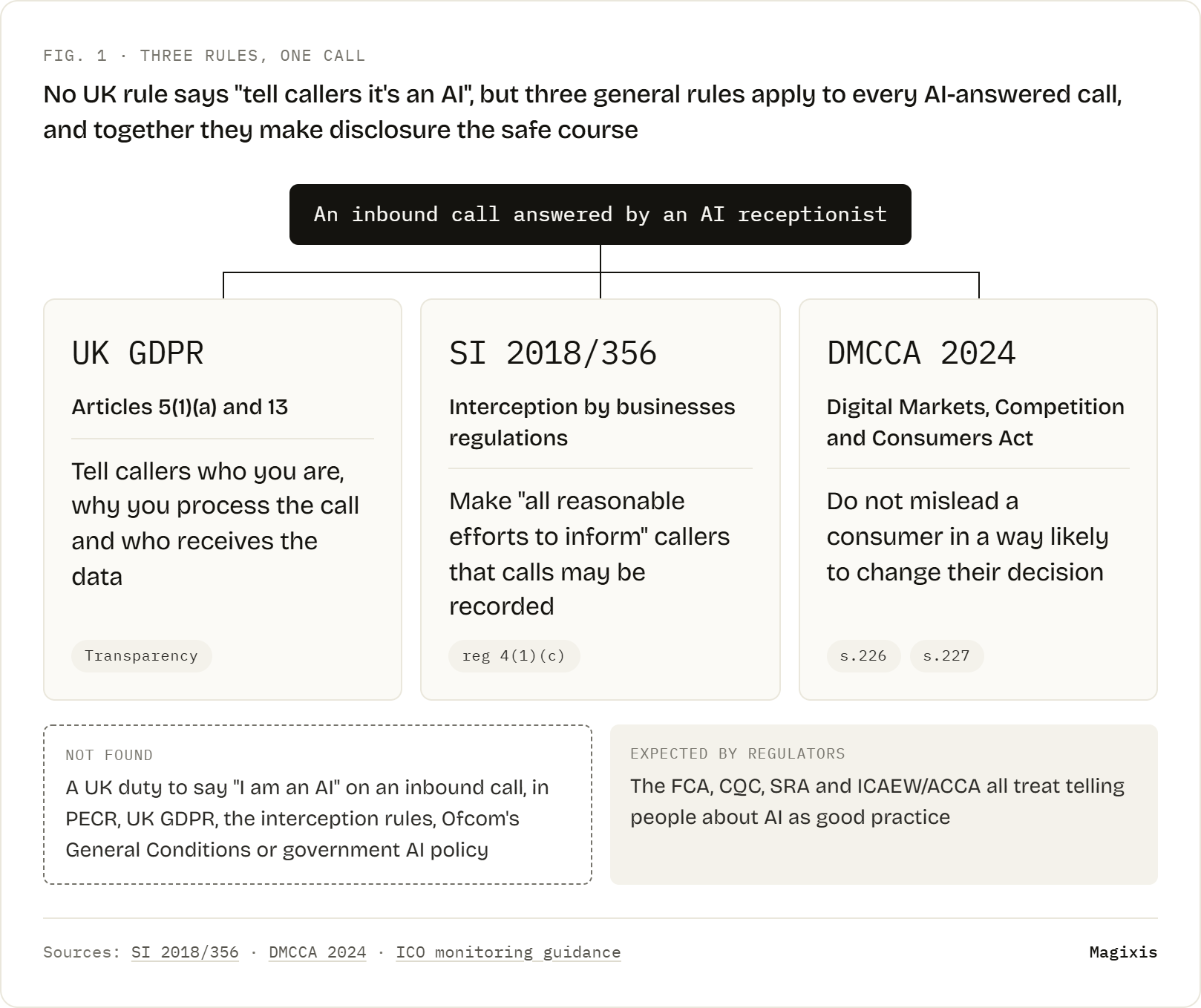
Not in those words. We found no UK statute, regulation or regulator rule that requires a business to tell an inbound caller they are speaking to an AI. Three sets of rules still point the same way. UK GDPR requires clear information about how a caller's voice and words are used. The 2018 interception regulations require you to make all reasonable efforts to tell callers a call may be recorded. Consumer law bars misleading practices. Add the FCA, CQC and SRA, who all expect firms to be open about AI, and saying so at the start of every call is the only safe course.
This guide is for UK businesses that answer their phones with an AI receptionist or voice agent, or are deciding whether to: clinics, law firms, accountants, trades and anyone else whose customers ring in. Magixis builds AI receptionists, so we have a stake in this, and every rule below is linked to its source.
This covers inbound calls to UK businesses. It is a plain-English reading of legislation and regulator guidance as at 4 November 2026, not legal advice. Where a point needs a solicitor, we say so.
- No UK rule says "tell callers it's an AI" in those words. We checked PECR, UK GDPR, the interception regulations, Ofcom's General Conditions and the government's AI position.
- You must tell callers about recording. Regulation 4(1)(c) of SI 2018/356 requires all reasonable efforts to inform them. It asks you to inform callers, and it does not require their consent.
- Passing an AI off as a person is risky. It is hard to square with UK GDPR fairness, and could be a misleading action under the DMCCA 2024 if it changes a consumer's decision.
- Sector regulators expect disclosure. The FCA, CQC, SRA and ICAEW/ACCA all treat telling people about AI as good practice, and the FCA and CQC also want a route that avoids the AI.
- EU callers are different. Article 50(1) of the EU AI Act has applied since 2 August 2026 and requires AI systems that talk to people to tell them they are AI.
What does UK law require on an inbound AI call?
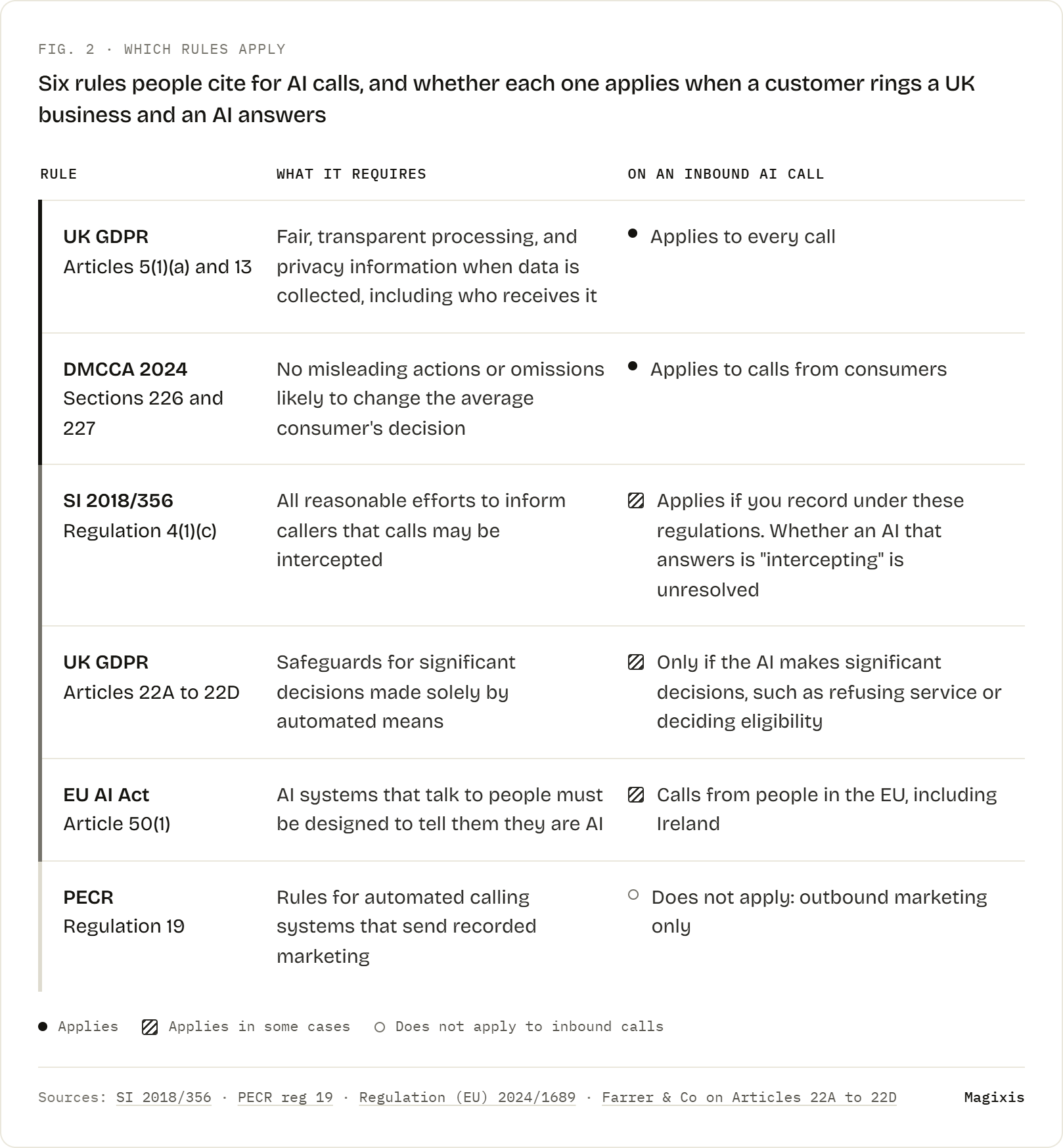
Three duties apply to an inbound call answered by AI, and none of them mentions AI. Two more apply only in narrow cases, and one rule that vendors quote often does not apply to inbound calls at all.
| Rule | What it requires | On an inbound AI call |
|---|---|---|
| UK GDPR Articles 5(1)(a) and 13 |
Fair, transparent processing, and privacy information when data is collected, including who receives it | Applies to every call |
| DMCCA 2024 Sections 226 and 227 |
No misleading actions or omissions likely to change the average consumer's decision | Applies to calls from consumers |
| SI 2018/356 Regulation 4(1)(c) |
All reasonable efforts to inform callers that calls may be intercepted | Applies if you record under these regulations. Whether an AI that answers is "intercepting" is unresolved |
| UK GDPR Articles 22A to 22D |
Safeguards for significant decisions made solely by automated means | Only if the AI makes significant decisions, such as refusing service or deciding eligibility |
| EU AI Act Article 50(1) |
AI systems that talk to people must be designed to tell them they are AI | Calls from people in the EU, including Ireland |
| PECR Regulation 19 |
Rules for automated calling systems that send recorded marketing | Does not apply: outbound marketing only |
Data protection: telling people how their call is used
UK GDPR requires processing to be fair and transparent (Article 5(1)(a)) and requires privacy information when data is collected from the person (Article 13): who you are, why you are processing the call, on what lawful basis, and who receives the data. An AI provider that processes the call is one of those recipients. Article 13 does not say "disclose AI". Letting a caller believe they are talking to a person is still hard to reconcile with the transparency principle.
Automated decisions have their own rules. Since 5 February 2026, Articles 22A to 22D have replaced Article 22, under the Data (Use and Access) Act 2025. Their safeguards apply only to significant decisions based solely on automated processing, meaning decisions with a legal or similarly significant effect. An AI receptionist that takes messages or books appointments is unlikely to be making one. An AI that refuses service, judges urgency or decides eligibility might be, and that is a question for a solicitor.
Call recording: inform, not consent
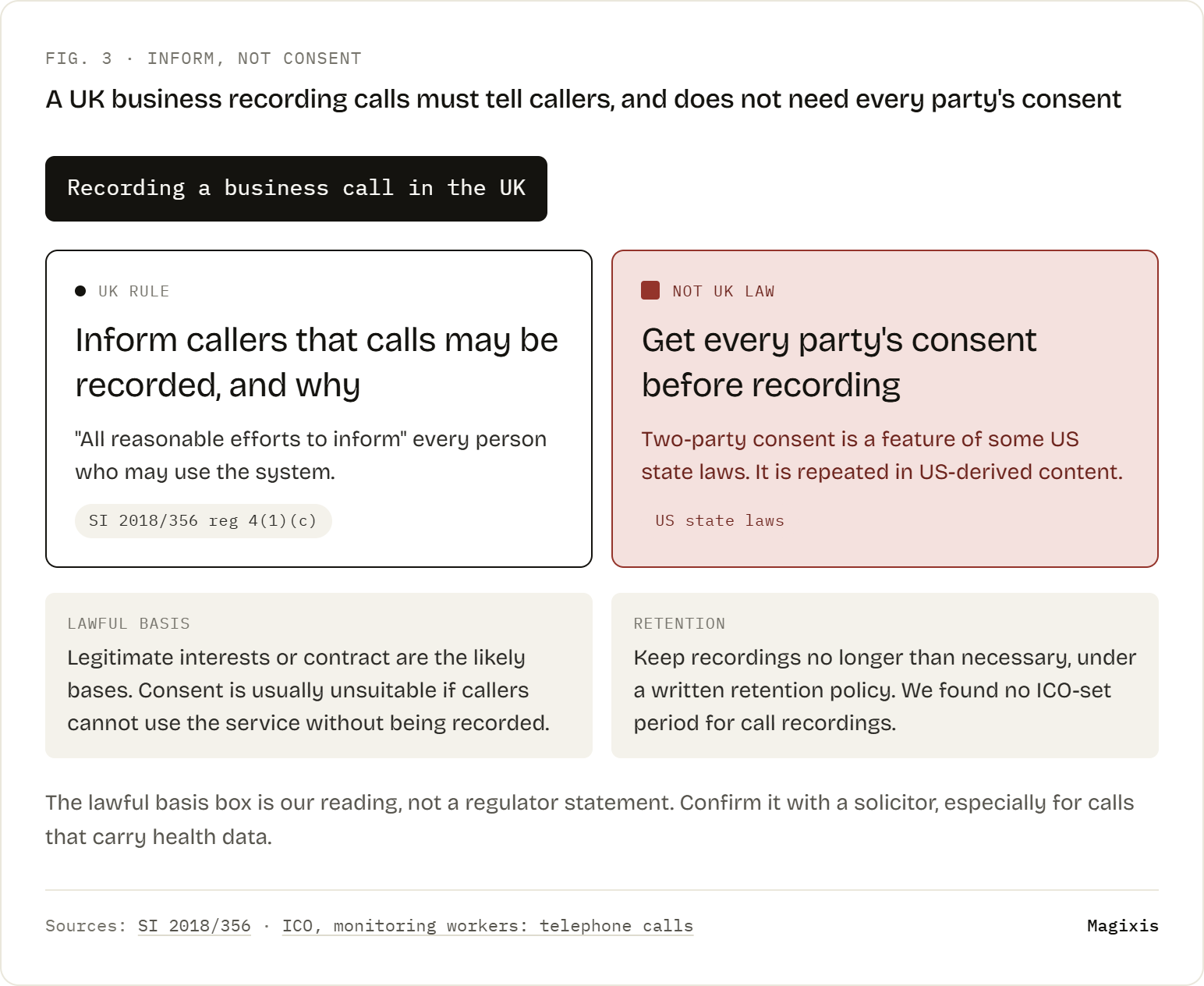
If you record calls and rely on the 2018 business monitoring regulations, regulation 4(1)(c) requires you to have made "all reasonable efforts to inform every person who may use the telecommunication system" that their communications may be intercepted. The duty is to tell callers, and it does not require their consent. The ICO's guidance on monitoring says callers should be told a call may be recorded "and to explain the reason why", and signposted to fuller privacy information.
One question no source answers: when the AI is itself the party answering on your behalf, is it "intercepting" at all? A solicitor should confirm whether the Investigatory Powers Act 2016 framework is engaged, or whether UK GDPR alone governs recording and transcription. Either way, the practical answer is to tell callers.
The lawful basis box is our reading, not a regulator statement. Confirm it with a solicitor, especially for calls that carry health data.
Consumer law: don't mislead
Part 4, Chapter 1 of the Digital Markets, Competition and Consumers Act 2024 prohibits misleading actions (section 226) and misleading omissions (section 227) that are likely to make the average consumer take a different transactional decision. It replaced the Consumer Protection from Unfair Trading Regulations 2008 from 6 April 2025, and it has no AI-specific provision. An AI that claims or implies it is human, where that affects whether a caller books, buys or goes elsewhere, could be a misleading action.
Which vendor claims about AI disclosure are wrong?
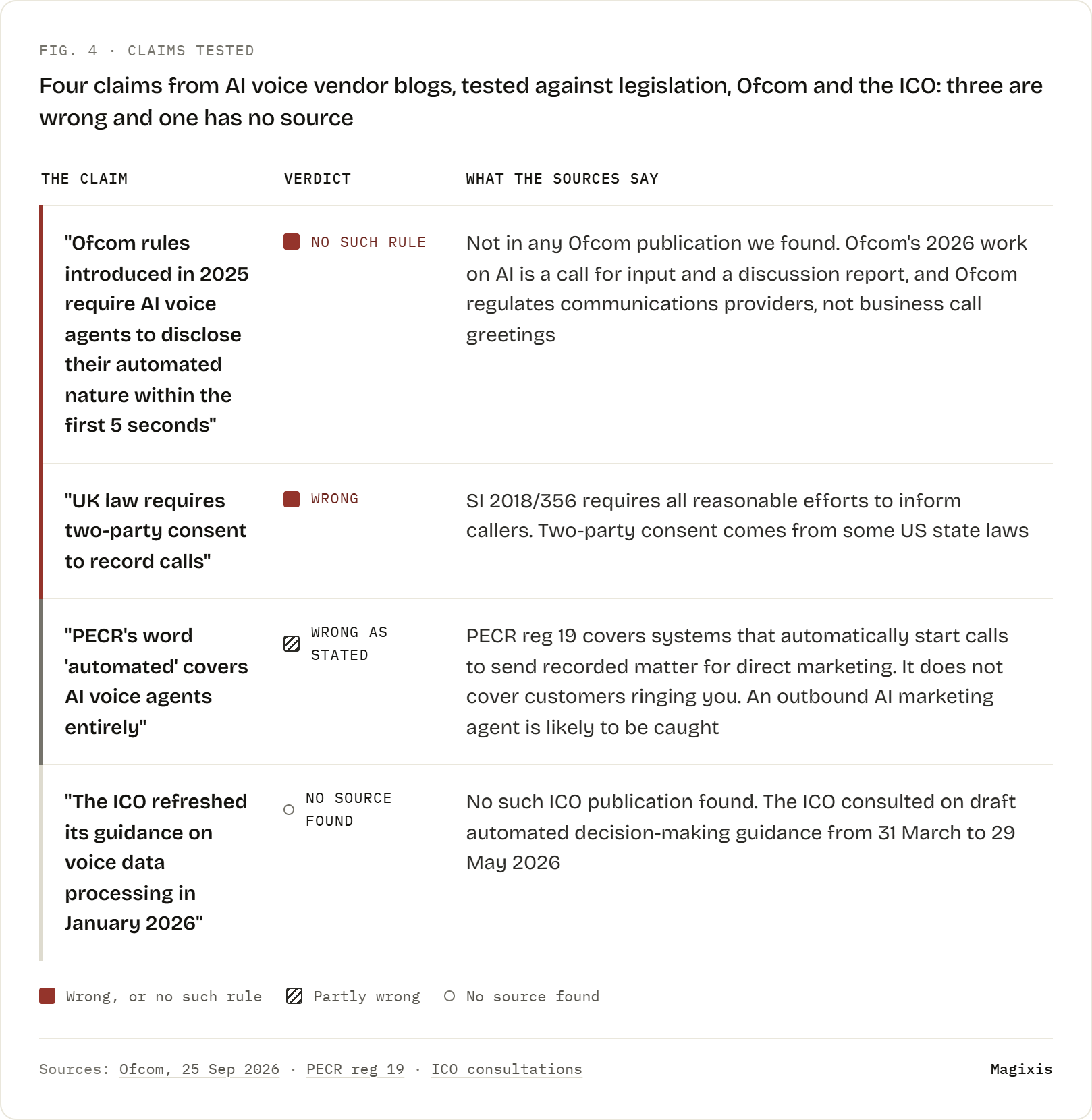
Several AI voice vendors publish compliance claims that the primary sources do not support. These four come up most often.
| The claim | Verdict | What the sources say |
|---|---|---|
| "Ofcom rules introduced in 2025 require AI voice agents to disclose their automated nature within the first 5 seconds" | No such rule | Not in any Ofcom publication we found. Ofcom's 2026 work on AI is a call for input and a discussion report, and Ofcom regulates communications providers, not business call greetings |
| "UK law requires two-party consent to record calls" | Wrong | SI 2018/356 requires all reasonable efforts to inform callers. Two-party consent comes from some US state laws |
| "PECR's word 'automated' covers AI voice agents entirely" | Wrong as stated | PECR reg 19 covers systems that automatically start calls to send recorded matter for direct marketing. It does not cover customers ringing you. An outbound AI marketing agent is likely to be caught |
| "The ICO refreshed its guidance on voice data processing in January 2026" | No source found | No such ICO publication found. The ICO consulted on draft automated decision-making guidance from 31 March to 29 May 2026 |
The Ofcom claim is the one most often repeated. Ofcom's 25 September 2026 press release says it "should be very clear to telecoms customers when they are interacting with a GenAI application". That sentence is about telecoms companies' own customer service. It does not set a rule for a clinic, salon or law firm, and it contains no five-second limit.
Has anyone been fined over AI voice calls?
Not for answering inbound calls. We found no ICO or Ofcom enforcement against a business for recording calls or for using AI to answer them. The nearest cases are outbound marketing.
On 25 September 2025 the ICO fined Home Improvement Marketing Ltd £300,000 and Green Spark Energy Ltd £250,000 for unlawful automated marketing calls under PECR regulation 19. Both used "avatar software" that gave people the impression they were talking to "Jo, Helen or Ian" from the UK, when the calls were recorded scripts played by agents abroad. Green Spark made 9.5 million automated calls. In 2026 the ICO fined TMAC, a pendant alarm company, £100,000 and Thermotech Wall and Loft Surveys Ltd £240,000 for unsolicited marketing calls under regulations 21 and 24.
All four cases concern outbound marketing. The Thermotech notice also refers to complaints about automated voices; check the notice for the exact contraventions.
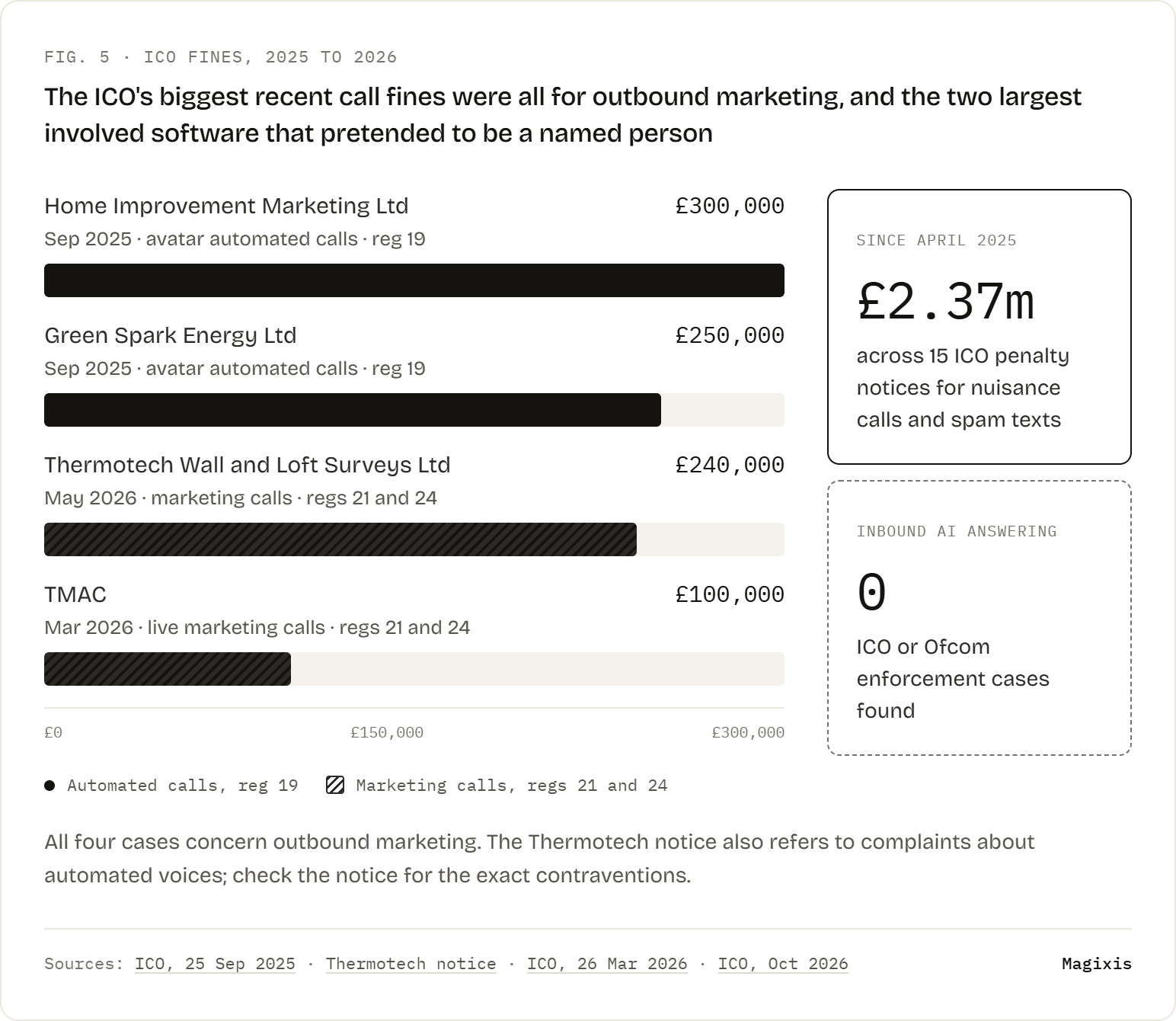
In October 2026 the ICO said complaints about automated nuisance calls had reached their highest level since 2021. The avatar cases are marketing law, but they show how the ICO reads a voice built to pass as a named person.
When does call data get more sensitive?
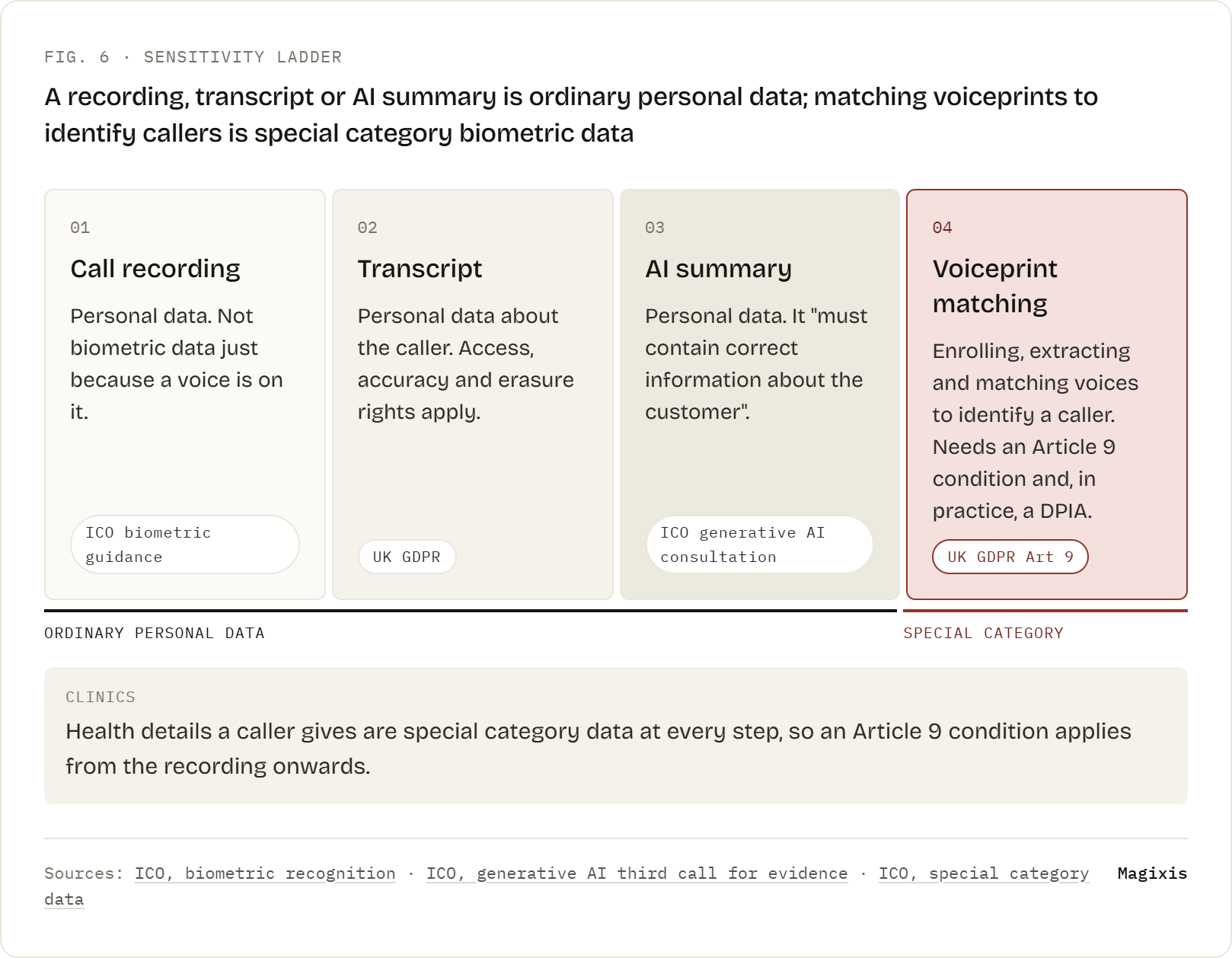
Recording, transcribing and summarising a call is ordinary personal data processing. Using voiceprints to recognise callers moves it into special category data.
The ICO's biometric recognition guidance says that an audio recording from which a person could be identified "doesn't make the audio recording biometric data". It becomes biometric data once a system enrols speakers, extracts features and matches them, and special category biometric data where the purpose is to identify someone uniquely. That needs an Article 9 condition and, in practice, a data protection impact assessment (DPIA).
Transcripts and summaries are still personal data about the caller. In its generative AI consultation, the ICO uses a customer summary as its example and says the output "must contain correct information about the customer". Accuracy, access and erasure rights apply to them as they do to the recording. Clinics carry an extra layer: health information a caller mentions is special category data, which needs an Article 9 condition, and a DPIA is likely for AI processing of it.
Who is responsible: you or your AI provider?
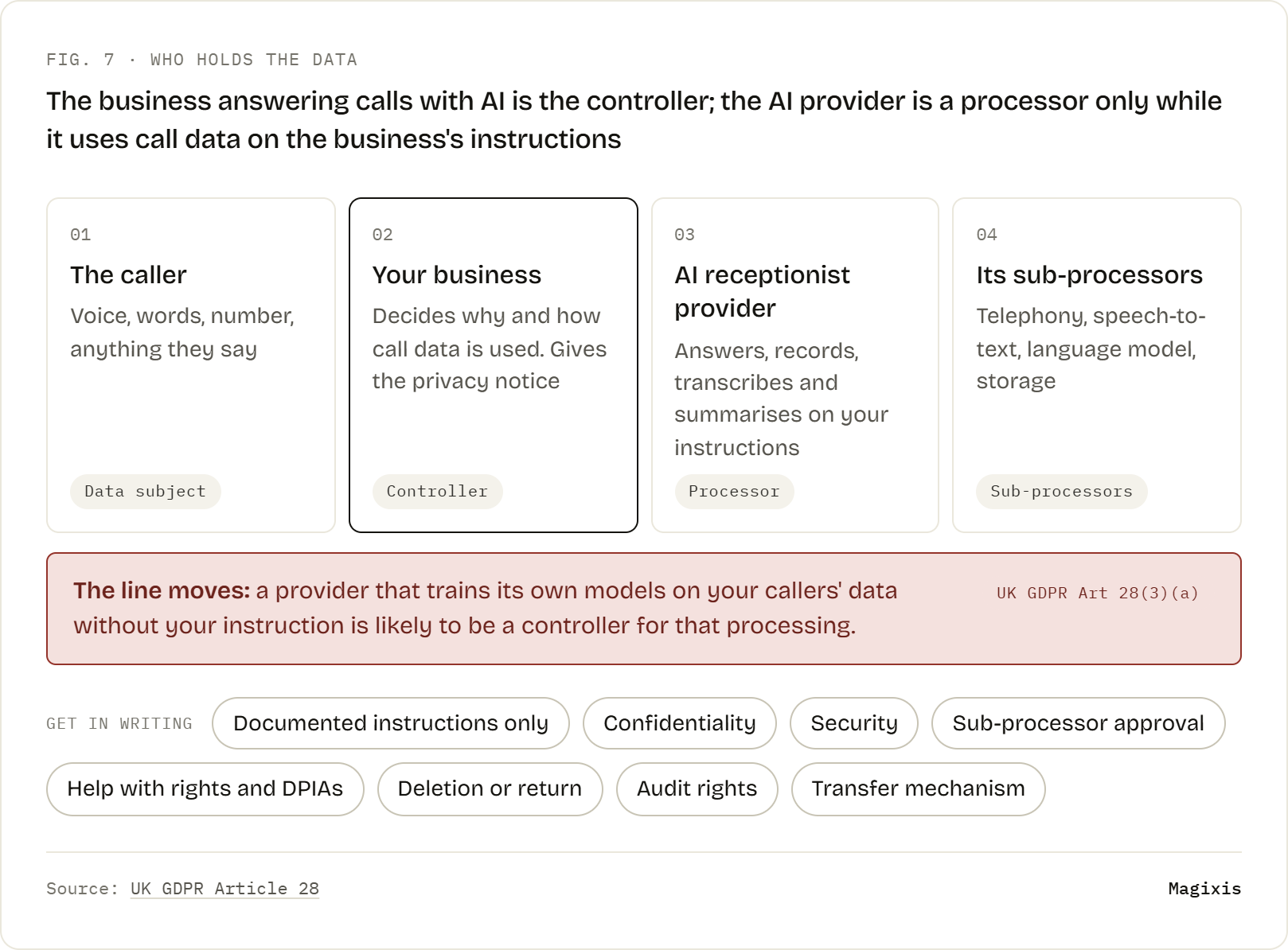
You are, normally. The business that decides why and how call data is used is the controller. An AI receptionist provider that acts only on its instructions is a processor, and the relationship needs a contract under UK GDPR Article 28. That contract has to cover processing only on your documented instructions, confidentiality, security, approval of sub-processors, help with data subject rights and DPIAs, deletion or return of data at the end, and audit rights.
The line moves if the provider uses your callers' data for its own purposes. A provider that trains its general models on customer calls without your instruction is acting outside a processor's role, and is likely to be a controller for that processing. Ask, and get the answer in the contract.
If call data leaves the UK, the transfer needs a mechanism: adequacy regulations (including the UK-US data bridge for certified US organisations), the ICO's International Data Transfer Agreement, or the UK Addendum to the EU standard contractual clauses.
What do regulators in your sector say?
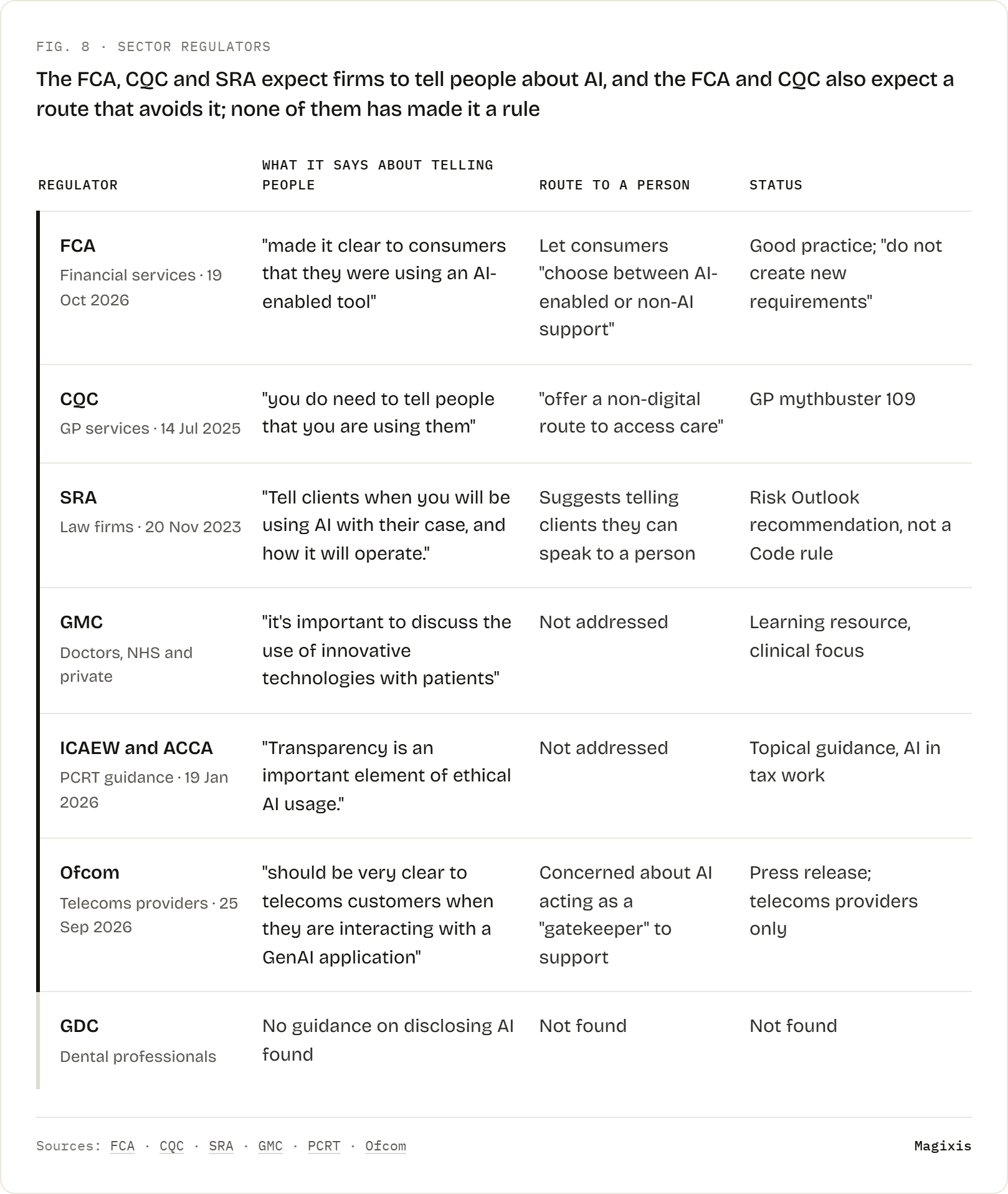
Sector regulators go further than the law. None of them creates a new rule here, but each expects the firms it oversees to be open about AI, and the FCA and CQC both want a route that avoids it.
FCA-regulated firms have the clearest statement. The FCA's October 2026 good and poor practice review lists as good practice firms that "made it clear to consumers that they were using an AI-enabled tool", and as poor practice firms "unclear about whether AI or a person performed a particular function". It wants consumers able to "choose between AI-enabled or non-AI support". The FCA says its examples "do not create new requirements"; they illustrate the Consumer Duty.
For GP practices, CQC's GP mythbuster 109 says "you do need to tell people that you are using them" and that practices must "offer a non-digital route to access care". It covers digital front doors and chatbots. The GMC says "it's important to discuss the use of innovative technologies with patients", with a focus on clinical use. We found no GDC guidance on disclosing AI, and nothing from NHS England on AI answering calls.
For law firms, the SRA's 2023 Risk Outlook recommends: "Tell clients when you will be using AI with their case, and how it will operate." It is a recommendation, not a Code rule. For accountants, the January 2026 PCRT guidance says "Transparency is an important element of ethical AI usage" and links disclosure to not misleading a client by omission, though it covers AI in tax work rather than call answering.
| Regulator | What it says about telling people | Route to a person | Status |
|---|---|---|---|
| FCAFinancial services · 19 Oct 2026 | "made it clear to consumers that they were using an AI-enabled tool" | Let consumers "choose between AI-enabled or non-AI support" | Good practice; "do not create new requirements" |
| CQCGP services · 14 Jul 2025 | "you do need to tell people that you are using them" | "offer a non-digital route to access care" | GP mythbuster 109 |
| SRALaw firms · 20 Nov 2023 | "Tell clients when you will be using AI with their case, and how it will operate." | Suggests telling clients they can speak to a person | Risk Outlook recommendation, not a Code rule |
| GMCDoctors, NHS and private | "it's important to discuss the use of innovative technologies with patients" | Not addressed | Learning resource, clinical focus |
| ICAEW and ACCAPCRT guidance · 19 Jan 2026 | "Transparency is an important element of ethical AI usage." | Not addressed | Topical guidance, AI in tax work |
| OfcomTelecoms providers · 25 Sep 2026 | "should be very clear to telecoms customers when they are interacting with a GenAI application" | Concerned about AI acting as a "gatekeeper" to support | Press release; telecoms providers only |
| GDCDental professionals | No guidance on disclosing AI found | Not found | Not found |
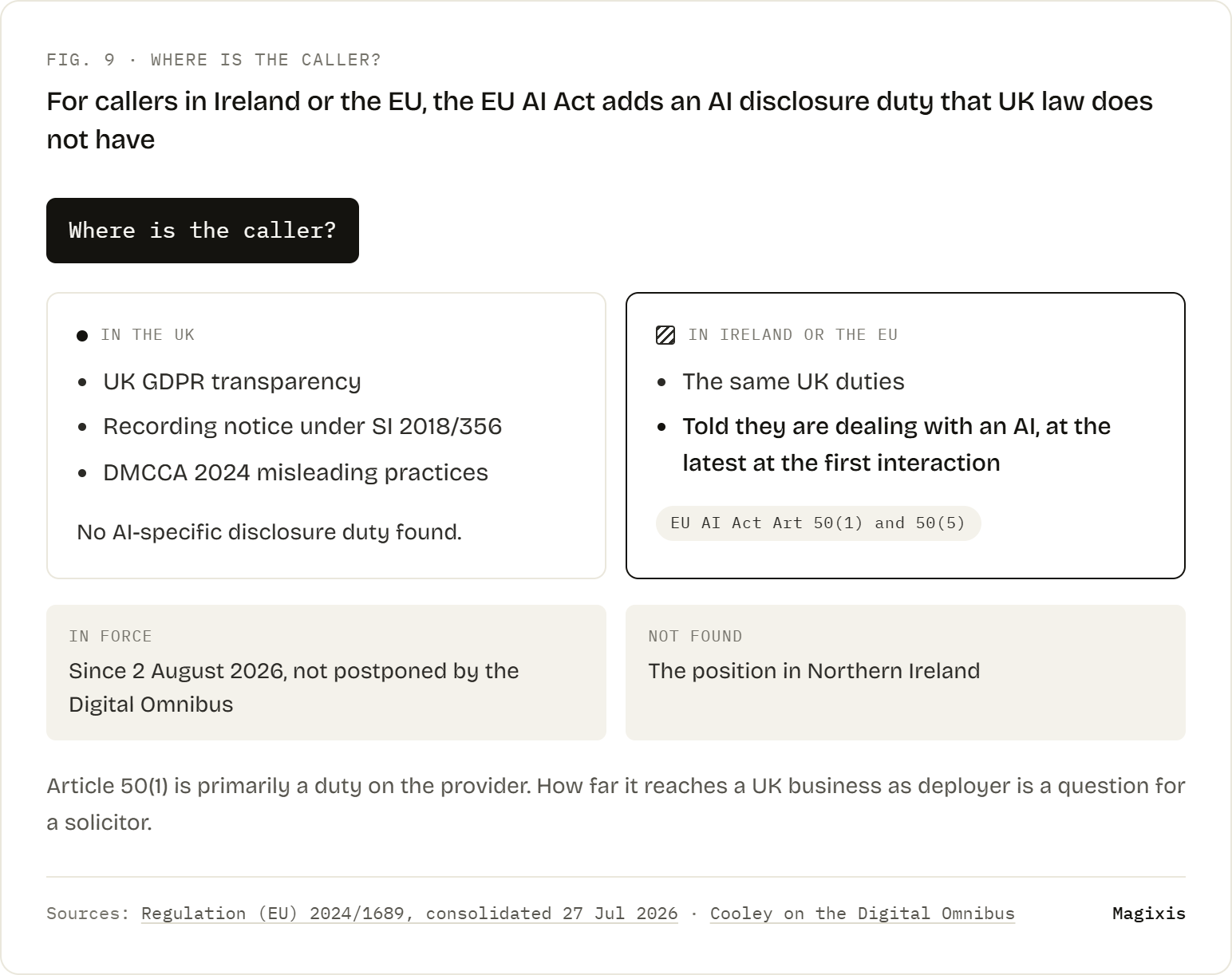
Do callers in Ireland or the EU change anything?
They can. Article 50(1) of the EU AI Act requires providers to ensure that AI systems "intended to interact directly with natural persons" are designed so that people are told they are dealing with AI, unless that is obvious. The information has to be given at the latest at the first interaction. Article 50 has applied since 2 August 2026, and the Digital Omnibus on AI did not postpone Article 50(1).
Article 50(1) is a duty on the provider, the company that builds the system. The Act also reaches providers and deployers outside the EU where the system's output is used in the EU. A UK clinic whose AI answers calls from patients in Ireland should assume disclosure is expected on those calls, and check its provider builds it in. A UK business with UK callers is not caught just because the Act exists. We found no source on the position in Northern Ireland.
- UK GDPR transparency
- Recording notice under SI 2018/356
- DMCCA 2024 misleading practices
- The same UK duties
- Told they are dealing with an AI, at the latest at the first interaction
Article 50(1) is primarily a duty on the provider. How far it reaches a UK business as deployer is a question for a solicitor.
What should a good AI call opening say?
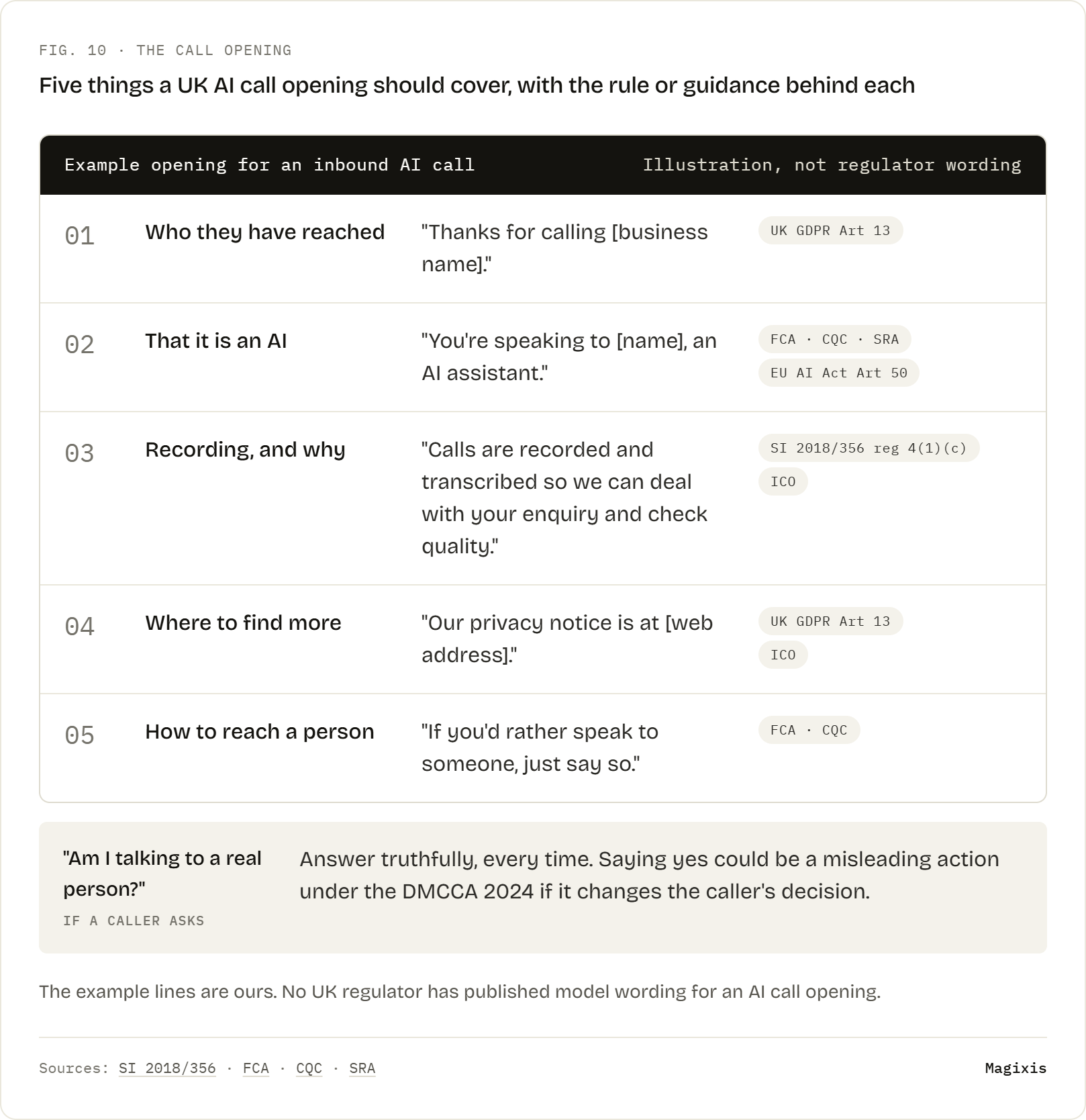
No UK regulator has published model wording. Putting the sources together, an opening should cover five things in its first few sentences: who the caller has reached, that they are speaking to an AI, that the call is recorded and why, where the privacy notice is, and how to reach a person.
- 01Who they have reached"Thanks for calling [business name]."UK GDPR Art 13
- 02That it is an AI"You're speaking to [name], an AI assistant."FCA · CQC · SRAEU AI Act Art 50
- 03Recording, and why"Calls are recorded and transcribed so we can deal with your enquiry and check quality."SI 2018/356 reg 4(1)(c)ICO
- 04Where to find more"Our privacy notice is at [web address]."UK GDPR Art 13ICO
- 05How to reach a person"If you'd rather speak to someone, just say so."FCA · CQC
The example lines are ours. No UK regulator has published model wording for an AI call opening.
Questions to put to your solicitor
- Does any UK law, including the DMCCA 2024 and UK GDPR fairness, create a de facto duty to disclose AI on inbound calls? How far could presenting an AI as a person be a misleading action under section 226?
- When an AI itself answers and records the call, is that "interception" under the Investigatory Powers Act 2016, or does UK GDPR alone govern it?
- Is legitimate interests or contract, with clear notice and no consent, a sound lawful basis for recording, transcribing and summarising our calls? If callers give us health data, which Article 9 condition applies?
- Could anything our AI does, such as refusing appointments or judging urgency, count as a "significant decision" under Articles 22A to 22D?
- If we take calls from people in Ireland or the EU, does Article 50 of the EU AI Act reach us or our provider, and what is the position in Northern Ireland?
- If our provider uses call data to train its models, does it become a controller, and what must our Article 28 contract say to prevent or govern that?
Where Magixis sits
Magixis builds AI receptionists for UK businesses, so these rules apply to every call we answer for a client. Our agents name themselves at the start of each call, give a recording notice with another way to get in touch, and answer truthfully if a caller asks whether they are a person. Recordings are kept for 30 days and transcripts for 90 days by default, and a data processing agreement is signed with every client.
Our sub-processors, data residency and EU AI Act position are on the trust page. How the agent answers your existing number is on how it works, and prices are on the pricing page.
Dates that will date this post
ICO fines two firms £550,000 in total for avatar-based automated marketing calls
PCRT topical guidance on ethical AI use (ICAEW, ACCA and other bodies)
Ofcom call for input on AI in telecoms
Articles 22A to 22D replace Article 22 of UK GDPR (reported)
ICO consults on draft automated decision-making guidance
Regulations requiring an ICO code of practice on AI and automated decision-making in force (reported)
EU AI Act Article 50 transparency duties apply
Ofcom report and press release on AI in telecoms
FCA publishes AI good and poor practice for financial services
EU AI Act Article 50(2) marking transition ends for systems already on the market (reported)
WatchFinal ICO guidance on automated decision-making
WatchICO statutory code on AI and automated decision-making: consultation expected 2027 (reported)
Watch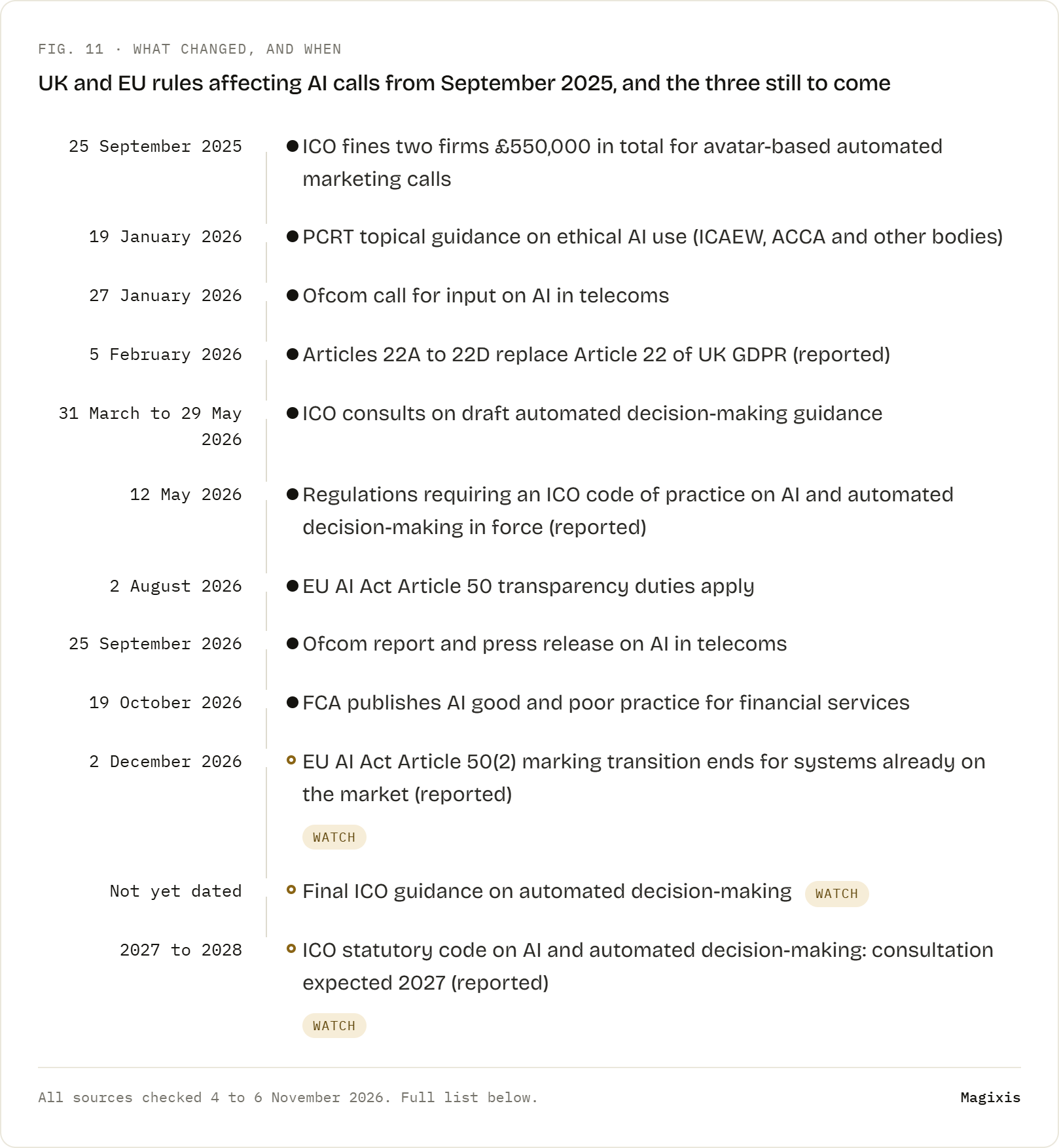
Every source in this post was checked between 4 and 6 November 2026. The things most likely to change it are the ICO's final automated decision-making guidance and its statutory code on AI, either of which could set out what good practice on an AI call looks like.
FAQ
Is it illegal to use an AI receptionist without telling callers?
We found no UK law that makes it illegal in those words. UK GDPR transparency, the recording notice under SI 2018/356 and consumer law on misleading practices all point towards telling callers, and FCA, CQC and SRA guidance expects it.
Do I need consent to record business calls in the UK?
No. A business relying on SI 2018/356 must make all reasonable efforts to inform callers that calls may be recorded. Legitimate interests or contract are the usual lawful bases under UK GDPR, with a clear notice. Two-party consent is a US idea.
Is there an Ofcom rule that an AI must identify itself within five seconds?
Not in any Ofcom publication we found. Ofcom regulates communications providers, and its 2026 work on AI is a call for input and a discussion report. Its press release asks telecoms providers to make it very clear when customers are talking to AI.
Are call transcripts and AI summaries personal data?
Yes, where they are about an identifiable caller. The ICO says an AI summary of a customer must contain correct information about them, so accuracy, access and erasure rights apply as they do to the recording.
Is a call recording biometric data?
Not on its own. The ICO says an audio recording is not biometric data just because someone could be identified from it. Matching voiceprints to recognise or verify callers is special category biometric data and needs an Article 9 condition.
Does the EU AI Act apply to my UK business's AI calls?
Possibly, if your AI talks to people in the EU, for example patients in Ireland. Article 50(1) has applied since 2 August 2026 and requires people to be told they are dealing with AI. If you take EU calls, ask a solicitor and check your provider builds the disclosure in.
- legislation.gov.uk, PECR 2003, regulation 19
- legislation.gov.uk, SI 2018/356, interception by businesses regulations
- Home Office, Explanatory Memorandum to SI 2018/356
- legislation.gov.uk, Digital Markets, Competition and Consumers Act 2024
- legislation.gov.uk, UK GDPR Article 28
- CMA, Unfair commercial practices technical note, 4 April 2025
- ICO, Monitoring workers: telephone calls
- ICO, Biometric recognition
- ICO, What is special category data?
- ICO, Generative AI third call for evidence
- ICO, Consultations
- ICO, Robo-call fines, 25 September 2025
- ICO, TMAC fine, 26 March 2026
- ICO, Thermotech monetary penalty notice, 28 May 2026
- ICO, Automated nuisance call complaints at five-year high, October 2026
- Ofcom, Call for input on AI in telecoms, 27 January 2026
- Ofcom, Consumers using AI, human contact still valued, 25 September 2026
- FCA, AI in financial services: good practice, 19 October 2026
- CQC, GP mythbuster 109, 14 July 2025
- SRA, Risk Outlook: AI in the legal market, 20 November 2023
- GMC, AI and innovative technologies
- ACCA and ICAEW, PCRT topical guidance on AI, 19 January 2026
- EUR-Lex, Regulation (EU) 2024/1689, consolidated, 27 July 2026
- House of Lords Library, AI regulation in the UK, 20 May 2026
- Farrer & Co, Data (Use and Access) Act 2025: five key changes
- Bratby Law, DUAA commencement
- Cooley, Digital AI Omnibus