

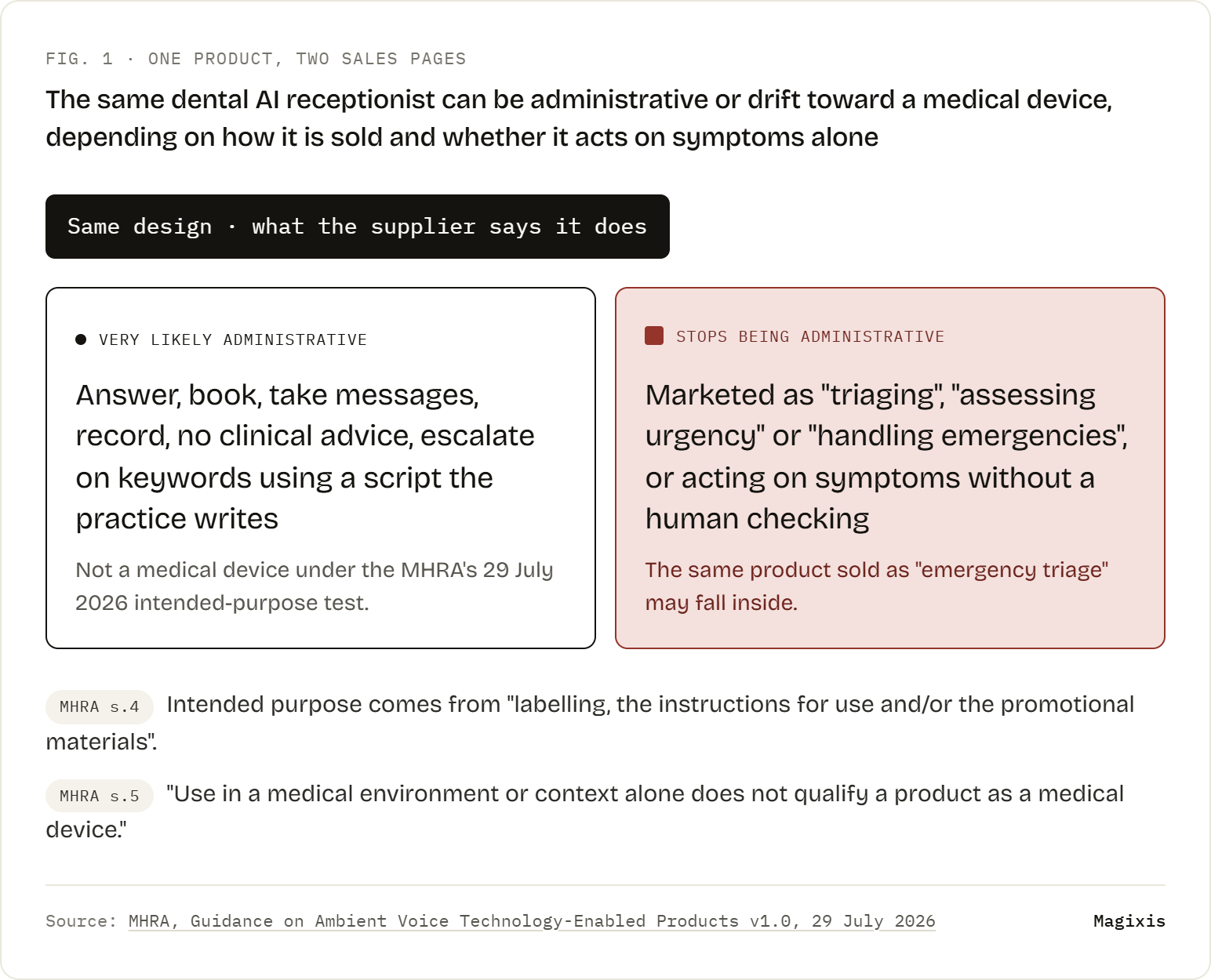
The design under test (answer, book, take messages, record, no clinical advice, escalate on keywords using a script the practice writes) is very likely administrative and not a medical device under the MHRA's 29 July 2026 intended-purpose test. It stops being administrative if the supplier markets it as "triaging", "assessing urgency" or "handling emergencies", or if it acts on symptoms without a human checking.
No UK regulator has published guidance that deals specifically with AI telephone reception. Every conclusion below is reached by analogy from scribe guidance, CQC GP guidance and general law.
England-first, status at 5 November 2026. This post summarises published guidance and law. It is not legal advice.
- Device line: MHRA says intended purpose comes from "labelling, the instructions for use and/or the promotional materials". Use in a medical setting "alone does not qualify a product as a medical device". Taking automated clinical action "without clinician review" is the example that makes a product a device. A keyword-escalation receptionist sold as admin probably falls outside. The same product sold as "emergency triage" may fall inside.
- Accountability does not move: taking calls and booking are not CQC regulated activities in themselves. The supplier does not register. The registered dental provider stays liable under Regulations 12 and 17. GDC Standard 6.3.1 says you "can delegate the responsibility for a task but not the accountability", and GDC 4.2.9 says "You must not make any recordings or images without the patient's permission".
- Data and disclosure: a caller describing toothache is giving health data (special category). The practice is controller and the supplier is normally processor. A DPIA is in practice required. No UK statute requiring "you are speaking to an AI" was found. CQC GP mythbuster 109 says "you do need to tell people that you are using them". The ICO's post-DUAA ADM guidance was a draft (31 March 2026). This report could not confirm whether a final version has been published (UNVERIFIED).
The ten-line summary
- The device test is intended purpose, and marketing counts. MHRA AVT guidance s.4 defines intended purpose by "labelling, the instructions for use and/or the promotional materials". Disclaimers fail "if medical claims are made or implied elsewhere". (PRIMARY: MHRA AVT guidance v1.0, 29 Jul 2026)
- Use in a clinic does not make something a device. s.5: "Use in a medical environment or context alone does not qualify a product as a medical device." (PRIMARY: MHRA)
- Automated clinical action without review makes it a device. Example 8 is a device because it acts "without required review by a clinical professional". (PRIMARY: MHRA)
- The MHRA guidance is silent on telephony, reception, call handling and urgency flagging. It covers clinical-conversation scribes. Applying it to receptionists is analogy. (PRIMARY: MHRA full text reviewed)
- Statutory "triage" is a regulated activity only when provided "by a body established for that purpose" (Regulated Activities Regs 2014 Sch 1 para 9(2)). A dental practice's own front desk is not such a body. The practice is already registered for treatment of disease, disorder or injury. (PRIMARY: legislation.gov.uk)
- CQC treats AI as governed under existing regulations. GP mythbuster 109 requires DCB0160, a hazard log, a CSO, human oversight, a DPIA, DSPT and telling patients. There is no dental equivalent. (PRIMARY: CQC MB109, 14 Jul 2025; CQC dental mythbuster index)
- GDC: delegation does not shift accountability (6.3.1). Registrants can be "held responsible" for non-registrant team members (6.1.6). Recordings need "the patient's permission" (4.2.9). Emergency and out-of-hours arrangements must be clear (2.3.9). (PRIMARY: GDC Standards)
- NHS GDS contract: the patient information leaflet must state out-of-hours arrangements "and how the patient may contact such services" (Sch 4 para 14). NHS 111 is not named in those provisions. (PRIMARY: SI 2005/3361)
- Data protection: health data is special category. The practice is controller and the supplier is processor under Art 28. The ICO requires a DPIA for "innovative technology… (including AI)" combined with another criterion. (PRIMARY: ICO DPIA list)
- No enforcement action, FtP case or ASA ruling on an AI phone tool in UK healthcare was found in the searches run. That absence is not verified exhaustively.
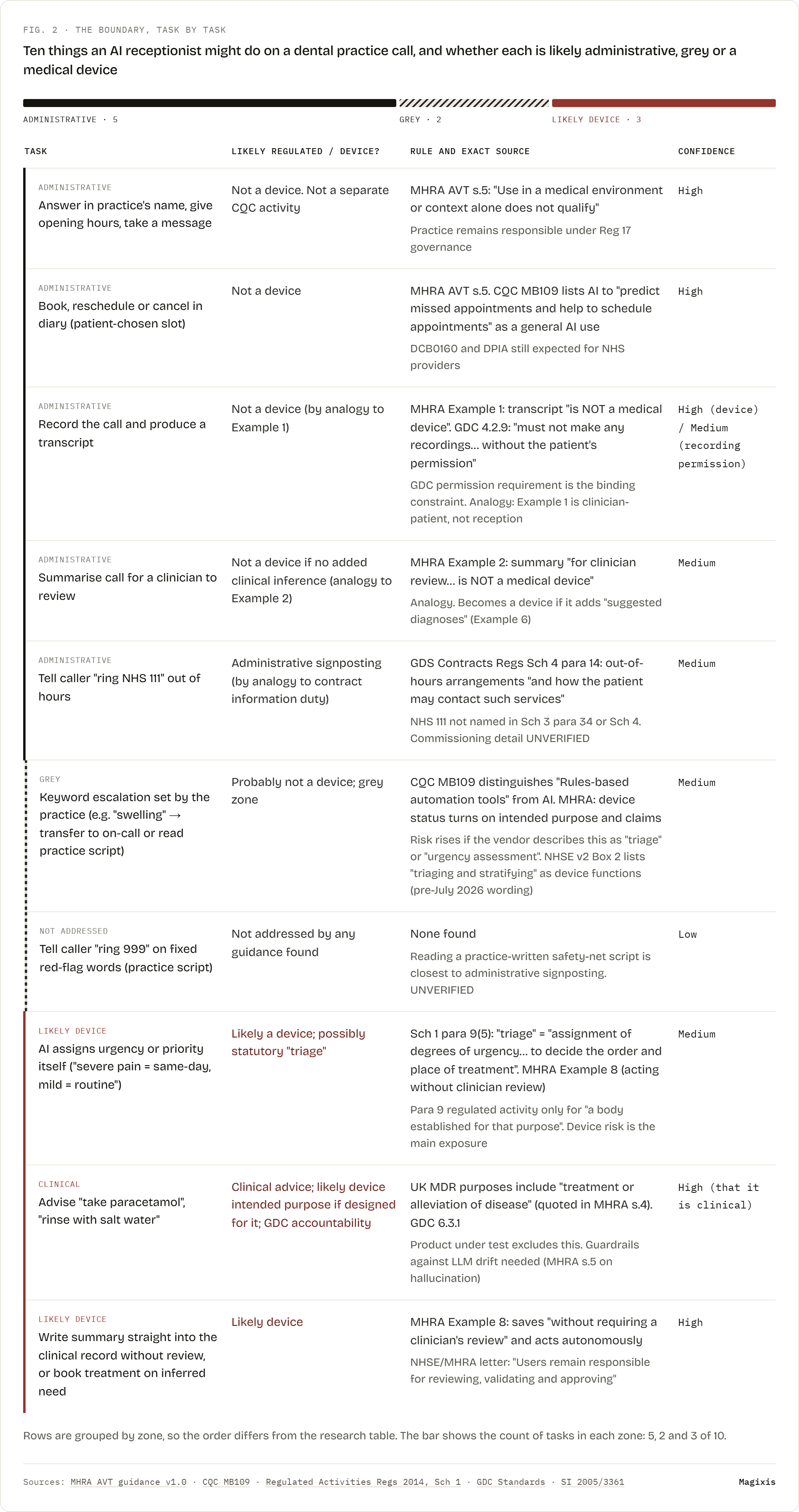
Which reception tasks are administrative, and which could make an AI receptionist a medical device?
| Task | Likely regulated / device? | Rule and exact source | Confidence |
|---|---|---|---|
| AdministrativeAnswer in practice's name, give opening hours, take a message | Not a device. Not a separate CQC activity | MHRA AVT s.5: "Use in a medical environment or context alone does not qualify"Practice remains responsible under Reg 17 governance | High |
| AdministrativeBook, reschedule or cancel in diary (patient-chosen slot) | Not a device | MHRA AVT s.5. CQC MB109 lists AI to "predict missed appointments and help to schedule appointments" as a general AI useDCB0160 and DPIA still expected for NHS providers | High |
| AdministrativeRecord the call and produce a transcript | Not a device (by analogy to Example 1) | MHRA Example 1: transcript "is NOT a medical device". GDC 4.2.9: "must not make any recordings… without the patient's permission"GDC permission requirement is the binding constraint. Analogy: Example 1 is clinician-patient, not reception | High (device) / Medium (recording permission) |
| AdministrativeSummarise call for a clinician to review | Not a device if no added clinical inference (analogy to Example 2) | MHRA Example 2: summary "for clinician review… is NOT a medical device"Analogy. Becomes a device if it adds "suggested diagnoses" (Example 6) | Medium |
| AdministrativeTell caller "ring NHS 111" out of hours | Administrative signposting (by analogy to contract information duty) | GDS Contracts Regs Sch 4 para 14: out-of-hours arrangements "and how the patient may contact such services"NHS 111 not named in Sch 3 para 34 or Sch 4. Commissioning detail UNVERIFIED | Medium |
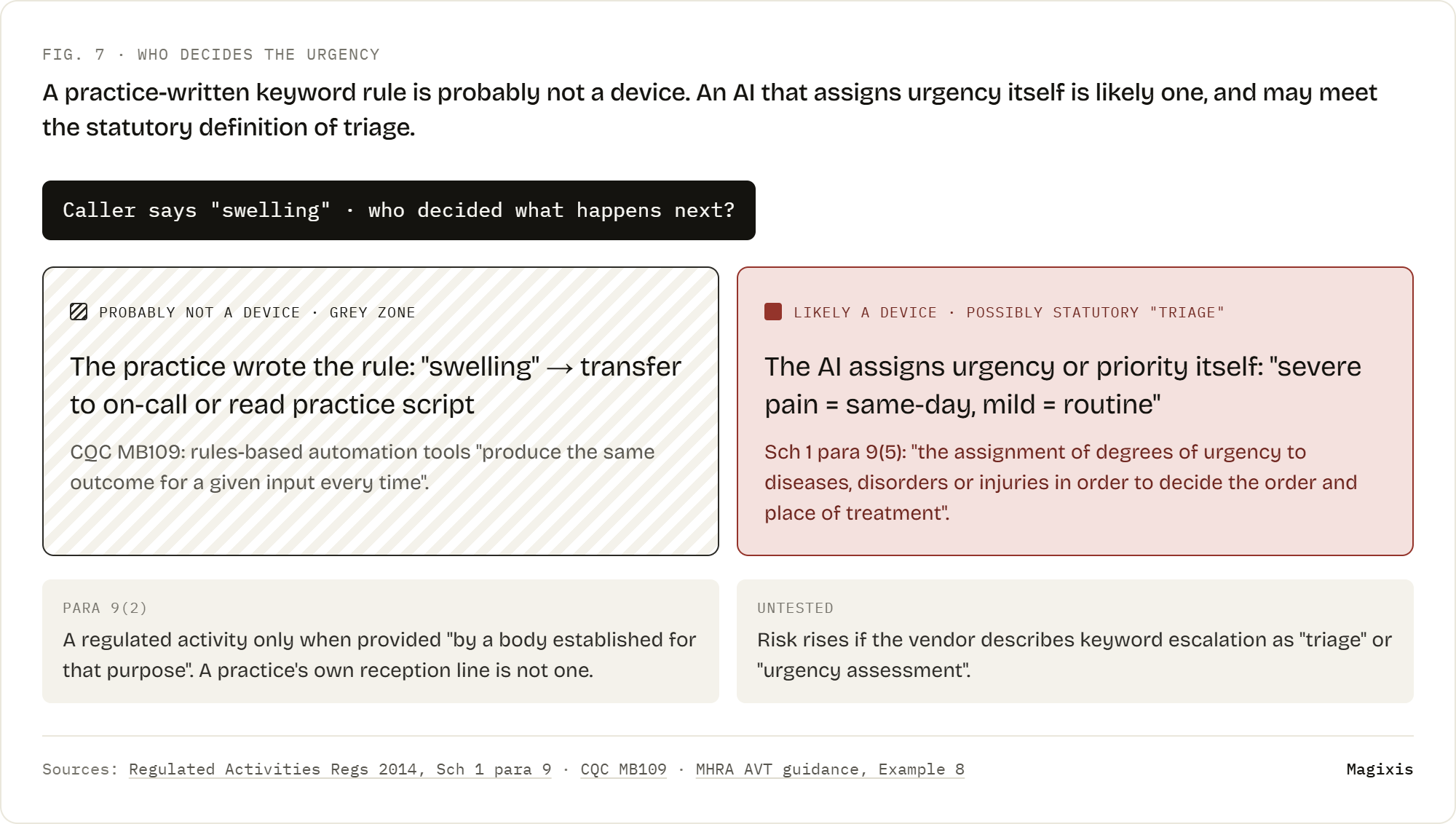
| GreyKeyword escalation set by the practice (e.g. "swelling" → transfer to on-call or read practice script) | Probably not a device; grey zone | CQC MB109 distinguishes "Rules-based automation tools" from AI. MHRA: device status turns on intended purpose and claimsRisk rises if the vendor describes this as "triage" or "urgency assessment". NHSE v2 Box 2 lists "triaging and stratifying" as device functions (pre-July 2026 wording) | Medium |
| Not addressedTell caller "ring 999" on fixed red-flag words (practice script) | Not addressed by any guidance found | None foundReading a practice-written safety-net script is closest to administrative signposting. UNVERIFIED | Low |
| Likely deviceAI assigns urgency or priority itself ("severe pain = same-day, mild = routine") | Likely a device; possibly statutory "triage" | Sch 1 para 9(5): "triage" = "assignment of degrees of urgency… to decide the order and place of treatment". MHRA Example 8 (acting without clinician review)Para 9 regulated activity only for "a body established for that purpose". Device risk is the main exposure | Medium |
| ClinicalAdvise "take paracetamol", "rinse with salt water" | Clinical advice; likely device intended purpose if designed for it; GDC accountability | UK MDR purposes include "treatment or alleviation of disease" (quoted in MHRA s.4). GDC 6.3.1Product under test excludes this. Guardrails against LLM drift needed (MHRA s.5 on hallucination) | High (that it is clinical) |
| Likely deviceWrite summary straight into the clinical record without review, or book treatment on inferred need | Likely device | MHRA Example 8: saves "without requiring a clinician's review" and acts autonomouslyNHSE/MHRA letter: "Users remain responsible for reviewing, validating and approving" | High |
Rows are grouped by zone, so the order differs from the research table. The bar shows the count of tasks in each zone: 5, 2 and 3 of 10.
Is a dental AI receptionist a medical device under the MHRA test?
- Intended-purpose test (s.4). "intended purpose" means "the use to which the device is intended according to the data supplied by the manufacturer on the labelling, the instructions for use and/or the promotional materials". A product's purpose "is not specifically determined by the inclusion of any particular technology".
- Marketing (s.4, Examples 6 and 7). Disclaimers such as "this product is not for diagnosis" are "not acceptable… if medical claims are made or implied elsewhere… including… websites, sales presentations, or online advertisements". Example 7 has the same function as Example 2. It "is marketed with a medical purpose and is a medical device" because of the claim "guides diagnosis and treatment planning".
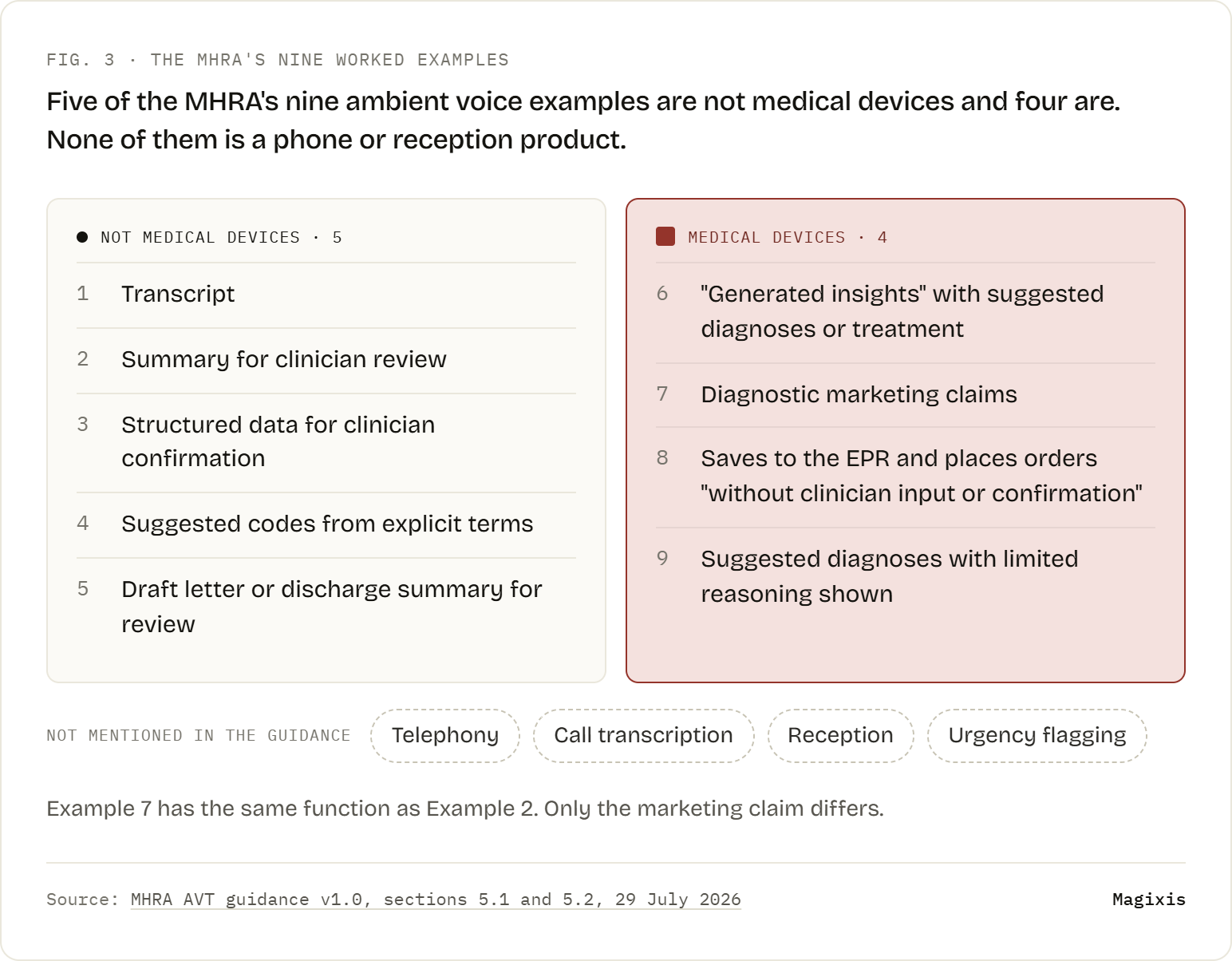
- Worked examples. Not devices: (1) transcript, (2) summary for clinician review, (3) structured data for clinician confirmation, (4) suggested codes from explicit terms, (5) draft letter or discharge summary for review. Devices: (6) "generated insights" with suggested diagnoses or treatment, (7) diagnostic marketing claims, (8) saves to the EPR and places orders "without clinician input or confirmation", (9) suggested diagnoses with limited reasoning shown.
- 1Transcript
- 2Summary for clinician review
- 3Structured data for clinician confirmation
- 4Suggested codes from explicit terms
- 5Draft letter or discharge summary for review
- 6"Generated insights" with suggested diagnoses or treatment
- 7Diagnostic marketing claims
- 8Saves to the EPR and places orders "without clinician input or confirmation"
- 9Suggested diagnoses with limited reasoning shown
Example 7 has the same function as Example 2. Only the marketing claim differs.
- Automated action wording (Example 8). The product is "intended to autonomously make judgements, treatment decisions and take actions that a clinical professional would otherwise take or oversee… directly acts without required review by a clinical professional".
- GenAI drift (s.5). Manufacturers "are expected to design their products to ensure systems behave consistently with their stated purpose". "Hallucination is a well-known behaviour of GenAI." Risk must be mitigated "by design first… before considering warnings".
- Telephony, reception, urgency flagging. The MHRA guidance does not mention telephony, call transcription, reception, call summaries outside clinician-patient encounters, or urgency flagging. NHS England scribing guidance (v2 text retrieved) asks only: "can the product be integrated with other existing products and providers like telephony?"
- Scope. GB only. "Under the terms of the Windsor Framework, EU Regulations on medical devices (2017/745) (EU MDR) apply in Northern Ireland." The revision-history table is empty (v1.0).
- Classification (s.6). Rule 10 (Class IIa for "direct diagnosis"). Rule 12: "All other active devices are class I".
Version history (NHS England)
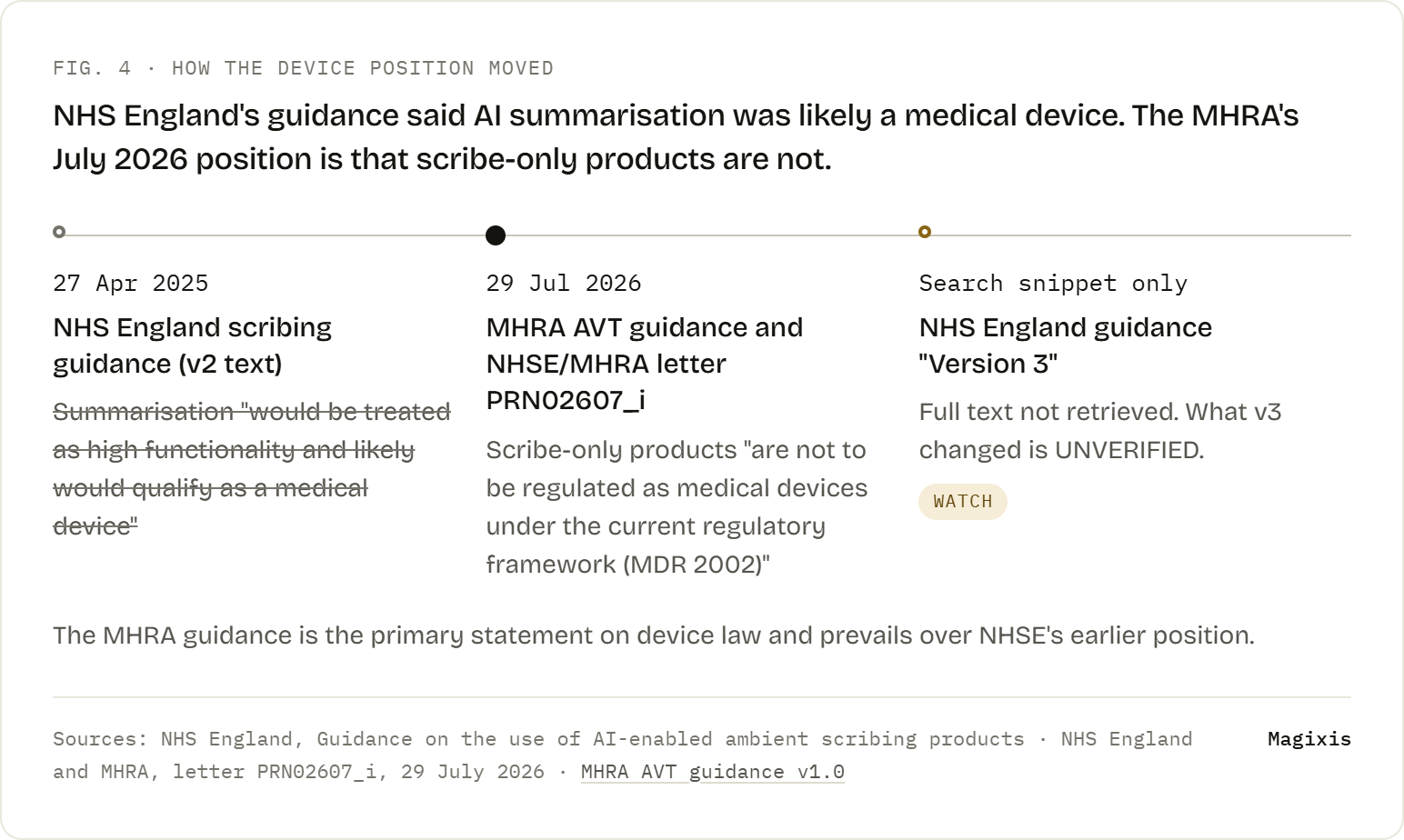
- The NHSE scribing guidance (first published 27 April 2025 per secondary citation) said in Box 2: "the use of Generative AI for further processing, such as summarisation, would be treated as high functionality and likely would qualify as a medical device". It also listed "triaging and stratifying" as device functions and required "at least MHRA Class 1 registration" for the AVT registry.
- The joint NHSE/MHRA letter PRN02607_i (29 Jul 2026, signed by Rob Thompson and Lawrence Tallon) says scribe-only products "are not to be regulated as medical devices under the current regulatory framework (MDR 2002)". It also says "NHS organisations remain responsible for ensuring AVT products are deployed safely".
- Conflict. The NHSE guidance page fetched on 5 Nov 2026 displayed "Version 2" text, including the summarisation-is-likely-a-device wording. A search snippet of the same URL shows "Version 3… consistent with the revised standards outlined in the NHS England AVT Supplier Registry". The v3 text could not be retrieved in full, so exactly what v3 changed is UNVERIFIED. The MHRA guidance is the primary statement on device law and prevails over NHSE's earlier position. Secondary commentary (Covington) describes MHRA as having "essentially overruled NHS England". A secondary source (8fold) states that registry suppliers no longer need to evidence MHRA registration for all products (UNVERIFIED against primary).
The MHRA guidance is the primary statement on device law and prevails over NHSE's earlier position.
Other MHRA material
- Stand-alone software guidance: the current version number and date were not retrieved (UNVERIFIED). It is cited within the AVT guidance for Rules 10 and 12 and for "decision support" reference-information reasoning.
- Draft Medical Devices (Amendment) Regulations 2026: published on the WTO portal 8 May 2026, with comments to 19 June 2026 (secondary sources: Hill Dickinson, Emergo, Fieldfisher). They are not in force. Reported changes are new GB classification schedules, an international reliance pathway, mandatory UDI and PCCPs for software. One secondary source (Qualio) says software-specific provisions were "not updated in this draft" pending the National Commission on AI. Hogan Lovells says reform "will result in the up-classification of many software and AI medical device products". These are conflicting secondary readings; the primary text was not reviewed (UNVERIFIED).
Does a dental AI receptionist need CQC registration, and who is accountable when it fails?
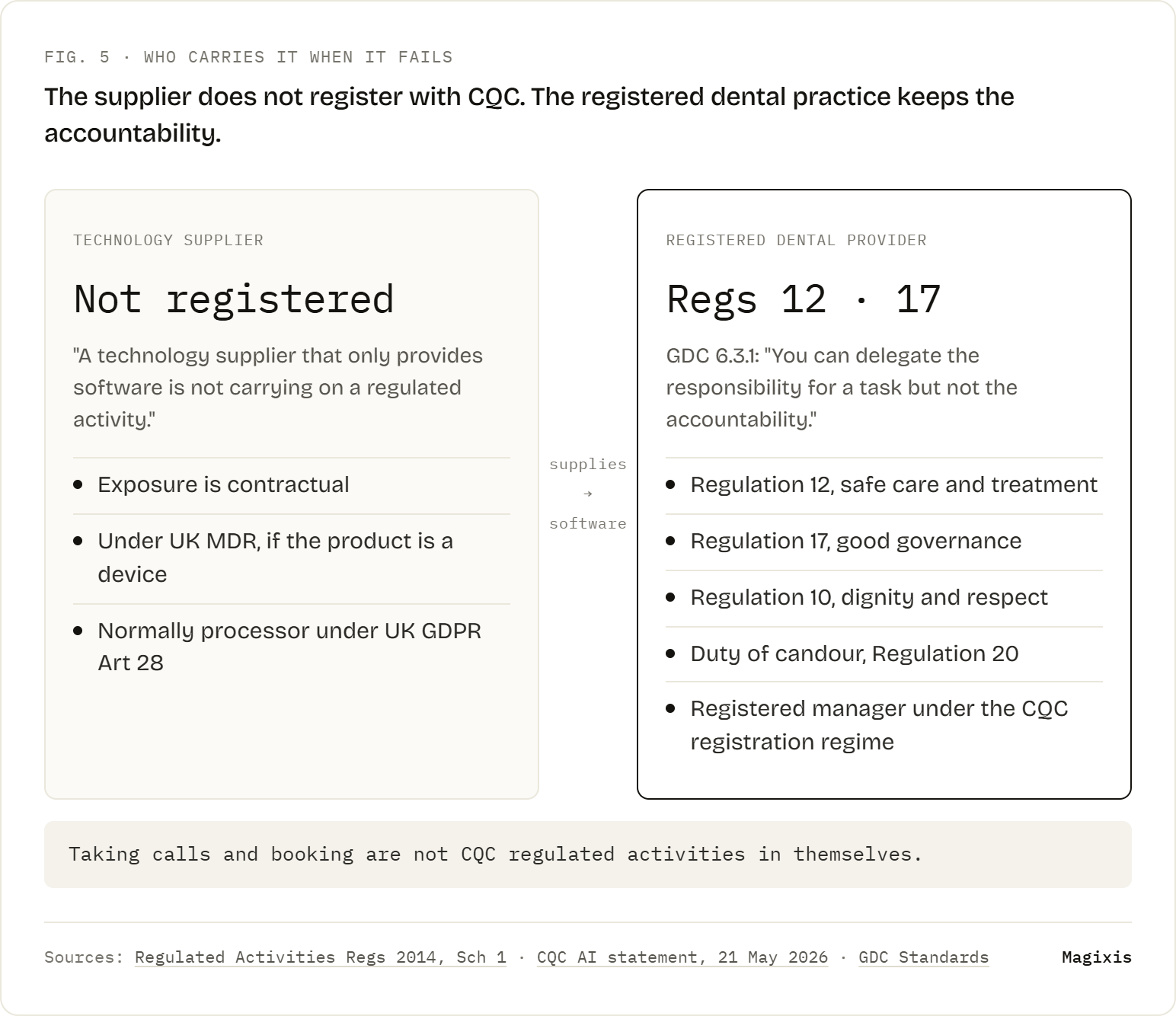
- Regulated activity. Dental care sits under Sch 1 para 4, treatment of disease, disorder or injury, with "dental practitioner" defined by reference to GDC registration. Answering calls, booking and taking messages are not listed activities in their own right; they are part of how the registered provider carries on its regulated activity. A technology supplier that only provides software is not carrying on a regulated activity. NHSE guidance Box 3 (developed with CQC) says "All the above regulations and standards apply irrespective of whether regulated activity is supported by/delivered with or without technology".
- Fundamental standards. Regulation 12 (safe care and treatment), Regulation 17 (good governance) and Regulation 10 (dignity and respect, named in NHSE Box 3) are the main hooks. Statutory wording of Regs 12(1) and 17(1) was not re-fetched in this session (UNVERIFIED verbatim); CQC dental mythbuster 26 confirms Regs 12, 15 and 17 as the regulations it maps technology and equipment risks to. Duty of candour (Reg 20) applies to "notifiable safety incident[s]" during regulated activity.
- GP mythbuster 109 (14 Jul 2025). Key points for a phone AI:
- "This guidance applies to IT-based and digital solutions used in a practice as well as AI tools."
- It separates "Rules-based automation tools", which "produce the same outcome for a given input every time", from AI.
- "Automated triage systems assess the nature and urgency of a patient's symptoms".
- "If you use an AI tool in your practice that influences clinical decision-making, it is likely to be qualified as a medical device."
- Inspectors look for DCB0160, DTAC, a hazard log, a CSO, "human oversight", DPIA and DSPT.
- "you do need to tell people that you are using them".
- "practices offer a non-digital route to access care".
- Dental equivalent. None. The CQC dental mythbuster index (to no. 42) has no AI item. CQC's cross-sector statement "Artificial intelligence in health and social care: CQC's role, expectations and plans" (cqc.org.uk, last updated 21 May 2026) says "We do not assess or approve specific technologies", "AI can enhance, but not replace human decision making" and "Non-digital routes to care are offered if needed". It covers AI "supporting administrative tasks" and links AI to Regs 9, 10, 11, 12 and 17.
- Accountability when it fails. The practice carries it as registered provider, with the registered manager under the CQC registration regime. The supplier's exposure is contractual and, if the product is a device, under UK MDR. NHSE guidance s.3.10: "NHS organisations may still be liable… particularly if it concerns a non-delegable duty of care".
- Exposure is contractual
- Under UK MDR, if the product is a device
- Normally processor under UK GDPR Art 28
- Regulation 12, safe care and treatment
- Regulation 17, good governance
- Regulation 10, dignity and respect
- Duty of candour, Regulation 20
- Registered manager under the CQC registration regime
What do the GDC standards require when an AI answers the phone?
These Standards for the Dental Team are in force:
- 6.1.6You "could be held responsible for the actions of any member of your team who does not have to register… (for example, receptionists…)".
- 6.3.1"You can delegate the responsibility for a task but not the accountability."Accountability
- 6.6.8Team must understand "what decisions and actions have, and have not, been delegated".
- 4.1 · 4.1.1"Make and keep contemporaneous, complete and accurate patient records"; 4.1.1 includes "audio or visual recordings of consultations".
- 4.2.9"You must not make any recordings or images without the patient's permission."Binding constraint for call recording
- 4.5.2Encrypt electronic confidential information.
- 5.1 · 5.1.2"Effective complaints procedure"; staff "trained in handling complaints".
- 2.3.9"You must provide patients with clear information about your arrangements for emergency care including the out of hours arrangements."
An AI is not a "member of your team" under the Standards. Whether announced recording meets "permission" is UNVERIFIED.
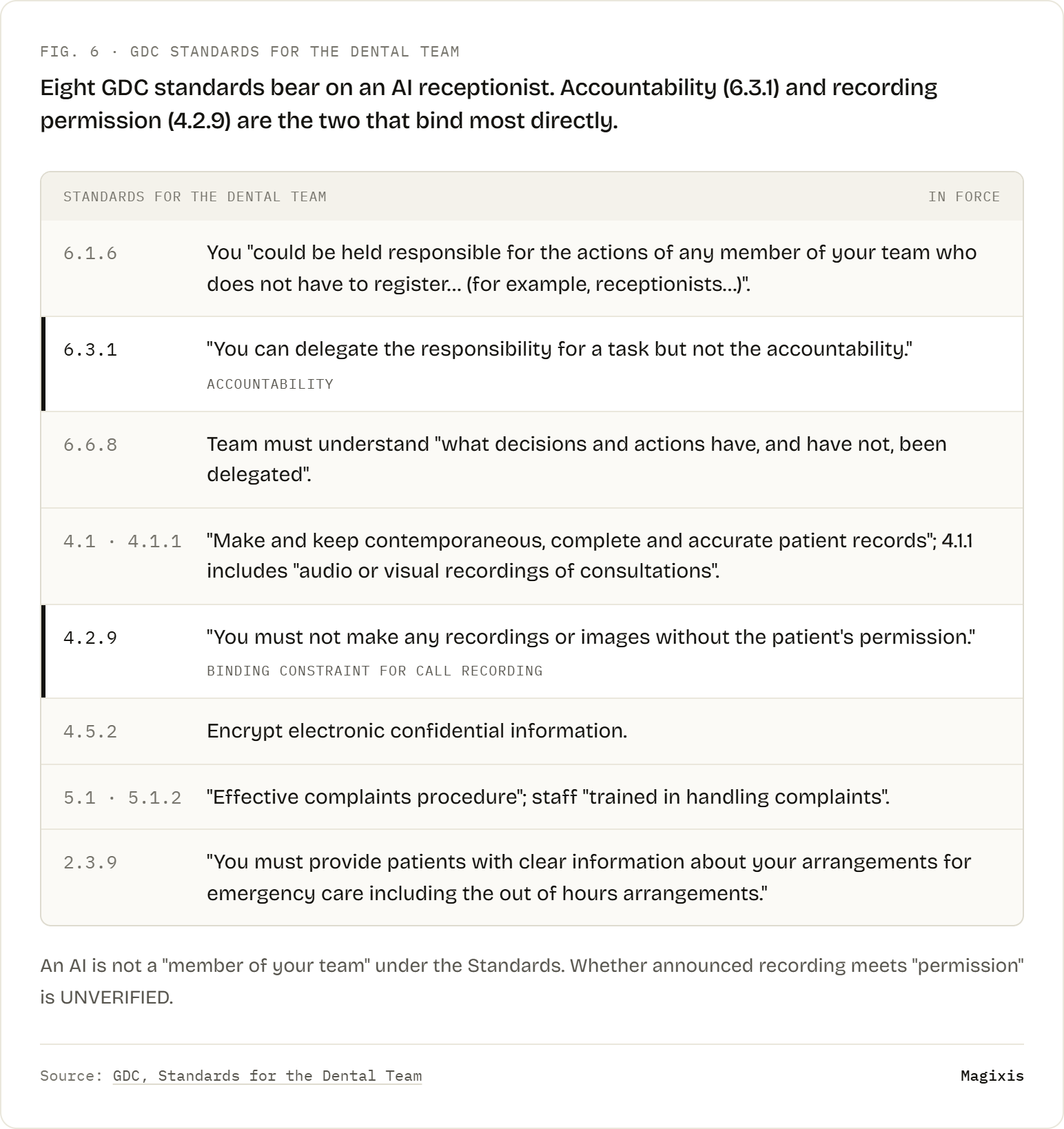
- Implication. An AI is not a "member of your team" under the Standards. By analogy, the practice must still give it a defined, documented remit (6.6.8) and remain accountable (6.3.1). Call recording needs a permission mechanism, such as a greeting announcement with an opt-out route. Whether announced recording meets "permission" is UNVERIFIED.
- Framework for Professionalism consultation. Opened 2 June 2026 and closed 31 August 2026. It proposes four Principles of Professionalism supported by Expectations, statutory Professional Guidance and resources. In the GDC "View from the Chair" blog of 2 Sep 2026, Dr Helen Phillips wrote "we were delighted to receive more than 230 responses from dental professionals, stakeholders and the public". No AI-specific content in the draft was verified. No outcome was found as of 5 Nov 2026 (UNVERIFIED that none exists). Dental Protection's submission (dentalprotection.org, posted 2 Sep 2026; Dental Director Dr George Wright quoted by SDMag on 9 Sep 2026) says in Q5 that "the General Dental Council should consider developing guidance on the professional expectations associated with the use of artificial intelligence in dentistry". It notes AI is increasingly used for "clinical practice, communication, administration and practice promotion".
- GDC on AI. Research review published 12 Aug 2025 (Peninsula Dental School, 45 studies): "real-world implementation of AI in dental services remains limited". On 17 Sep 2026 the Professional Standards Authority, "the ten regulators that the PSA oversees" (including the GDC) and the Accredited Registers Collaborative published a joint statement of intent (Pharmaceutical Journal). Co-signatory the General Osteopathic Council (17 Sep 2026) welcomed the National Commission into the Regulation of AI in Healthcare's recommendations (report published 10 Sep 2026) and committed to "a set of high-level principles". This is still not confirmed on gdc-uk.org.
- Defence bodies and BDA, AI generally. MDDUS checklist (29 Apr 2025): "Inform patients if AI is being used in their care", "Obtain consent for AI-assisted transcriptions or recordings", "Have a contingency plan in case AI systems fail". BDA (undated): accountability "rests with you as the dental professional".
- AI on the phone specifically. No guidance found from Dental Protection, MDDUS or the BDA.
Is keyword escalation "triage"?
"Triage" (Sch 1 para 9). Para 9(2): "Medical advice in cases where immediate action or attention is needed, or triage provided, over the telephone or by electronic mail by a body established for that purpose." Para 9(5): "triage" means "the assignment of degrees of urgency to diseases, disorders or injuries in order to decide the order and place of treatment". A practice's own reception line is not "a body established for that purpose". An AI supplier offering a stand-alone remote triage service to the public could arguably be one. Not tested by any source found.
Keyword escalation. Whether practice-authored keyword escalation is "triage" for device or Sch 1 purposes has no UK guidance. The practice authoring the rules arguably makes the practice, not the vendor, the source of any urgency logic. That is untested.
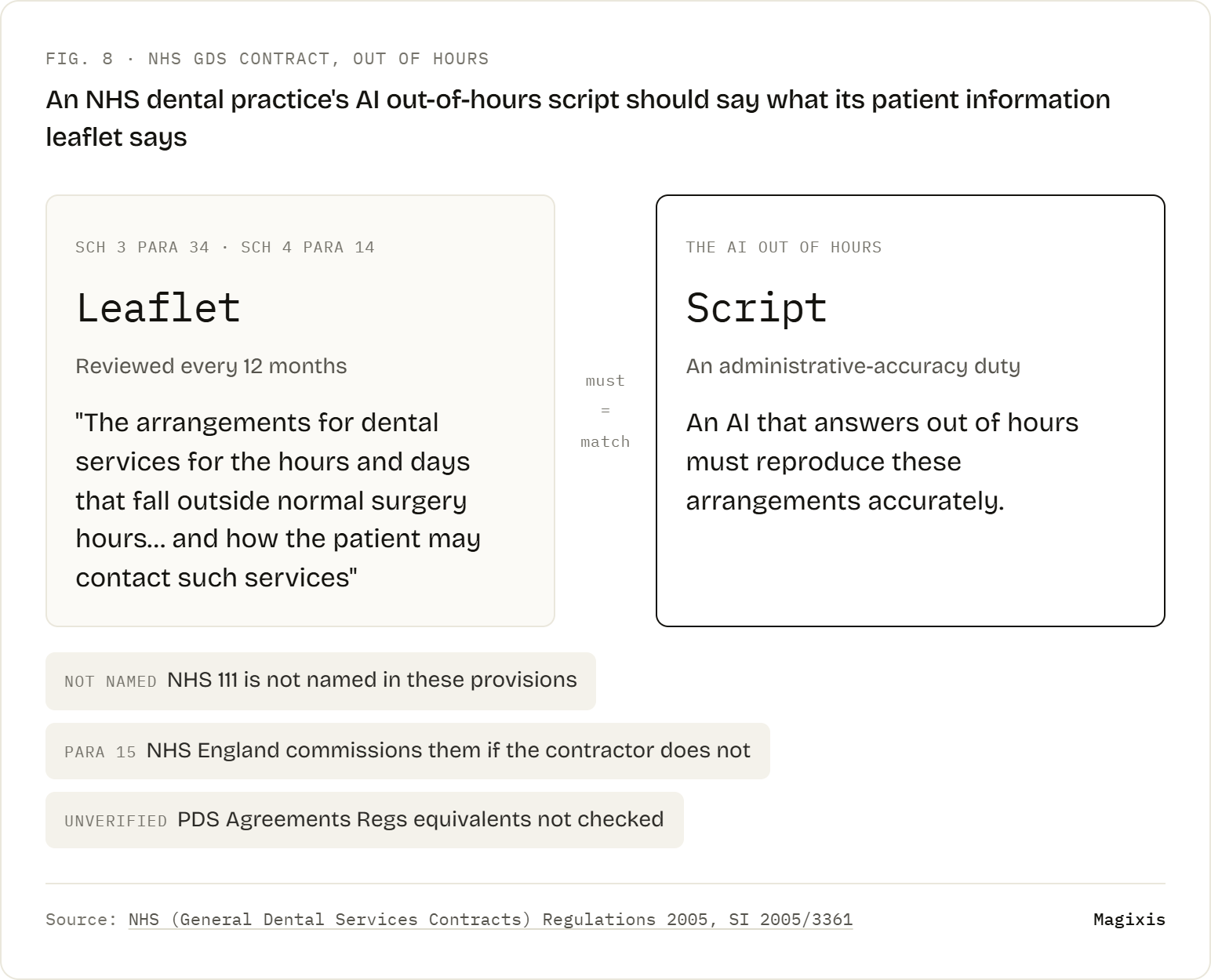
What does the NHS dental contract say about out-of-hours calls?
- GDS Contracts Regs 2005 (SI 2005/3361). Sch 3 para 34 requires a patient information leaflet, reviewed every 12 months. Sch 4 para 14 requires "The arrangements for dental services for the hours and days that fall outside normal surgery hours… and how the patient may contact such services". Para 15 states that NHS England commissions them if the contractor does not. An AI that answers out of hours must reproduce these arrangements accurately; this is an administrative-accuracy duty. The PDS Agreements Regs equivalents were not checked (UNVERIFIED). NHS 111 is not named in these provisions. Local commissioning requirements for urgent dental access and 111 signposting were not retrieved (UNVERIFIED).
- 111/999 signposting. No published guidance classifies AI signposting to 111 or 999 as clinical or administrative (none found).
- DSPT and IG. CQC MB109 lists the NHS DSPT. NHSE scribing guidance: "Ensure that you and your supplier comply with the Data Security and Protection Toolkit (DSPT), as well as Cyber Essentials", and complete DCB0160 plus a DPIA. Applying scribe-specific IG to telephony is analogy.
Which data protection rules apply to a call about toothache?
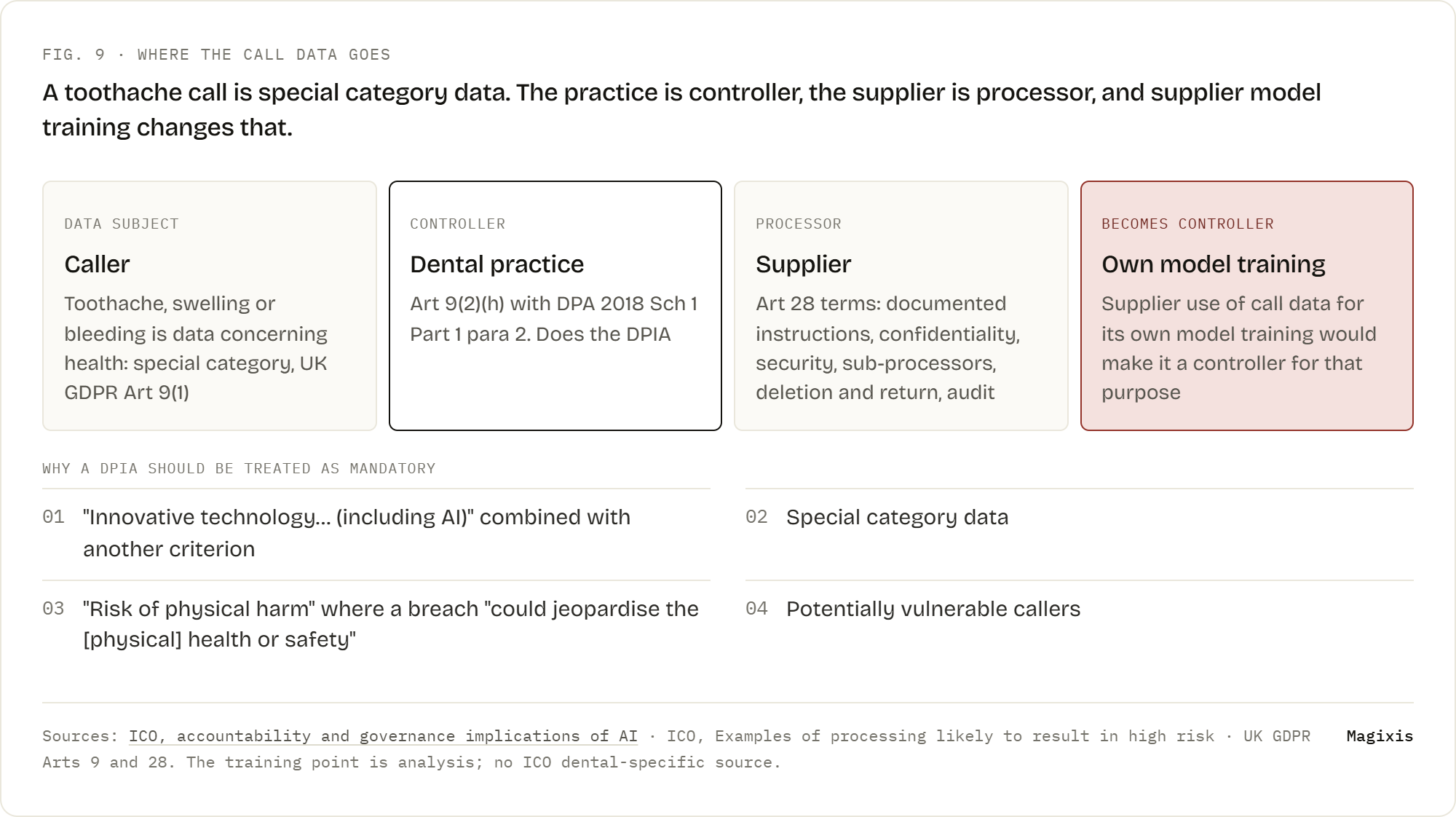
- Special category data. A caller's description of toothache, swelling or bleeding is data concerning health and therefore special category (UK GDPR Art 9(1)). The usual conditions are Art 9(2)(h) (health care) with DPA 2018 Sch 1 Part 1 para 2. Verbatim statutory text was not re-fetched in this session (UNVERIFIED wording). The practice as controller must satisfy them. The supplier acts as processor under Art 28 terms: documented instructions, confidentiality, security, sub-processors, deletion and return, audit. Any supplier use of call data for its own model training would make it a controller for that purpose (analysis; no ICO dental-specific source).
- DPIA. The ICO list requires a DPIA for "Innovative technology… (including AI)" when "combined with any other criterion from WP248rev01". It also lists "Risk of physical harm" where a breach "could jeopardise the [physical] health or safety". ICO AI guidance: "In the vast majority of cases, the use of AI will involve a type of processing likely to result in a high risk". Special category data plus AI plus potentially vulnerable callers means a DPIA should be treated as mandatory.
Automated decision-making
ADM (Arts 22A to 22D, in force 5 Feb 2026). The ICO defines ADM as a decision "based solely on automated processing (ie there is no meaningful human involvement…)" with "a legal or similarly significant effect". Art 22B restricts significant decisions based on special category data to explicit consent, or contract/law plus substantial public interest. Routing a call to a human or booking a patient-chosen slot is not plausibly a "significant decision". An AI that alone refuses or delays urgent care on the basis of symptoms could be (analysis; no ICO example found). The ICO draft was published 31 Mar 2026 and the consultation closed 29 May 2026. A secondary source says final guidance was "due in summer 2026". The ICO's DUAA page (updated 19 Jun 2026) still said "We've consulted on draft guidance". An ICO children's-data page refers to "dedicated guidance on… automated decision-making" under Arts 22A to D. Final publication status as of 5 Nov 2026 is UNVERIFIED. Treat the content as draft.
Telling callers they are speaking to an AI, and recording the call
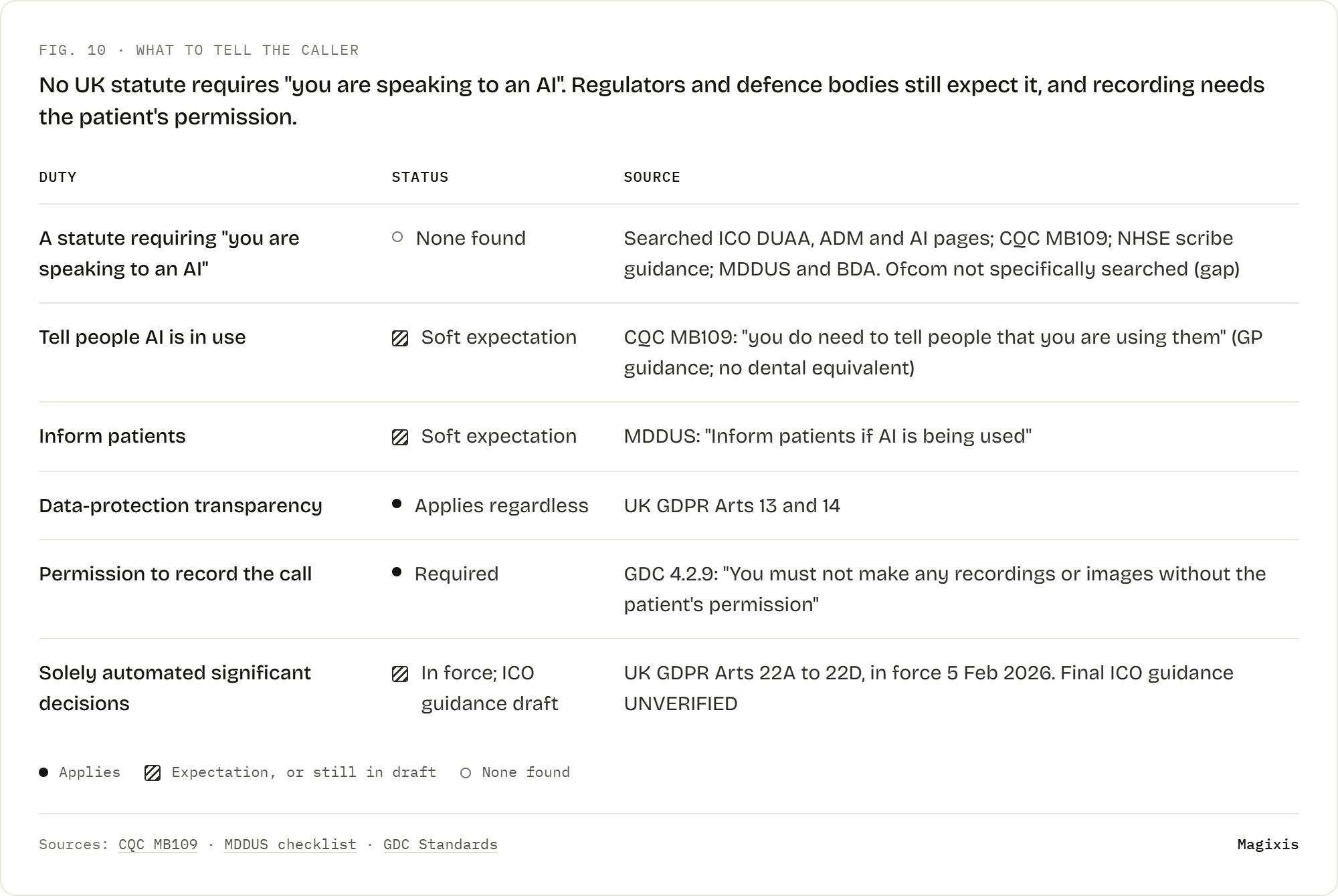
AI disclosure. No UK statute or ICO, Ofcom or sector rule requiring a caller to be told they are speaking to an AI was found. Searched: ICO DUAA, ADM and AI pages; CQC MB109; NHSE scribe guidance; MDDUS and BDA. Ofcom was not specifically searched (gap). Soft expectations exist: CQC MB109 "you do need to tell people that you are using them" and MDDUS "Inform patients if AI is being used". Data-protection transparency (Arts 13 and 14) applies regardless.
Call recording and retention. GDC 4.2.9 (permission) and 4.1.1 (recordings form part of records where available). NHSE IG guidance (scribes): once a summary is "signed off as accurate… the original recording and transcript could be deleted". No dental-specific retention period for call audio was verified (UNVERIFIED).
| Duty | Status | Source |
|---|---|---|
| A statute requiring "you are speaking to an AI" | None found | Searched ICO DUAA, ADM and AI pages; CQC MB109; NHSE scribe guidance; MDDUS and BDA. Ofcom not specifically searched (gap) |
| Tell people AI is in use | Soft expectation | CQC MB109: "you do need to tell people that you are using them" (GP guidance; no dental equivalent) |
| Inform patients | Soft expectation | MDDUS: "Inform patients if AI is being used" |
| Data-protection transparency | Applies regardless | UK GDPR Arts 13 and 14 |
| Permission to record the call | Required | GDC 4.2.9: "You must not make any recordings or images without the patient's permission" |
| Solely automated significant decisions | In force; ICO guidance draft | UK GDPR Arts 22A to 22D, in force 5 Feb 2026. Final ICO guidance UNVERIFIED |
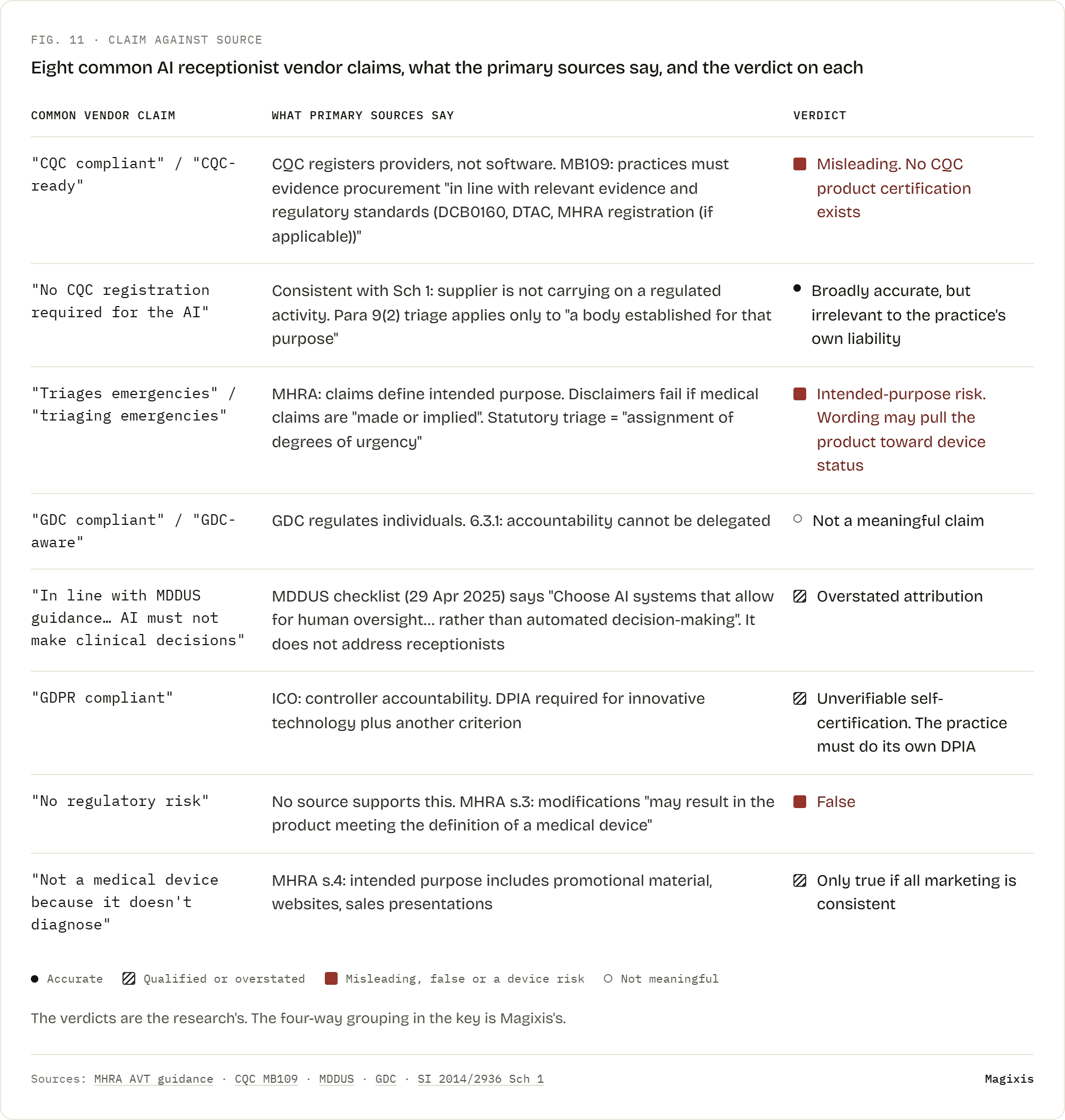
How do common vendor claims compare with the primary sources?
| Common vendor claim | What primary sources say | Verdict |
|---|---|---|
| "CQC compliant" / "CQC-ready" | CQC registers providers, not software. MB109: practices must evidence procurement "in line with relevant evidence and regulatory standards (DCB0160, DTAC, MHRA registration (if applicable))" | Misleading. No CQC product certification exists |
| "No CQC registration required for the AI" | Consistent with Sch 1: supplier is not carrying on a regulated activity. Para 9(2) triage applies only to "a body established for that purpose" | Broadly accurate, but irrelevant to the practice's own liability |
| "Triages emergencies" / "triaging emergencies" | MHRA: claims define intended purpose. Disclaimers fail if medical claims are "made or implied". Statutory triage = "assignment of degrees of urgency" | Intended-purpose risk. Wording may pull the product toward device status |
| "GDC compliant" / "GDC-aware" | GDC regulates individuals. 6.3.1: accountability cannot be delegated | Not a meaningful claim |
| "In line with MDDUS guidance… AI must not make clinical decisions" | MDDUS checklist (29 Apr 2025) says "Choose AI systems that allow for human oversight… rather than automated decision-making". It does not address receptionists | Overstated attribution |
| "GDPR compliant" | ICO: controller accountability. DPIA required for innovative technology plus another criterion | Unverifiable self-certification. The practice must do its own DPIA |
| "No regulatory risk" | No source supports this. MHRA s.3: modifications "may result in the product meeting the definition of a medical device" | False |
| "Not a medical device because it doesn't diagnose" | MHRA s.4: intended purpose includes promotional material, websites, sales presentations | Only true if all marketing is consistent |
The verdicts are the research's. The four-way grouping in the key is Magixis's.
What do UK dental AI receptionist vendors say on their own pages?
Vendor audit, retrieved 5 November 2026; quotes from live pages or search-index snippets of those pages.
Vendors are anonymised. Two of the 13 (Vendors L and M) had no first-party page to quote, so 11 is 13 minus 2. Vendor B and Vendor J are partners. Vendor K names the BDA and Vendor H names MDDUS, which are professional bodies, not regulators.
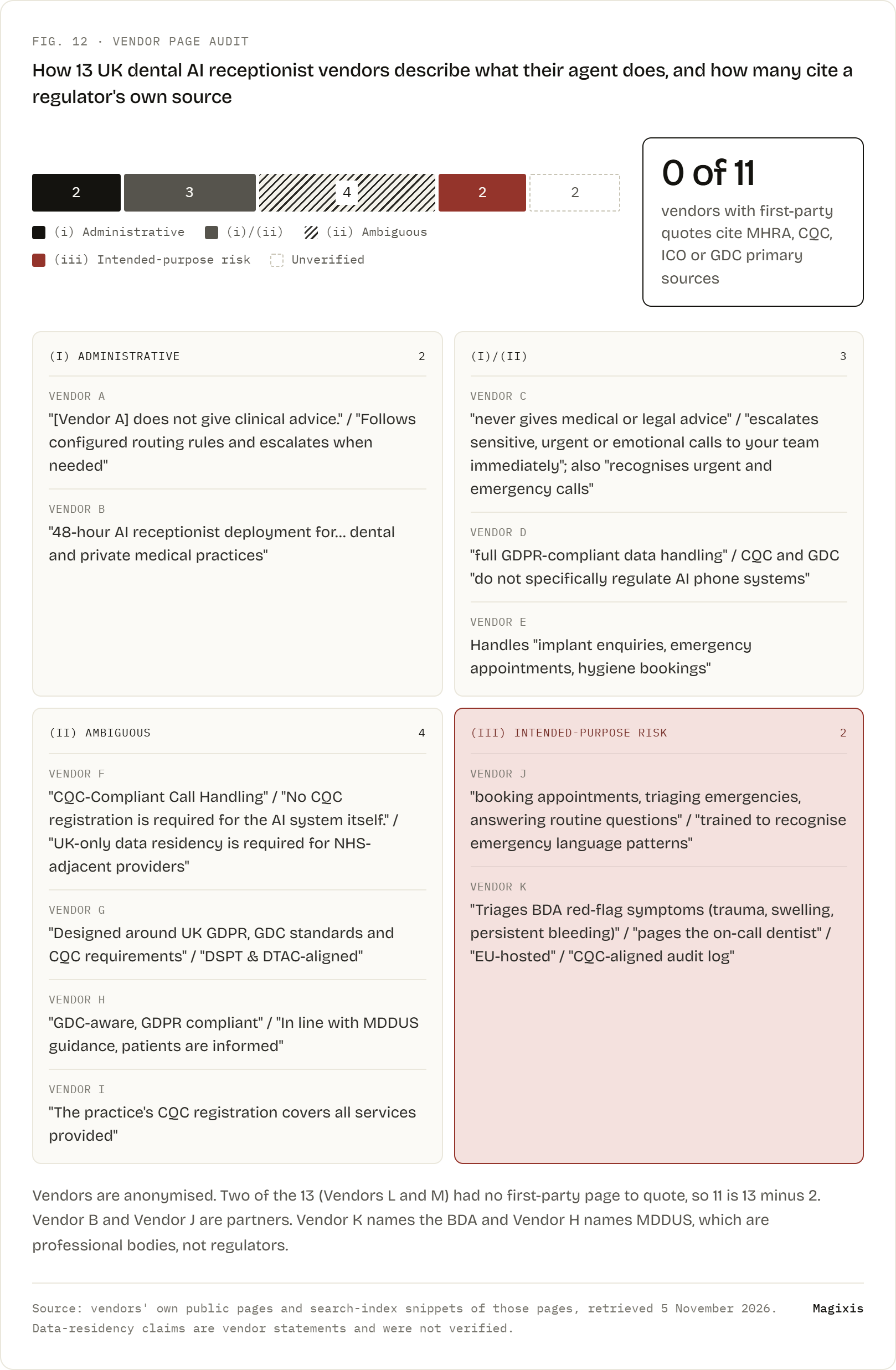
None of the vendors reviewed cites MHRA, CQC, ICO or GDC primary sources for its regulatory claims. Data-residency claims ("EU-hosted", "UK-only") are vendor statements and were not verified.
Has any regulator taken action over an AI phone tool?
No MHRA, CQC, ICO, ASA or GDC enforcement action, FtP case, ruling or published concern involving an AI phone tool or automated call triage in UK healthcare was found. The searches in this research were not dedicated enforcement-database searches. They covered MHRA AVT guidance, CQC mythbusters, ICO ADM and DPIA pages, GDC consultation and news pages, defence-body AI guidance, and vendor pages. The absence of precedent is therefore UNVERIFIED rather than confirmed. ASA rulings and the ICO enforcement register were not searched.
Does any of this apply in Scotland, Wales and Northern Ireland?
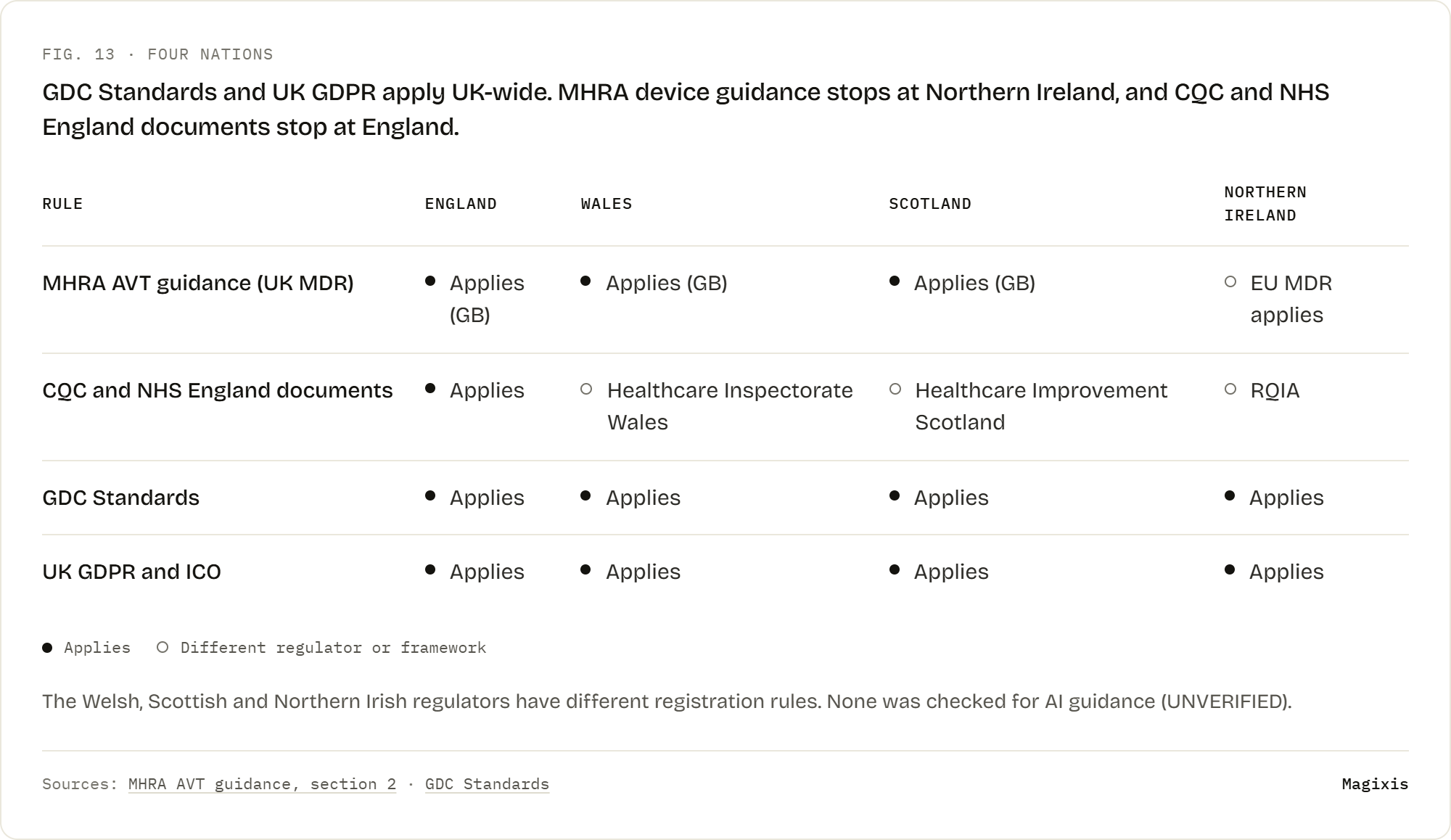
- MHRA AVT guidance: GB only. Northern Ireland follows EU MDR.
- CQC and the NHS England documents cover England only. In Scotland, Wales and Northern Ireland the regulators are, respectively, Healthcare Improvement Scotland, Healthcare Inspectorate Wales and RQIA, with different registration rules; none was checked for AI guidance (UNVERIFIED).
- GDC Standards and UK GDPR/ICO apply UK-wide.
| Rule | England | Wales | Scotland | Northern Ireland |
|---|---|---|---|---|
| MHRA AVT guidance (UK MDR) | Applies (GB) | Applies (GB) | Applies (GB) | EU MDR applies |
| CQC and NHS England documents | Applies | Healthcare Inspectorate Wales | Healthcare Improvement Scotland | RQIA |
| GDC Standards | Applies | Applies | Applies | Applies |
| UK GDPR and ICO | Applies | Applies | Applies | Applies |
The Welsh, Scottish and Northern Irish regulators have different registration rules. None was checked for AI guidance (UNVERIFIED).
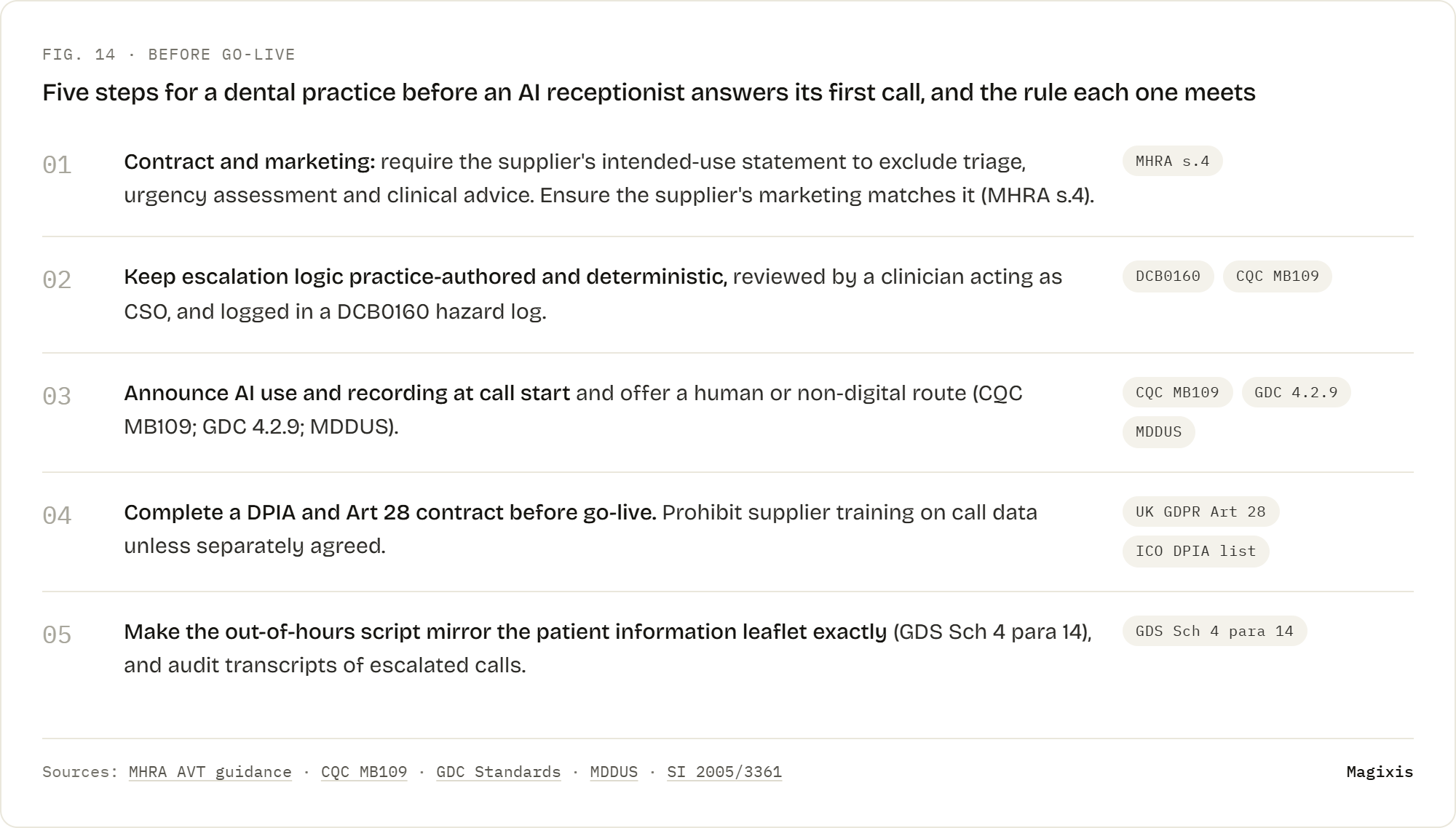
What should a dental practice do before an AI receptionist goes live?
Recommendations for a practice deploying the design under test:
- 01Contract and marketing: require the supplier's intended-use statement to exclude triage, urgency assessment and clinical advice. Ensure the supplier's marketing matches it (MHRA s.4).
- 02Keep escalation logic practice-authored and deterministic, reviewed by a clinician acting as CSO, and logged in a DCB0160 hazard log.
- 03Announce AI use and recording at call start and offer a human or non-digital route (CQC MB109; GDC 4.2.9; MDDUS).
- 04Complete a DPIA and Art 28 contract before go-live. Prohibit supplier training on call data unless separately agreed.
- 05Make the out-of-hours script mirror the patient information leaflet exactly (GDS Sch 4 para 14), and audit transcripts of escalated calls.
Where Magixis sits
Magixis is built to the design this post tests. The agent gives no clinical advice and does not assess urgency. It answers in the practice's name, books where the practice allows it, takes messages and records the call. When a caller uses words the practice has listed, it reads the practice's own wording and puts the call through to the person the practice has chosen. Symptoms are recorded in the caller's words, not interpreted.
We hold no MHRA registration and no clinical safety or healthcare regulatory certification today. For an NHS practice, that means your Clinical Safety Officer would carry the DCB0160 assessment without a manufacturer's safety case to lean on. We would rather you knew that before a demo than after one. Storage, sub-processors and retention are set out on our trust page, and how it works for practices is on the AI receptionist for dental practices page.
What is still unverified?
- Analogy used throughout. The MHRA AVT examples concern clinician-patient conversations. Applying them to front-desk calls is reasoned analogy, not regulator statement. The same applies to CQC MB109 (GP, not dental) and NHSE scribe IG (scribes, not telephony).
- Not verified: NHSE scribing guidance v3 full text; MHRA stand-alone software guidance version and date; draft 2026 device regs software provisions; ICO final ADM guidance; GDC consultation outcome; Regs 12 and 17 verbatim; PDS Agreements Regs; Ofcom position; Boxly and Flamingo Digital first-party claims; dental call-audio retention period.
Dates that will date this post
NHSE ambient scribing guidance first published (summarisation "likely" a device). Superseded on device point by MHRA
MDDUS AI-in-dentistry checklist. Current
CQC GP mythbuster 109. Current; no dental equivalent
GDC publishes AI research review. Research only
UK GDPR Arts 22A to 22D in force (DUAA)
ICO draft ADM guidance consultation opens. Draft
MHRA draft Medical Devices (Amendment) Regulations 2026 (WTO). Draft; comments closed 19 Jun 2026
WatchSI 2026/425 (ICO AI/ADM code duty) in force. Code not yet published (UNVERIFIED)
WatchCQC "Artificial intelligence in health and social care: CQC's role, expectations and plans" (last updated date). Current; cross-sector, not dental-specific
ICO ADM consultation closes. Final status UNVERIFIED
WatchGDC Framework for Professionalism consultation. Outcome not found
WatchMHRA AVT guidance v1.0; NHSE/MHRA letter PRN02607_i. In force as guidance
HSSIB AVT investigation in acute care notified (secondary); report expected summer 2027. UNVERIFIED primary
WatchJoint statement of intent on AI by the PSA, the ten regulators it oversees (incl. GDC) and the Accredited Registers Collaborative. Not confirmed on gdc-uk.org
MDDUS "AI in Dental Practice" CPD course. Scheduled
WatchMarked "watch": items still in draft, unverified or scheduled. The ICO's final ADM guidance and the GDC consultation outcome are the two most likely to change this post.
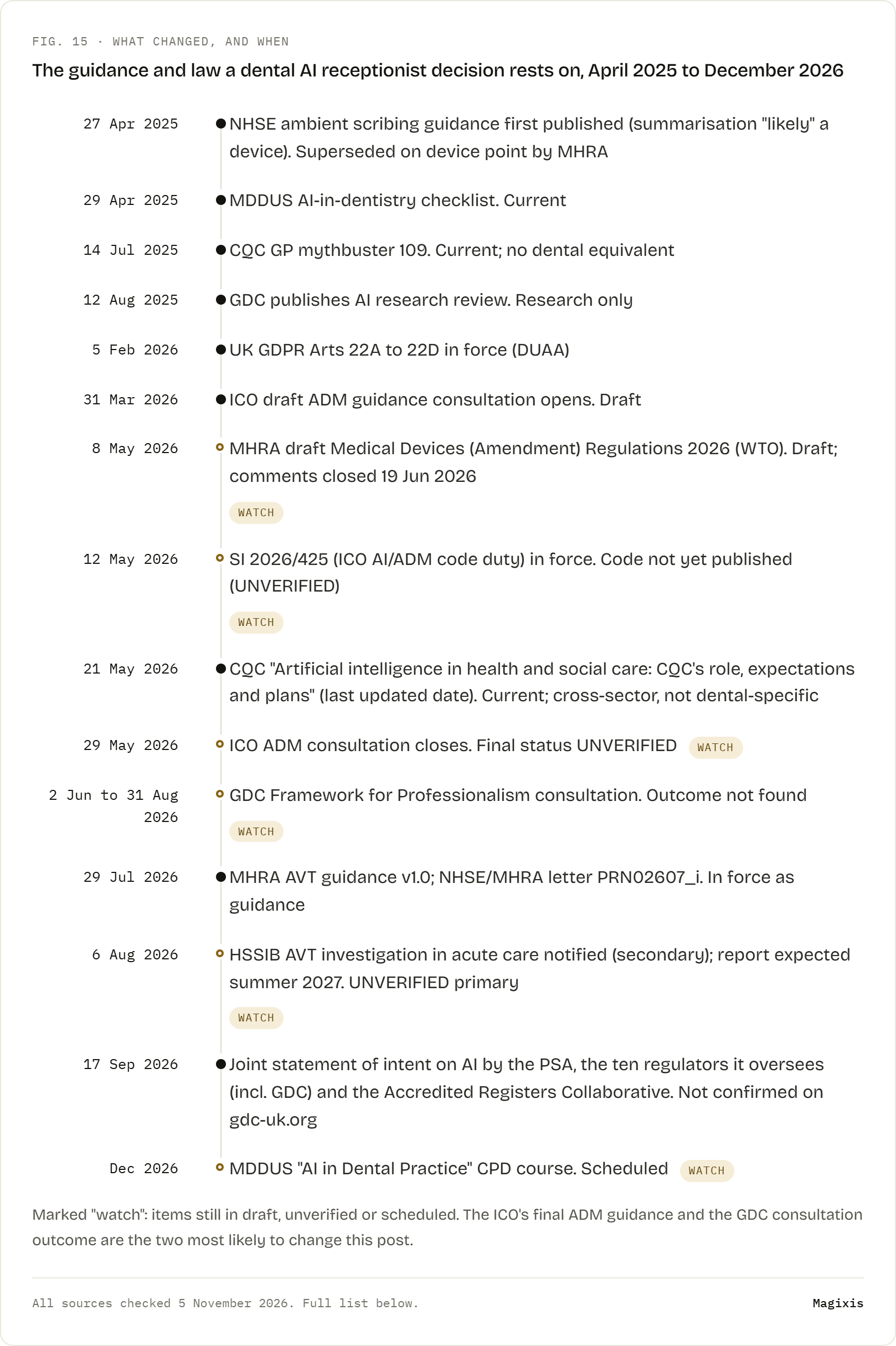
Every source in this post was checked on 5 November 2026. The ICO's final ADM guidance, the GDC Framework for Professionalism outcome and the MHRA's 2026 amending regulations are the most likely to change it, and we will update this page when they land.
FAQ
Is an AI receptionist for a dental practice a medical device?
Not if it only answers, books, takes messages, records and escalates on a script the practice writes. Under the MHRA's 29 July 2026 guidance, device status turns on intended purpose, which includes the supplier's marketing. A product sold as "triaging" or "assessing urgency", or one that acts on symptoms without a human checking, may be a medical device.
Does a dental AI receptionist need to be registered with CQC?
No. Answering calls and booking are not regulated activities in their own right, and a supplier that only provides software is not carrying on a regulated activity. The registered dental provider stays accountable under Regulations 12 and 17.
Can an AI receptionist triage dental emergencies?
An AI that assigns urgency itself is likely a medical device, and its function matches the statutory definition of triage: "the assignment of degrees of urgency to diseases, disorders or injuries in order to decide the order and place of treatment". An administrative receptionist should follow escalation rules the practice writes and pass the call to a person.
Do patients have to be told they are speaking to an AI?
No UK statute requiring it was found. CQC GP mythbuster 109 says "you do need to tell people that you are using them", MDDUS says to inform patients, and UK GDPR transparency duties apply regardless. Announcing it at the start of the call meets all three.
Can a dental practice record calls answered by an AI?
Yes, with the patient's permission. GDC Standard 4.2.9 says "You must not make any recordings or images without the patient's permission". Whether a recorded announcement with an opt-out counts as permission has not been confirmed.
Does a dental practice need a DPIA for an AI receptionist?
In practice, yes. The ICO requires a DPIA for innovative technology, including AI, combined with another high-risk criterion, and a call about toothache carries special category health data. The practice is the controller, so the DPIA is the practice's to complete.
- MHRA, Guidance on Ambient Voice Technology-Enabled Products v1.0, 29 July 2026
- MHRA, MHRA clarifies regulatory status of ambient voice technologies used in the NHS, 29 July 2026
- NHS England and MHRA, letter "Medical device regulation for ambient voice technology products" PRN02607_i, 29 July 2026
- NHS England, Guidance on the use of AI-enabled ambient scribing products (page displaying v2; snippet showing v3)
- NHS Transformation Directorate, IG guidance on ambient scribing
- UK Government, Health and Social Care Act 2008 (Regulated Activities) Regulations 2014, Sch 1
- UK Government, NHS (General Dental Services Contracts) Regulations 2005
- CQC, GP mythbuster 109: Artificial intelligence in GP services
- CQC, Artificial intelligence in health and social care: CQC's role, expectations and plans, updated 21 May 2026
- CQC, Mythbusters and tips for dentists (index)
- GDC, Standards for the Dental Team
- GDC, Framework for Professionalism consultation, 2 June 2026; Chair blog, 2 September 2026; AI research review, 12 August 2025
- ICO, Examples of processing likely to result in high risk
- ICO, Accountability and governance implications of AI
- ICO, ADM consultation and draft impact assessment, 31 March 2026; DUAA guidance page, updated 19 June 2026
- MDDUS, AI in dentistry: a checklist for practitioners, 29 April 2025
- BDA, Using AI in dental practice
- Dental Protection, submission to the GDC Framework consultation, 2026
- Trade press and secondary: British Dental Journal; SDMag; Dentistry.co.uk; HTN; Covington; Hogan Lovells; Hill Dickinson; Fieldfisher; Emergo; Qualio